Next Stop: Space Economy


Today, more and more key economic trends are emerging outside of traditional industrial structures—and the use of orbital infrastructure is becoming a decisive competitive factor. At the same time, new applications, data-driven business models, and technological integration are transforming entire industries and creating an environment in which innovative companies can strategically position themselves early on to benefit from long-term structural changes. However, the industry’s development is fraught with uncertainties, particularly with regard to technological, regulatory, and financial factors. The space economy is playing an increasingly central role, especially in the context of digitalization, automation, and global connectivity.
All eyes were on the SpaceX IPO
SpaceX’s recent initial public offering has drawn the attention of markets worldwide to the new space economy. With an offering size of approximately $75 billion, the NASDAQ-100® debut on June 12, 2026, ranks among the most spectacular technology IPOs in history and pushed the company’s valuation toward $2 trillion. Driven by stable revenue from the Starlink satellite network, ambitious plans for AI infrastructure in space, and massive cost advantages from the next generation of Starship rockets, the company is considered a major player within a growing industry. At the same time, its ambitious valuation and enormous capital requirements remain key risk factors — and underscore just how dynamic, yet also challenging, the market surrounding the space economy is.
The Space Economy in Transition: New Markets, New Opportunities
The global space industry is undergoing a profound transformation. What was long dominated primarily by government space agencies has increasingly evolved into a commercial growth market. Private companies are driving innovation, while government entities are increasingly acting as clients and partners. Declining launch costs due to reusable launch systems, the miniaturization of satellites (e.g., CubeSats), and technological advances in sensor technology and data processing are opening up new business opportunities.
Furthermore, geopolitical developments and national security interests are accelerating the expansion of orbital infrastructure. Satellites are increasingly viewed as strategic assets, which encourages additional investment in related technologies. At the same time, demand is rising from commercial sectors such as telecommunications, Earth observation, and global Internet access.
Satellites play a key role in this development. They enable global communication, navigation, weather monitoring, and the collection of geodata. At the same time, new fields of application are emerging in areas such as precision agriculture, autonomous logistics, disaster management, defense, internet connectivity in remote regions, and data-driven financial and insurance models. Experts predict that the space economy could reach a market volume in the trillions in the long term.
Satellites as the Backbone of Modern Infrastructure
The economic significance of satellites has long extended beyond the space industry. Satellite networks form the foundation for numerous digital services and critical infrastructure. Modern communication systems, global supply chains, navigation (e.g., GPS), and military and civilian security applications are increasingly dependent on reliable and precise satellite data.
A major driver of growth is the exponential increase in data-driven applications. Earth observation satellites provide high-resolution data that can be analyzed in real time—for example, to monitor climate change, optimize agricultural yields, or assess economic activity. This data forms the basis for new business models in the fields of analytics, artificial intelligence, and cloud computing.
At the same time, demand for powerful data and computing capacities is growing. Processing large volumes of data from space requires specialized software solutions, scalable cloud infrastructures, and high-performance data centers. This is creating new business opportunities for companies that, while not directly building rockets or satellites, provide crucial building blocks for the space economy—such as semiconductor manufacturers, software providers, or operators of digital platforms.
The space economy encompasses far more than just space companies
A key feature of the modern space economy is its broad industrial base. In addition to traditional space companies, numerous firms in related industries also benefit. These include, among others, suppliers of electronic components, providers of communications technology, operators of satellite networks, and companies that use satellite data for specific applications.
This diversification makes the space economy a complex yet particularly versatile investment theme. Value creation is spread across multiple levels—from hardware production to infrastructure and data processing, all the way to the application level. This presents investors with the challenge of appropriately capturing the various segments of the industry.
Many existing space or defense indices focus on individual sectors or are dominated by a few large companies. A holistic approach, however, requires consideration of the entire value chain as well as a balanced weighting of different business models.
The Solactive NextGen Satellite Space Economy Index
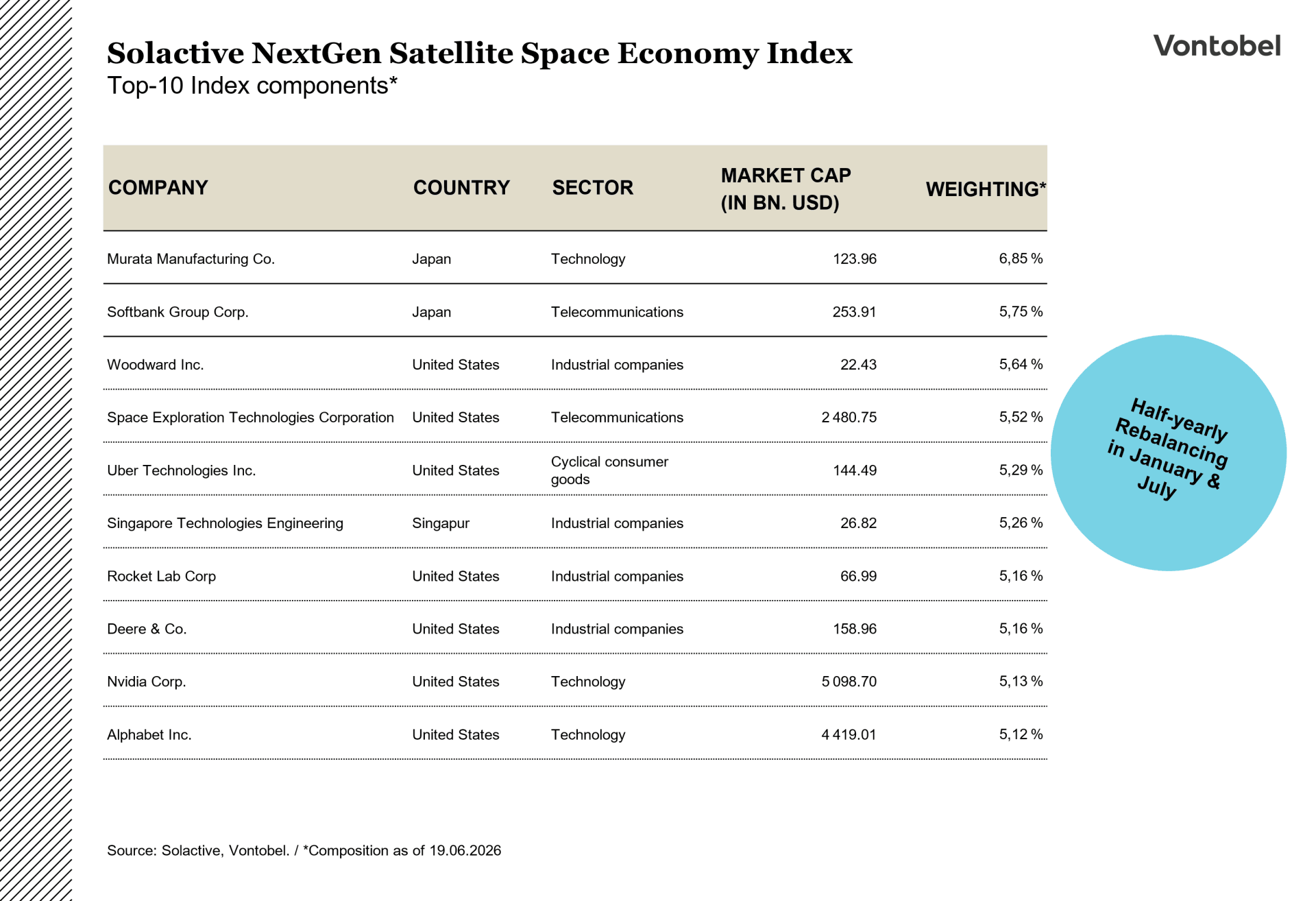
The Solactive NextGen Satellite Space Economy Index tracks the global satellite and space economy through 20 companies from developed markets. Selection is based on rules aligned with five key areas of the value chain:
- Satellite manufacturers
- Suppliers and component manufacturers
- Network and infrastructure operators
- Data and software providers
- Companies that commercially utilize satellite data
For inclusion in the index, both the thematic relevance to the space economy (Thematic Score) and fundamental quality metrics such as revenue growth, profitability, research and development expenditures, and free cash flow (Financial Score) are evaluated. By combining these two factors, the index aims to identify companies that are potentially influenced by developments in the space economy and that also have a solid economic foundation.
Balanced Portfolio and Long-Term Sector Focus
Another feature of the index is the equal weighting of all components. This gives small and medium-sized companies a comparable influence to that of established industry leaders, although it may also increase the risk of higher volatility due to the inclusion of smaller companies.
The composition is reviewed and adjusted semi-annually in January and July. Additionally, the methodology includes a special provision for SpaceX’s initial public offering (IPO). In this case, an extraordinary rebalancing of the entire index is planned to enable the timely integration of a potentially significant market participant.
With its structured approach, the Solactive NextGen Satellite Space Economy Index thus offers a differentiated exposure to a future-oriented market characterized by technological innovation, growing economic significance, and long-term growth prospects.