Oil prices in the maelstrom of political tensions


The conflict in the Middle East is escalating: The tensions between the U.S., Israel, and Iran are not only having geopolitical but also economic consequences. The global oil supply could be significantly impacted by the conflict, which has recently caused oil prices to rise sharply. The closure of the Strait of Hormuz is likely to further strain global oil supplies and put additional pressure on the markets. The Vontobel Oil Strategy Index offers a flexible investment strategy to respond to developments in the oil market.
Escalation of the conflict in the Middle East
Over the past week, geopolitical tensions in the Middle East have escalated into open conflict. On February 28, the United States and Israel launched a coordinated military operation against Iran. In response, Iran attacked not only Israel but also U.S. military bases and infrastructure in the Gulf region. Neighboring countries, such as the United Arab Emirates, have also been drawn into the conflict.
According to recent reports, the Strait of Hormuz—often referred to as "the world's oil artery"—has been mostly closed, with shipping traffic now severely restricted. This blockade further exacerbates the global oil supply situation and is likely to impact the global economy. Approximately 20 million barrels of crude oil—about one-fifth of global consumption—pass through this strategically critical waterway daily.
OPEC's reaction
The Organization of the Petroleum Exporting Countries (OPEC) and its allies have already reacted. The so-called "Voluntary Eight" (V8) group—a coalition of eight leading oil producers—announced on Sunday a larger-than-expected increase in production quotas by 206,000 barrels per day. Analysts had previously anticipated an increase of only 137,000 barrels per day.
In its statement, however, the V8 group avoided directly referencing the conflict with Iran, one of OPEC's founding members. Instead, the production increase was justified by "a stable global economic outlook and healthy market fundamentals." While this measure may provide short-term relief, it will not take effect until April. Even then, it is unlikely to compensate for the loss of oil supply if the Strait of Hormuz remains closed.
Alternative transportation options to combat shortages
In order to further mitigate the effects of a possible blockade, regional and global players could resort to alternative measures. These include the use of pipelines that transport crude oil directly to other ports.
Combined, these various pipelines could provide bypass capacity of about 7–8 million barrels per day. However, this is not enough to replace the approximately 20 million barrels per day typically transported through the Strait of Hormuz, though it could somewhat alleviate the supply shortage.
Effects on oil prices
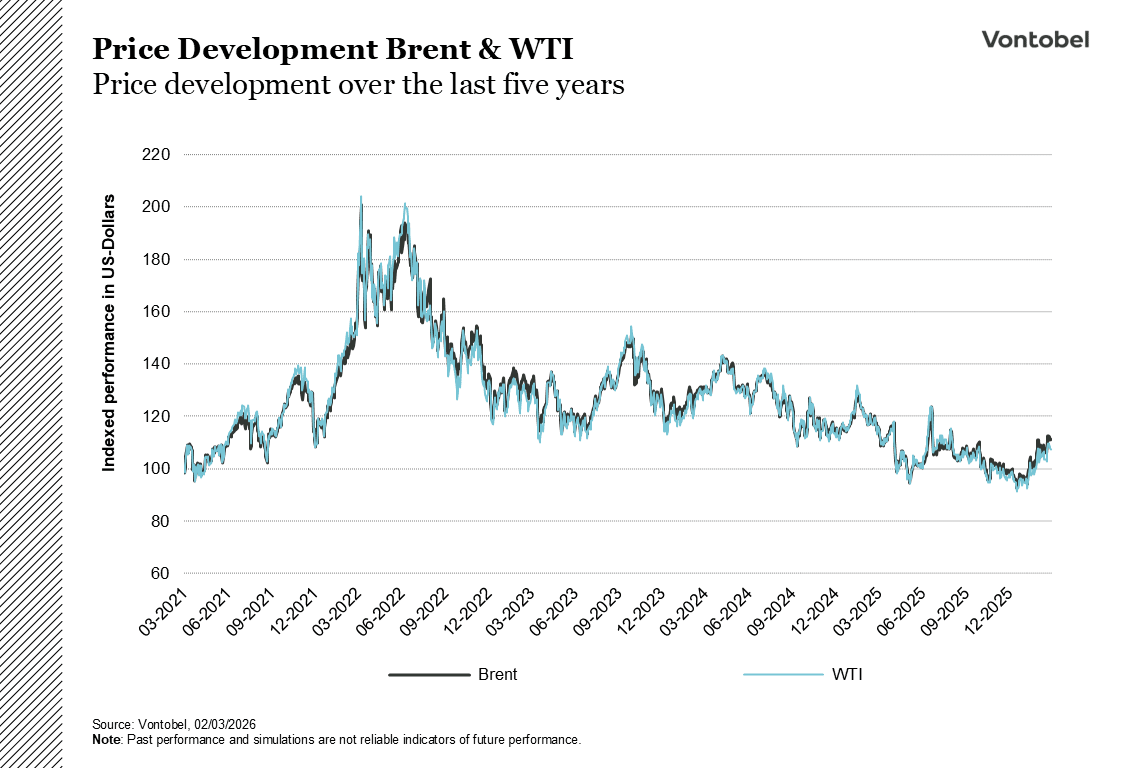
The price of Brent crude oil rose by USD 4.4 per barrel early Monday morning, while West Texas Intermediate (WTI) rose by USD 4.8 per barrel (03/02/2026). This follows a rise in oil prices of more than USD 10 since the beginning of the year. It is difficult to predict what will happen next. The development of oil prices is likely to remain exciting - and also offer interesting opportunities for investors.
The Vontobel Oil Strategy Index: A clever oil investment strategy
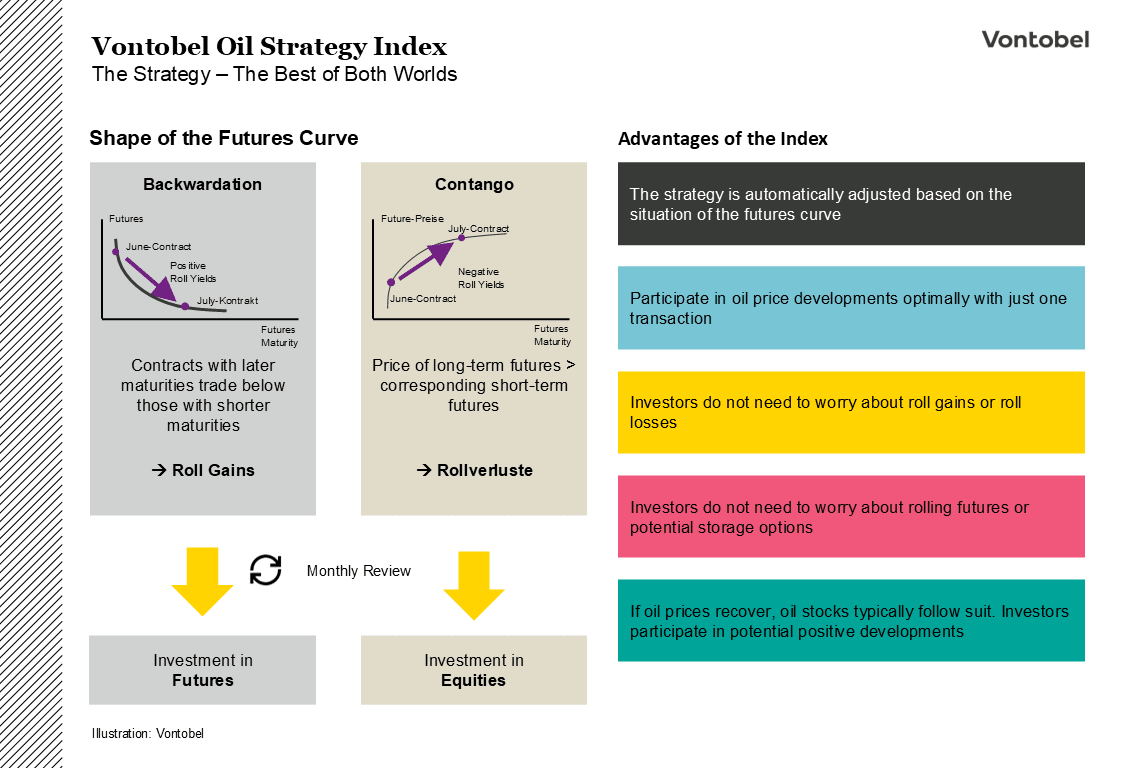
The Vontobel Oil Strategy Index offers an opportunity to benefit from developments on the oil market. The index pursues a flexible investment strategy based on the shape of the oil price futures curve. Depending on the market situation, the index invests either in oil futures or in shares of oil companies.
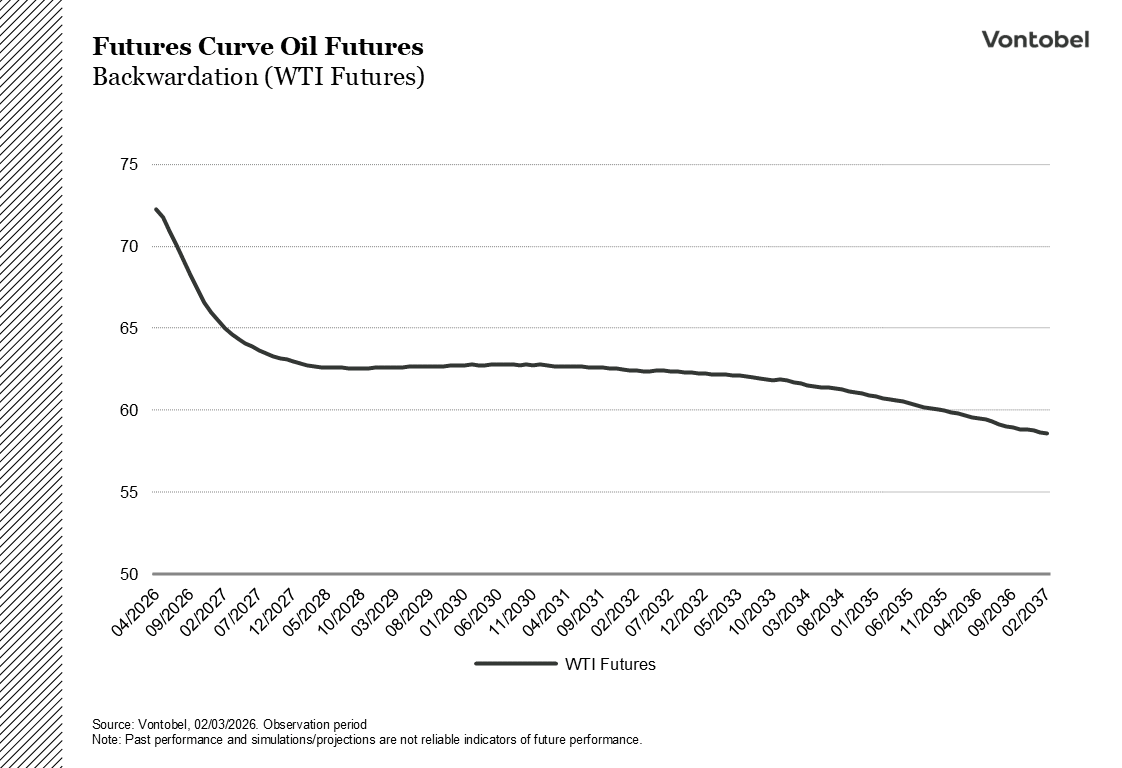
- Backwardation situation: In a backwardation phase, the spot price of a commodity is higher than the price of futures with a longer maturity. This means that a commodity that is delivered immediately is more expensive than a commodity that is to be delivered at a later date. In this situation, the index invests in futures in order to profit from so-called roll profits.
- Contango situation: In a contango phase, the price of futures with a longer maturity is higher than the spot price. This means that a commodity that will only be delivered in the future is more expensive than a commodity for immediate delivery. In order to minimize the disadvantage from rolling losses in such a constellation, the index invests in shares of oil companies.
The oil market is currently in a backwardation situation. Accordingly, the Vontobel Oil Strategy Index is currently invested in oil futures.
Dynamic adjustment through regular review
The composition of the Vontobel Oil Strategy Index is reviewed on a regular basis. On the third-last trading day of the month, Solactive analyzes the current market situation and decides whether a backwardation or contango situation exists. Based on this analysis, a possible switch between futures and equities is made on the last trading day of the month.
With open-end tracker certificates on the Vontobel Oil Strategy Index, investors can participate in this dynamic strategy with just one transaction and benefit from developments on the oil market
Related Products
