When Safe Havens Begin to Waver: Gold and the Swiss Franc as Alternatives to Government Bonds


Political tensions, geopolitical conflicts, and rising government debt are currently causing turmoil in the capital markets. At the same time, yields on long-term government bonds in several industrialized countries have reached levels last seen decades ago. This raises an unusual question: Are investors beginning to assess sovereign risks more critically than in the past? This would be of great significance for investors. After all, if perceptions of the safety of government bonds were to change, other asset classes could also come into sharper focus.
Government Bonds Under Scrutiny
According to the European Commission, the annual inflation rate in the eurozone stood at 3.8 percent in September 2026 (European Commission, 2.10.2026). After inflation began rising again in March, the European Central Bank responded with interest rate hikes in June and September 2026 (European Central Bank, 11.06.2026; 10.09.2026). At the same time, many industrialized nations face the challenge of financing high levels of debt and funding substantial investments in infrastructure, defense, and industrial policy.
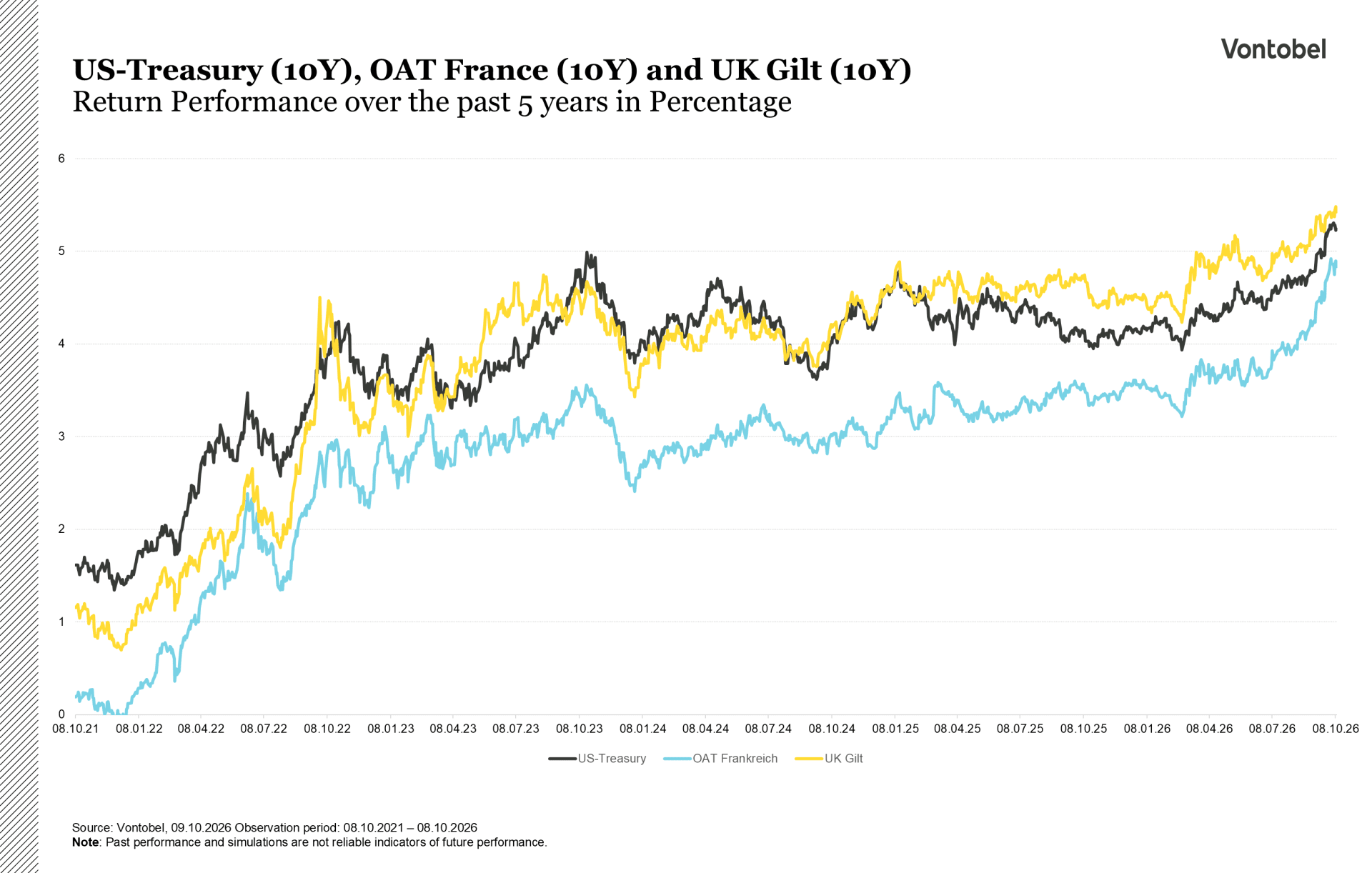
Against this backdrop, one development stands out in particular: yields on long-term government bonds in several major economies have risen to levels last seen decades ago. In France, the yield on the 10-year government bond stood at 4.96 percent in early October, its highest level since 2002. In addition to generally higher interest rates, political uncertainty is also weighing on investor confidence there (extraETF, 6.10.2026). Compounding this is the high level of government debt: France’s total debt amounted to approximately 3.46 trillion euros in 2025 (Statista, 18.08.2026). This combination could lead investors to demand a higher risk premium for French government bonds.
Yields have also risen significantly in the United Kingdom. The yield on 10-year government bonds surpassed the 6 percent mark in early October, reaching 6.07 percent, its highest level since 1998 (Yahoo Finance UK, 1.10.2026). According to Morningstar, this reflects, among other things, structural changes in the British bond market. For example, demand from traditional buyers such as defined-benefit pension funds is declining, while the Bank of England’s balance sheet reduction means additional bonds must be absorbed from the private market. At the same time, the market turmoil surrounding the UK’s 2022 mini-budget has permanently heightened investors’ sensitivity to political uncertainty. In periods of heightened uncertainty, investors therefore appear to be demanding a higher risk premium today than they did a few years ago (Morningstar, 21.09.2026).
In the U.S., the upward trend in yields also continued. The yield on 10-year government bonds reached 5.29 percent in early October, its highest level since April 2002, while the yield on 30-year Treasuries climbed to 5.66 percent, its highest level since May 2002 (CNBC, 6.10.2026). It is remarkable that yields in several major economies are reaching such high levels simultaneously. Normally, in times of political uncertainty, geopolitical conflicts, and economic risks, investors would increase their purchases of government bonds, causing their yields to fall. The current trend, however, suggests that investors are increasingly factoring the long-term consequences of high debt levels, political uncertainty, and rising financing costs into their valuations. The question is therefore no longer just how inflation and economic growth will develop, but also what risk premium investors will demand in the future for financing governments. Against this backdrop, asset classes outside the traditional government bond market that offer other stability features are gaining in importance.
Gold as an Alternative to the Government's Credit Promise
Gold offers one possible answer. This precious metal occupies a unique position in the financial system. Unlike a bond, gold depends neither on a government’s creditworthiness nor on a company’s ability to pay. It carries no default risk and has therefore been used as a store of value for centuries.
Its role becomes particularly evident in times when investors question their confidence in fiat currencies or government finances.
While a government bond represents a loan to a government and thus depends on that government’s financial capacity, gold is not a promise of payment by a debtor. Rather, its value is based on supply and demand, as well as its role as a globally accepted store of value.
This is precisely why the precious metal could gain in importance in an environment of rising political, geopolitical, and fiscal risks. It is also noteworthy that gold has risen by more than 130 percent over the past five years, significantly outperforming many traditional asset classes (finanzen.net, 7.10.2026).
For investors, gold is therefore not only a hedge against inflation but increasingly also against political uncertainty and potential losses of confidence in the financial system.

The Swiss Franc as an Anchor of Stability
In addition to gold, the Swiss franc could also benefit from such a scenario. For decades, Switzerland has enjoyed a reputation as a politically stable country with comparatively sound public finances and a central bank that has traditionally placed a particularly high priority on price stability (Swiss National Bank).
While many countries are facing rising debt and increased inflationary pressure, international investors value this reliability. The franc thus represents an attractive alternative for investors seeking safety without investing directly in government bonds.
When Security Is Redefined
The past few decades have been shaped by the assumption that government bonds are the most important safe haven in the capital markets. However, current developments raise the question of whether this special status will endure.
It remains to be seen whether this is merely a temporary market phase or a longer-term shift. What is striking, however, is that rising yields, high debt levels, political tensions, and geopolitical risks are now occurring simultaneously. This brings to the forefront a question that has rarely been asked in recent years: Which assets will investors turn to when government bonds themselves are increasingly perceived as a risk factor?
Gold and the Swiss franc could be among the beneficiaries in such an environment. Both represent different forms of stability and offer investors an alternative to traditional safe havens. However, gold and the Swiss franc are also subject to fluctuations in value and may perform differently depending on market conditions. That is precisely why it is worth monitoring their performance particularly closely in the coming years.
Nevertheless, it is important to bear in mind that political developments, geopolitical conflicts, future inflation trends, and changes in government debt are virtually impossible to predict reliably. Yet it is precisely these factors that are likely to have a decisive influence on how investors assess the risks of government bonds in the future and which assets they prefer as safe havens.
It also remains to be seen whether the current rise in yields actually reflects a structural loss of confidence in government bonds or is rather the result of a temporary adjustment to the current inflation and interest rate environment. Government bonds could just as easily re-establish their role as the preferred safe haven in the future. It is therefore impossible to definitively assess at this time which assets investors will view as particularly reliable in the long term. This makes it all the more important to always consider potential opportunities in the context of the associated risks.