Investors’ Outlook: A Shorter Leash

The Fed delivered its first interest-rate hike in three years, and several other central banks around the world have already done the same. With rate increases having resumed across major economies, the global easing cycle has effectively come to an end. But much of the inflationary pressure central banks are responding to stems from supply-side factors, such as higher oil prices and the lingering effect of tariffs, which monetary policy can’t do much about. As such, the scope for additional tightening is likely limited.
While economic growth has accelerated this year, the cycle appears to be maturing. Financial conditions have deteriorated amid higher oil prices and interest rates, and fiscal support is poised to fade as we move into 2027. Economic momentum may hence be nearing a peak. Early signs are visible in interest-rate-sensitive sectors such as housing, where the already slow recovery has stalled again. Still, the global economy is probably strong enough to withstand higher interest rates and avert a recession.
The main uncertainty is the energy shock. Iran may try to keep up the pressure on Washington ahead of the November midterm elections, but its ability to disrupt energy flows is getting harder as alternative export routes are being developed and production elsewhere expands. US President Donald Trump also has an incentive to de-escalate and bring oil prices down, especially as the war polls poorly and strategic oil reserves have hit 40-year lows.
Elsewhere, weak domestic demand in China is one area of concern, though fiscal stimulus could support growth and markets. An escalation of the Ukraine war is another risk, with Russian refineries hit by drone attacks and the possibility of a Russian response.
Capitol Gains? The Markets and the U.S. Midterm Elections
The 2026 US midterm elections, set to take place on November 3, represent a major political test for President Donald Trump and his administration. While presidential elections naturally attract the most public attention, history shows that midterms often play an equally important role in determining the direction of policy, financial markets, and investor sentiment. For markets, the key question is not merely who wins, but whether Trump retains enough support in Congress to continue implementing his economic agenda.
Midterm elections take place halfway through a president’s four-year term. Americans do not elect a president during the midterms. Instead, all 435 seats in the House of Representatives and roughly one-third of the 100 seats in the Senate are contested. The two chambers form Congress, which holds the power to pass legislation, approve spending measures, alter tax policy, and oversee the executive branch.
The House of Representatives is generally considered the more politically sensitive chamber because its members face re-election every two years. As a result, shifts in public sentiment tend to show up there first. Historically, the president’s party has frequently lost House seats in mid-term elections, particularly when approval ratings are weak. The Senate is designed to provide greater continuity, as senators serve six-year terms and only a portion of seats are contested in each election cycle. Losing either chamber would make it more difficult for Trump to pursue his agenda, but the House is currently viewed as the more immediate risk. As of late September, Polymarket put the probability of Republicans losing control of the House at 93 percent, compared with 65 percent for the Senate.
The Iran conflict has been one factor weighing on Trump’s approval ratings. Regardless of how one views the strategic objectives, military engagement abroad often creates political challenges at home. Higher energy prices, concerns about further escalation, and growing war fatigue among voters have all contributed to a more difficult political environment. The issue is particularly sensitive because Trump campaigned heavily on restoring domestic strength while avoiding prolonged foreign entanglements. After two decades of costly engagements in Iraq and Afghanistan, many Americans remain deeply skeptical of interventions that could evolve into another “forever war”. Recent polling suggests that the Iran conflict ranks among the most unpopular US military interventions in modern history, with some surveys showing even weaker public support than during the later stages of the Vietnam War. Even though the current conflict with Iran is far more limited in scope, it has revived concerns that the US could once again be drawn into a prolonged and costly conflict in the Middle East.
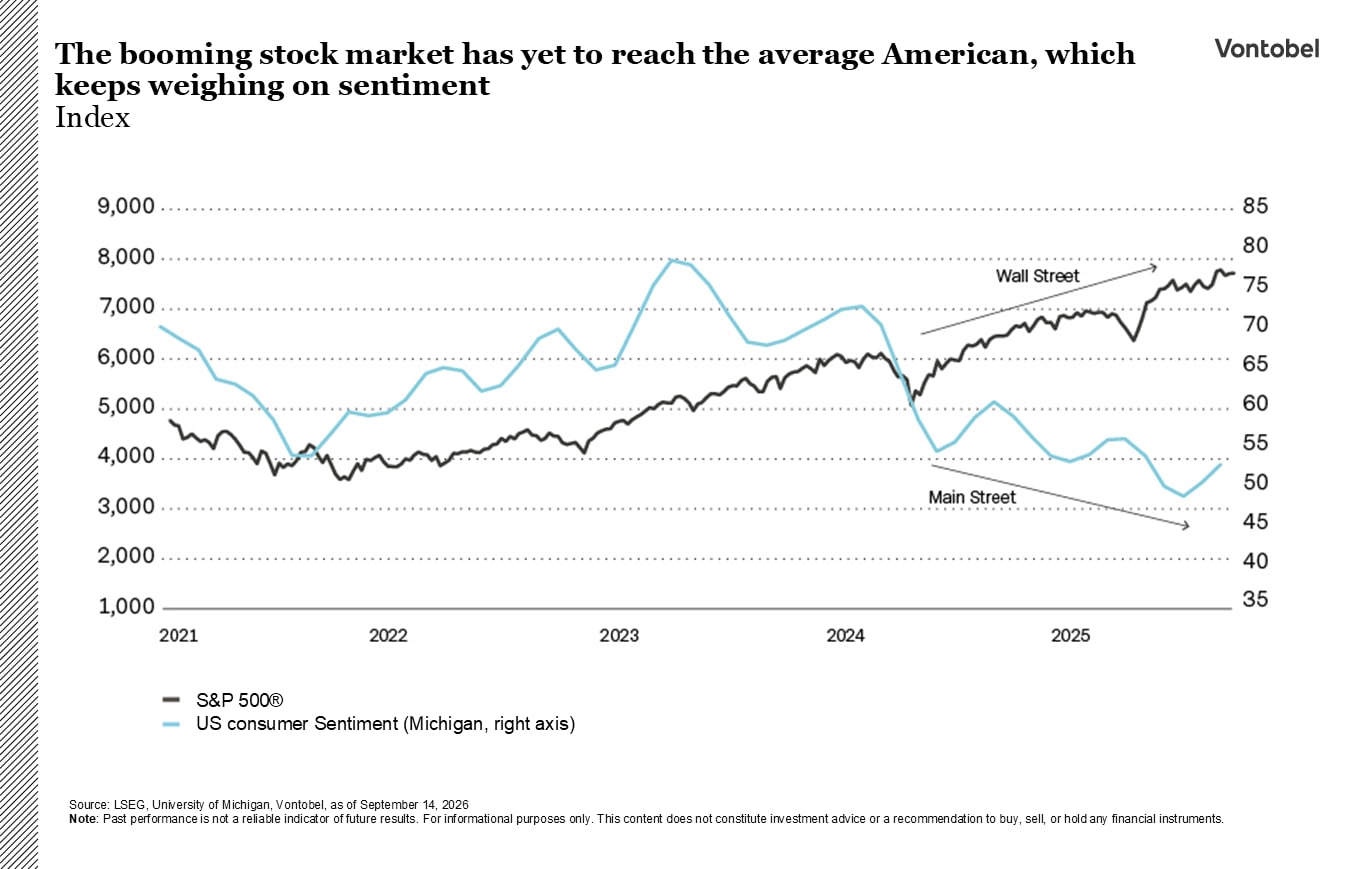
Equally important is the growing disconnect between financial markets and the lived experience of many households. On paper, the US economy appears in good shape. Equity markets have continued to perform strongly, corporate earnings have generally exceeded expectations, and technological innovation, particularly in artificial intelligence, has generated substantial wealth. Yet many Americans haven’t benefited from this prosperity. This divide has contributed to what many observers describe as a K-shaped economy. Higher-income households, which own most financial assets, have benefited enormously from rising stock prices, appreciating business values, and exposure to AI-related investment themes. Meanwhile, many middle and lower-income households continue to grapple with high living costs, housing affordability, and concerns about job security. The result is one segment of the economy that feels increasingly prosperous, while another perceives little improvement despite optimistic economic headlines.
For politicians, perceived reality often matters more than aggregate statistics. Voters do not cast ballots based on the performance of the S&P 500®. They vote based on how financially secure they feel. This helps explain why strong economic growth and buoyant equity markets do not automatically translate into political support. A booming stock market may be celebrated on Wall Street, but it offers limited comfort to households that do not own significant financial assets or benefit through higher wages.


From an investment perspective, the months leading up to midterm elections can be challenging for equities. Markets generally dislike uncertainty, and questions surrounding congressional control, fiscal policy, taxation, and regulation can contribute to bouts of volatility ahead of the vote. Historically, however, US equities have often performed well after midterm elections. Once the outcome is known, investors gain greater clarity regarding the policy environment for the next two years, removing an important source of uncertainty. Markets have also tended to welcome a divided government, as it reduces the likelihood of major policy changes and increases policy predictability. Administrations of both parties also often seek to support economic growth as the next presidential election approaches.
Nevertheless, investors may want to be cautious about assuming that historical patterns will automatically repeat. Several downside risks remain. The first concerns fiscal policy. Much of the recent economic resilience has been supported by substantial government spending and fiscal stimulus. If Democrats gain control of one or both chambers of Congress, further fiscal expansion could become more difficult. A divided government would likely bring greater scrutiny of budget deficits and government spending programs, particularly given mounting concerns about the long-term trajectory of US public debt. Democrats may also push for greater fiscal restraint, knowing that any resulting slowdown in economic activity would likely be blamed on the ruling Republican administration rather than Congress. While such an outcome could improve the long-term debt outlook, it would likely come at the cost of weaker growth in the near term.
Tax policy represents a second risk. Although sweeping tax increases would likely face considerable political resistance, a stronger Democratic position in Congress could revive discussions about higher taxes on very high-income individuals, capital gains, or large corporations. Such proposals would not necessarily become law, but they could still influence investor expectations and corporate behavior.

Perhaps the most underestimated risk is that the AI honeymoon begins to fade. Over the past several years, AI has been viewed primarily through the lens of productivity gains, technological leadership, and corporate profitability, prompting investors to reward perceived AI winners with extraordinary valuations. Yet as the technology becomes more deeply embedded in the economy, its social consequences are attracting greater attention. Fears of AI-driven job displacement are particularly pronounced in the US, where the potential loss of middle-class and white-collar jobs has become an increasingly prominent political issue. The debate is gradually moving from the opportunities created by AI toward questions surrounding automation, pressure on entry-level employment, and the future of knowledge work. Public support for the rapid build-out of AI infrastructure has also weakened. In parts of the US, local opposition to data centers has grown as communities push back against their substantial electricity consumption, water use, and land requirements. If voters increasingly associate AI with job losses, rising power demand, and limited benefits for the average worker, rather than broad-based prosperity, policymakers could face mounting pressure to regulate aspects of the technology more aggressively. This could challenge some of the optimistic assumptions currently reflected in AI-related equity valuations.
A further risk for equities is that the midterm elections may not reduce policy uncertainty as much as investors typically expect. If Republicans lose control of one or both chambers of Congress, legislative gridlock will become more likely, making it harder for the administration to advance its domestic agenda through conventional channels. Political uncertainty could simply take a different form. With Congress acting as a constraint, the White House might rely more heavily on executive orders, regulatory actions, and foreign policy initiatives, where presidential authority remains comparatively strong. Investors could then face a different kind of uncertainty: less debate over fiscal legislation and more on trade policy, tariffs, sanctions, immigration measures, and geopolitical developments. In other words, a Democratic victory in Congress would not necessarily bring an end to political risk for markets; it could just change where that risk comes from.
The bond market bears close watching as well. Interestingly, the 2018 midterm elections during Trump’s first presidency broadly coincided with a peak in Treasury yields. The 10-year Treasury yield reached a cycle high of around 3.25 percent shortly before the elections, then embarked on a sustained decline as growth expectations softened and the Fed eventually pivoted toward easing. History rarely repeats itself exactly, but there are some parallels worth noting. After several years of robust growth, substantial fiscal stimulus, and inflation concerns, bond yields are once again elevated heading into a midterm election.
If the elections result in political gridlock and a reduced likelihood of further fiscal expansion, investors could begin to price in slower nominal growth and a more benign inflation outlook. At the same time, the powerful growth tailwinds from fiscal stimulus and the AI boom may gradually fade, removing two key supports for growth expectations. Such a combination would be supportive of Treasuries and could mark an important turning point for yields.
On the other hand, concerns about continued deficit spending, geopolitical risks, or inflationary trade policies could keep yields elevated for longer. The midterms may therefore not determine the direction of bond markets outright, but they could represent an important inflection point, much as they did during Trump’s first term. Indeed, if growth expectations begin to moderate, investors may ultimately look back on the 2026 midterms as the point when Treasury yields reached their peak in this cycle.

The Fed moves closer to market pricing
The September Fed meeting made clear that the US rate environment has changed. The unanimous 25bps increase took the policy rate to 3,75 – 4,00 percent, while the new projections combined stronger growth, lower unemployment, and higher near-term inflation with a higher path for policy rates. The median fed funds rate forecast rose to 4,1 percent for both end-2026 and end-2027, bringing the Fed much closer to levels markets had already priced in.
That convergence is important for what comes next. Ahead of the meeting, investors had already built a size-able tightening cycle into forward rates. The September projections brought the Fed closer to market pricing, although the market-implied policy rate for end-2027 is still somewhat above the Fed’s median forecast. A further material rise in front-end yields would therefore increasingly require another shift in the inflation or growth outlook, rather than simply the Fed delivering what markets already expect. The tone of the meeting also suggests the Fed has become more comfortable keeping policy tighter while the economy is resilient. Strong activity and a stable labor market make it easier to lean against inflation, while the unanimous vote suggests that concern about persistent price pressures are shared across the Committee. Over a nine to 12-month horizon, we still believe yields are poised to decline as inflation moderates and policy expectations stabilize. But the scope for a large rally at the long end looks limited. Fiscal deficits are large, Treasury supply is heavy, and the term premium has rebuilt from the unusually low levels seen in the period after the global financial crisis.
The credit space saw little change. Investment-grade fundamentals appear sound, but spreads are tight and heavy supply remains a technical headwind. AI-related financing accounts for a growing share of issuance, while the recent underperformance of hyperscaler shows that markets are becoming less willing to overlook valuation, leverage, and rising capital commitments.
High yield looks more attractive on a relative basis. All-in yields still appear compelling, duration is low and credit quality has improved structurally, with BB-rated issuers now accounting for more than half of the index. This combination can limit sensitivity to volatility in long-end yields and allows carry to remain an important source of returns even without further spread compression.


Rates strike, earnings shield
After a strong August, global equity markets came under pressure in September as tensions in the Middle East escalated again, leading investors to reassess the inflation outlook and price in a more restrictive Fed. Rising government bond yields weighed on risk assets, resulting in a broad-based pullback in equities.
Wall Street folklore warns that 5 percent 10-year Treasury yields are kryptonite for stocks. When investors can earn 5 percent risk-free, equities face stiffer competition for capital, especially high-flying growth companies whose profits lie further in the future. But higher yields aren’t guaranteed villains. History shows that equities can withstand the pressure when rising rates reflect a stronger economy, as robust growth ultimately finds its way into higher corporate earnings.
While much of the recent rise in yields has been attributed to higher energy prices, fiscal deficits, and increased bond issuance, a significant share of the increase earlier this year also reflected robust US economic growth.
The pace at which yields move is also important. Rapid spikes tend to force markets to adjust instantly, causing a shock to valuations, tightening credit conditions over-night, and triggering forced selling by over-leveraged investors. This point is particularly relevant today, given how quickly rates have surged recently.
Even as markets fixate on the Fed’s next move, history suggests that the start of a rate-hike cycle is not necessarily a bearish tactical signal for equities. Previous tightening cycles were often accompanied by a period of heightened volatility after the initial hike, but equity markets generally recovered within five months and delivered positive returns over the following 12 months .
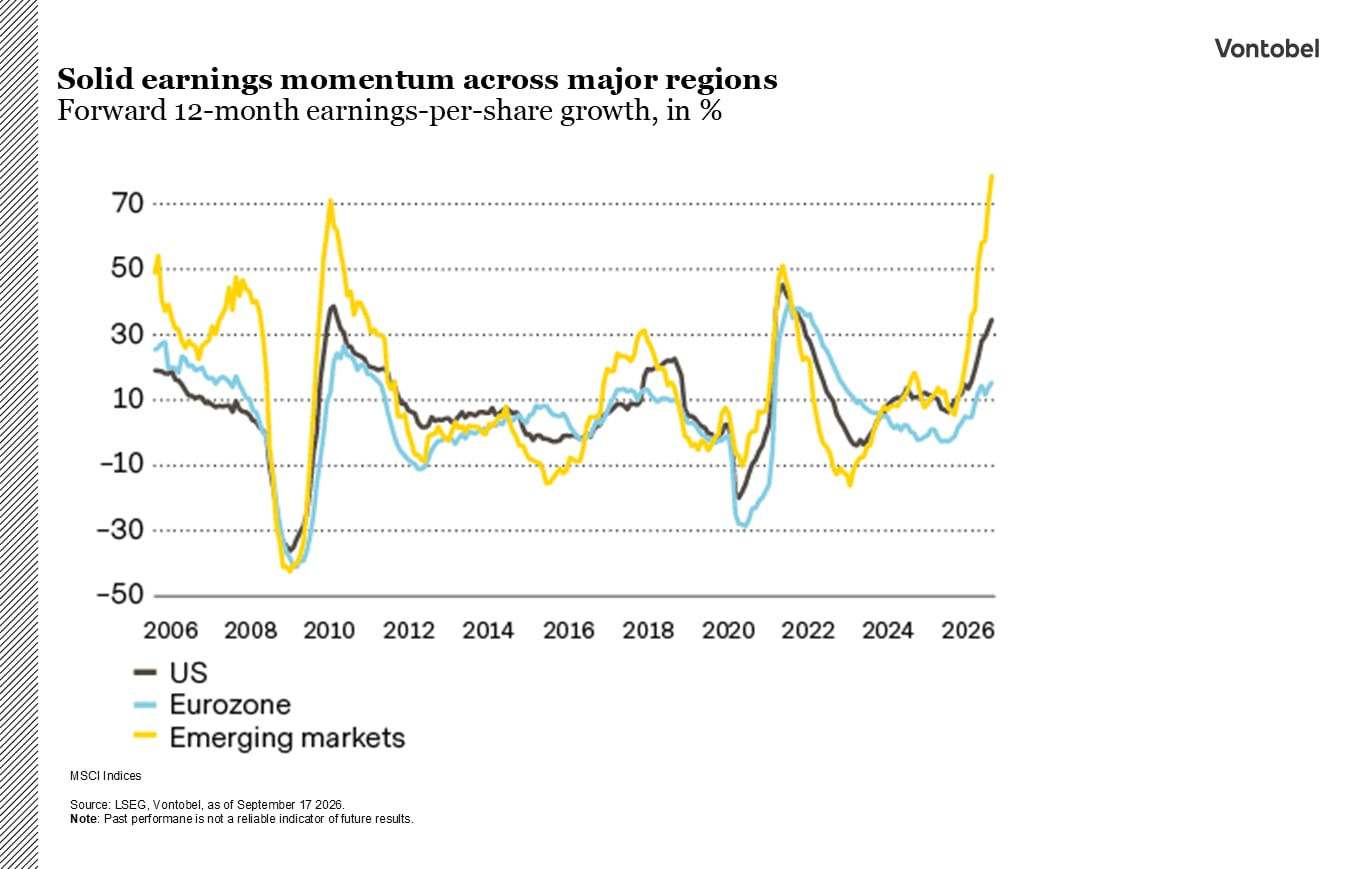
Corporate fundamentals are also still remarkably strong. Earnings growth has continued to hold up well, with positive surprises across regions and sectors. Balance sheets are healthy, corporate leverage is contained, and interest coverage ratios are near historical highs.
Looking ahead, the battle between earnings and interest rates is likely to determine where markets go next. The encouraging news is that investors have already absorbed a significant valuation reset as yields climbed and expectations for Fed tightening increased. The risk, however, is that rates continue to move higher while earnings growth decelerates meaningfully, putting pressure on valuations.

Two Sides of the Barrel
Headline crude oil prices often capture the spotlight, but a growing disconnect at the pump has left consumers puzzled. Drivers may read about softening crude prices yet continue to face stubbornly high prices for refined products such as gasoline and diesel.
Refined product markets have been hit from several directions this year. First, disruptions in the Strait of Hormuz have curtailed product flows out of the Gulf region. Making matters worse, refined products are generally harder to reroute than crude oil, making supply disruptions more difficult to offset. Second, those same bottlenecks have constrained crude oil shipments, tightening feedstock availability for refiners worldwide. Third, Ukrainian attacks on Russian refineries and fuel infrastructure have periodically taken refining capacity offline, further reducing product supply.
This contrast is visible in crack spreads, a measure of refining profitability. As gasoline, diesel, and jet fuel supplies have become increasingly scarce, crack spreads have surged. Refiners in the US and elsewhere have rushed to capitalize on these windfall margins, postponing seasonal maintenance and running plants at exceptionally high utilization rates. In the US, refinery utilization reached 97 percent in September, generally considered close to full operating capacity.
Whether this pace can be sustained is another question. History suggests that prolonged periods of operating near maximum capacity increase the risk of equipment failures, emergency maintenance, and unexpected out-ages. Ironically, such disruptions could widen the gap between crude and product markets even further. Unplanned refinery shutdowns reduce crude processing, which could weigh on crude prices. At the same time, supplies of gasoline, diesel, and jet fuel could tighten further, pushing product prices higher.
Looking ahead, geopolitics remains a key wildcard. In the third quarter, Ukrainian attacks on Russian energy infrastructure briefly slowed after renewed diplomatic efforts. However, the attacks have since resumed, keeping the risk of fresh disruptions to Russian refining capacity firmly on the market's radar. Markets must also contend with policy uncertainty in the US. President Trump has floated the idea of restricting diesel exports to shield domestic consumers from high fuel prices. Higher domestic inventories could ease diesel prices in the US, but reduced exports would likely tighten supplies elsewhere, particularly in Europe and Latin America, adding another source of volatility to refined product markets.


The dollar gets a Fed-lift
The September rate hike and higher Fed rate projections have boosted the US dollar’s near-term outlook. US growth is holding up, its rate advantage over other currencies has increased, and carry looks more attractive than a few months ago. For currencies, though, the Fed’s path relative to other central banks should be the main driver, not just the level of US rates.
The median projection in the Fed’s Summary of Economic Projections now points to another rate hike this year and expects rates to stay higher for longer than was projected in June. This may lend the dollar more support in the near term. But the September move was largely priced in, and further tightening is already embedded in expectations. A more sustained rise in the dollar may require US rate expectations moving higher relative to those elsewhere.
The Fed is not tightening alone. Markets expect higher policy rates over the next two years across most major economies. The US still has a substantial rate premium over the euro area, but the key question for currencies is whether that differential widens further. As the US tightening cycle nears a plateau, the boost from relative policy may fade.
Over the next nine to 12 months, the dollar’s rate advantage is likely to recede as the energy-driven inflation impulse fades and policy paths stabilize. This may give the euro room to recover gradually. The franc is poised to remain resilient, although its sizeable yield disadvantage could curb a sustained appreciation. Broader US inflation poses the main risk to this outlook, as it could keep the Fed tightening for longer.
Once policy expectations settle, structural fundamentals may come more to the fore. Current-account positions, fiscal balances, and debt dynamics offer a way to distinguish currencies with stronger underlying support from those more dependent on cyclical yield advantages.
The dollar still benefits from high yields, safe-haven demand, and deep capital markets, but large fiscal deficits and a persistent external imbalance may weigh on the currency in the medium term. The euro has a more balanced profile, with a positive external position and healthier aggregate debt dynamics despite fiscal risks in parts of the region. The franc also looks well supported, although its yield disadvantage may leave limited room for further appreciation.

