The Unsung Heroes of the Financial Markets: A Comparison of Three Stock Exchange Operators


When investors think of stock exchanges, the focus is often on the securities traded there. By contrast, the operators of the trading venues themselves receive less attention. Yet in recent years, many stock exchange companies have evolved into diversified financial infrastructure and data providers. In particular, Deutsche Börse, the CME Group, and the London Stock Exchange Group (LSEG) are pursuing different strategies and offering investors access to various growth drivers.
Deutsche Börse: More Than Just Xetra
Deutsche Börse is one of Europe’s leading stock exchange operators. While many investors are primarily familiar with the electronic trading platform Xetra, where a large portion of German equity trading takes place, the group’s business is significantly more diverse. The group includes, among others, Eurex, one of the world’s largest futures and options exchanges. In addition, Clearstream plays a central role as an international custodian and settlement service provider for securities. The offering is complemented by index and market data services as well as various trading and post-trade platforms for different asset classes (Deutsche Börse Annual Report 2025).
A key advantage of the business model lies in the high barriers to entry. The settlement and custody of securities require significant regulatory and technical prerequisites. As a result, Deutsche Börse enjoys a strong competitive position and derives a large portion of its revenue from recurring income (Deutsche Börse Annual Report 2025).
CME Group: The Specialist in Derivatives Markets
The CME Group holds a unique position within the global exchange landscape. The company operates some of the world’s most important futures exchanges and is best known for trading futures and options on interest rates, stock indices, commodities, and currencies. The group includes, among others, the Chicago Mercantile Exchange (CME), the Chicago Board of Trade (CBOT), the New York Mercantile Exchange (NYMEX), and the Commodity Exchange (COMEX) (CME Group Form 10-K 2025, 26.02.2026).
Futures contracts on a wide range of underlying assets are traded on these exchanges. These include, for example, U.S. Treasury bonds, stock indices, energy products, industrial metals, precious metals, and agricultural commodities. The CME Group thus plays a key role in price discovery and risk management in the international financial and commodities markets (CME Group Form 10-K 2025, 26.02.2026).
Its business model differs significantly from that of traditional stock exchanges. Demand for hedging and trading instruments is often driven by market uncertainty. Rising interest rates, geopolitical risks, or major fluctuations in the capital markets can lead to higher trading volumes and thus support the CME Group’s earnings. In addition, the company holds a leading market position in numerous product segments, which generates network effects. For market participants, it is often more attractive to trade where the highest liquidity already exists (CME Group Form 10-K 2025, 26.02.2026).
Nevertheless, investors should bear in mind that growth in trading activity is not continuous. Particularly quiet market periods can temporarily lead to lower trading volumes. However, due to its strong market position and its important role in price discovery and risk hedging in global markets, the CME Group is considered a major infrastructure provider within the financial system (CME Group Form 10-K 2025, 26.02.2026).
London Stock Exchange Group: From Stock Exchange Operator to Data Provider
The London Stock Exchange Group (LSEG) has undergone a far-reaching transformation in recent years. With the acquisition of the financial data provider Refinitiv, the company has increasingly evolved from a traditional stock exchange operator into a provider of financial data, analytical solutions, and market infrastructure (LSEG Annual Report 2025).
In addition to the London Stock Exchange, the group includes, among others, the index provider FTSE Russell, the clearing house LCH, and the financial data and analytics solutions business. Through these various business segments, LSEG covers large parts of the value chain in the capital markets. The company is thus active not only in trading but also in the areas of data, indexing, clearing, and risk analysis (LSEG Annual Report 2025).
Today, a significant portion of revenue no longer comes from actual stock trading but rather from data, analytics, and information services. This business is often characterized by long-term customer relationships, recurring revenue, and comparatively high switching costs for customers. Access to high-quality financial data is becoming increasingly important, particularly in the context of algorithmic trading strategies, regulatory requirements, and data-driven investment decisions (LSEG Annual Report 2025).
At the same time, the integration of large acquisitions always involves risks. Furthermore, LSEG competes with other established providers of financial information and market data. However, this broader portfolio can help reduce dependence on trading volumes and further diversify the revenue base (LSEG Annual Report 2025).
Three companies, three different approaches
Although all three companies can be classified as exchange operators, their business models differ significantly.
Deutsche Börse focuses primarily on trading, clearing, and custody infrastructure; the CME Group focuses on global derivatives trading; and LSEG is increasingly focusing on financial data and analytical services (Deutsche Börse Annual Report 2025; CME Group Form 10-K 2025, 26.02.2026; LSEG Annual Report 2025).
What all three companies have in common is that they can benefit from high barriers to entry, strong market positions, and, in some cases, significant network effects. At the same time, these are not risk-free investments. Regulatory changes, declining trading activity, or increasing competition can influence business performance.
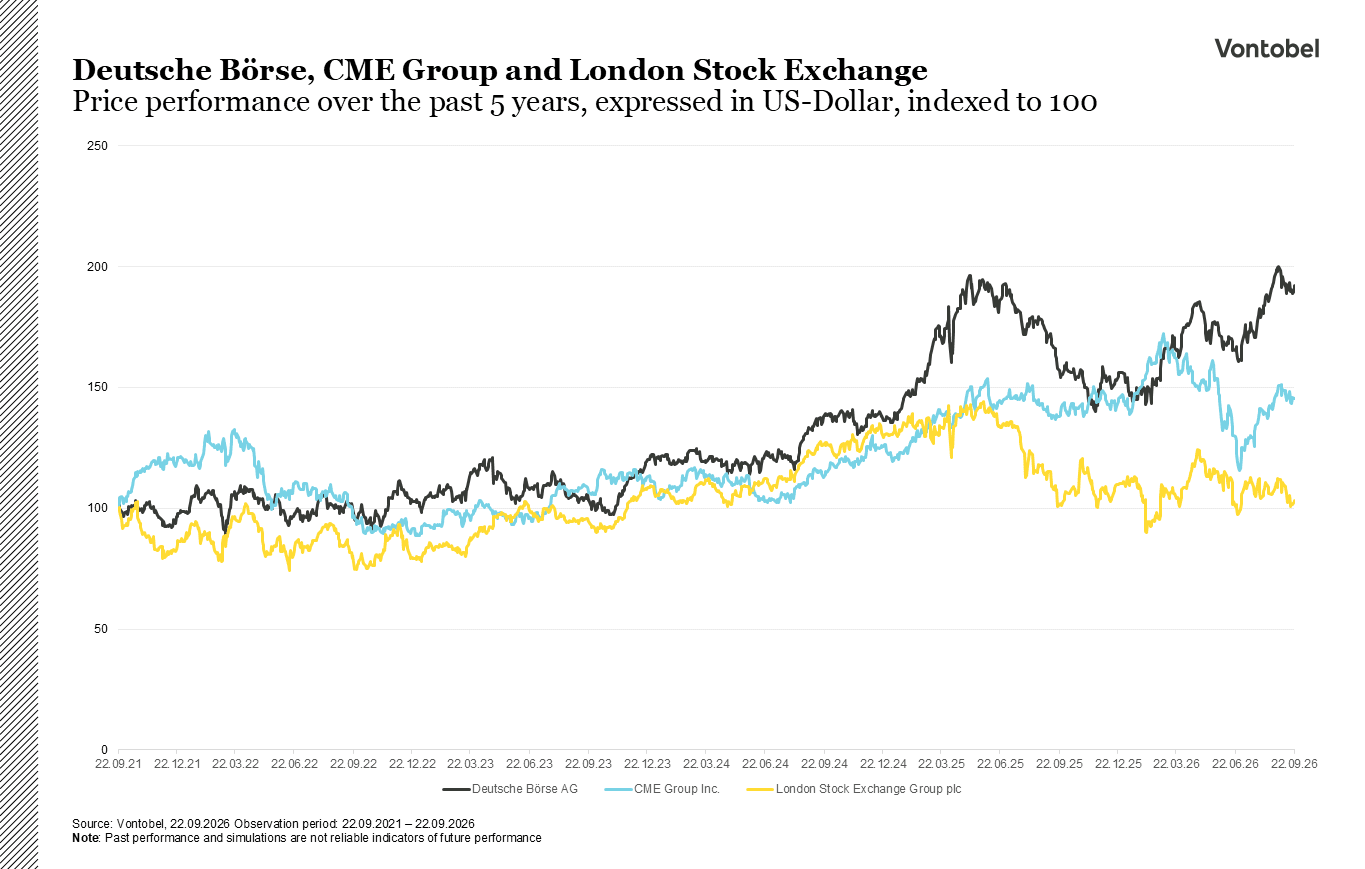
Different Paths to the Same Goal
Exchange operators are often less in the spotlight than technology or consumer companies. Nevertheless, many of these companies have robust business models, strong market positions, and a high proportion of recurring revenue.
While Deutsche Börse is known in particular for its financial market infrastructure, the CME Group offers access to global derivatives trading. LSEG, on the other hand, is increasingly pursuing a data-driven strategy. For investors, therefore, the decisive question is likely not which exchange operator is the “best”. Rather, the attractiveness of a particular stock depends on which part of the financial market ecosystem is considered particularly promising in the long term (Deutsche Börse Annual Report 2025; CME Group Form 10-K 2025, 26.02.2026; LSEG Annual Report 2025).