Investors' Outlook – A Tough Summer

Summer barely provided respite, whether on the thermometer or in markets. Tensions between the US and Iran flared up again, sending oil prices higher, while questions over AI spending weighed on technology stocks. Strong earnings and demand for AI infrastructure then helped equities recover. Bonds were less forgiving, as US government debt surpassed USD 40 trillion and concerns over heavy issuance pushed long-term yields higher.
Cruel Summer
The global economy, and especially the US, has held up well. Growth may lose some momentum from here as central banks provide less support than they did at the start of the year, the scope for further fiscal stimulus looks limited, and geopolitical risks haven’t gone away. But the slowdown is unlikely to tip the economy into recession.
Inflation is poised to inch lower, despite the pressure from energy prices over the summer. US goods inflation, which tariffs have temporarily pushed higher, is poised to moderate more. The impact of the oil shock is also likely to fade as more crude is rerouted to circumvent disruption in the Strait of Hormuz. So, while inflation is still above target in both the US and the Eurozone, we see the recent supply-side pressures easing over the coming months.
That should allow central banks to take a more patient approach to further tightening. Investors spent much of the summer fixated on oil and inflation, but the US labor market has been weakening in the background. Considering the Fed’s dual mandate, softer inflation and a cooling labor market may give it good reason to stay put. The bar for rate hikes is likely high.
With love, Kevin
The Fed has a towering reputation and a dismal recent track record. That was the message of Kevin Warsh’s April 2025 Group of Thirty (G30) lecture, Commanding Heights: Central Banks at a Crossroads, in which he delivered a scathing critique of what he called “the most influential economic agency in the world”.
In a nine-page broadside, Warsh laid out what he regards as the many failings of the institution he now heads. First came what he described as “central bank fast food”. Warsh expressed his disdain for the Fed’s frequent changes to its metrics, including its preferred measures of inflation. He also dismissed the central bank’s policy of data dependence as offering little real value, arguing that policymakers should pay scant attention to the second decimal place in the latest government data. In his view, “breathlessly awaiting trailing data from stale national accounts” that are subject to revision reflects a false sense of precision rather than sound policymaking. Warsh was equally skeptical of near-term forecasting. Once policymakers publish their economic projections, he argued, they risk becoming prisoners of their own words. Nor was he convinced by forward guidance, “a tool rolled out to great fanfare in the financial crisis”. In his view, while such efforts to steer market expectations may have been appropriate during times of acute economic stress, they are hardly justified under more normal conditions.

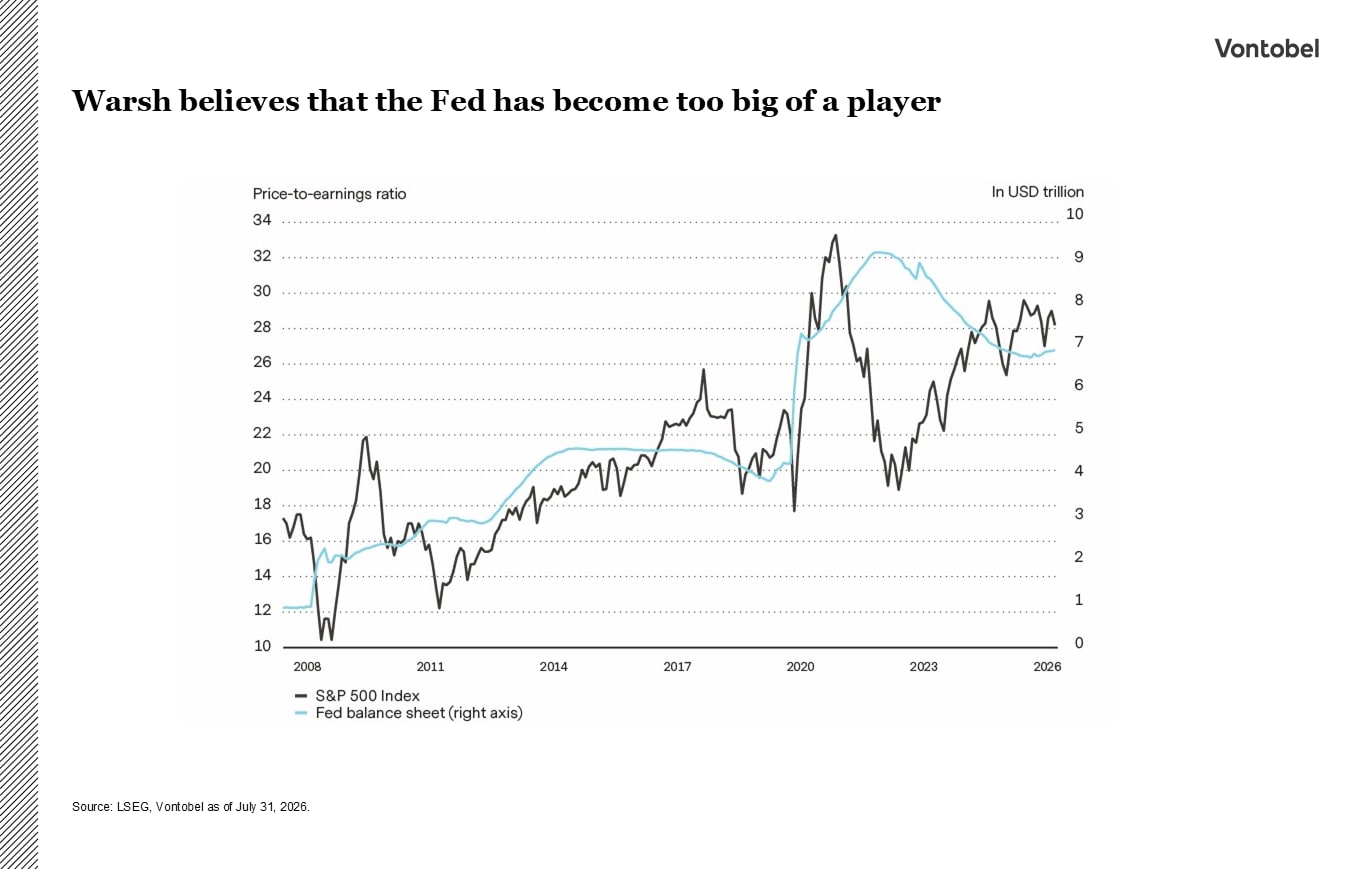
Then came what Warsh described as “a more substantial offering”. Looking beyond the day-to-day mechanics of policymaking, he argued that the Fed had fundamentally expanded its role in the US economy. Warsh noted that from the early 1990s until the global financial crisis, the central bank largely confined itself to managing episodes of crisis and market panic before, in his words, “largely and dutifully” leaving the stage once stability had returned. Since 2008, however, “central bank dominance has become a new feature of American governance.” He went on to fault Fed officials for supporting government spending during economic downturns while remaining conspicuously silent on fiscal discipline during periods of sustained growth and full employment. More concerning still, he argued, was the Fed’s position as the single largest buyer of US Treasury debt and other government-backed liabilities since 2008. Warsh viewed the Fed’s USD 7 trillion balance sheet as a “proxy for the Fed’s growing imprimatur on the economy.” In his view, this had created a self-reinforcing cycle: “Each time the Fed jumps into action, the more it expands its size and scope… more debt is accumulated… more capital is misallocated… more institutional lines are crossed… and the Fed is compelled to act even more aggressively the next time”.
But Warsh did not stop at fiscal policy. He also took aim at the “modern central bank,” which he said had become “a bit too willing to traffic in contraband” by venturing into politically charged issues beyond its statutory mandate (in other words, he accused the Fed of mission creep). In his view, the Fed should refrain from taking positions on social or political matters unless they pose a clear threat to its core missions of price stability and maximum employment. On the subject of those core missions, Warsh also accused the central bank of committing “intellectual errors” that ultimately led to the inflation shock of the early 2020s. Among them, he argued, was the belief that monetary policy had “nothing to do with money,” that the Fed was merely a bystander to forces beyond its control, and that inflation was driven primarily by “Putin and the pandemic” rather than by “the surge of government spending and (money) printing.”
Warsh’s 2025 speech provided an early glimpse of his desire for change. In the months that followed, he offered further food for thought, including his view that AI is a powerful disinflationary force, capable of boosting productivity and lowering costs across the economy.
Who is this fierce Fed critic?
Few figures in modern economic policy bridge the worlds of Wall Street, Capitol Hill, and central banking as seamlessly as Warsh. Educated at Stanford University and Harvard Law School, Warsh began his career in mergers and acquisitions at Morgan Stanley before serving as Special Assistant to the President for Economic Policy under George W. Bush. When he was appointed to the Fed’s Board of Governors in 2006 at just 35 years old, he became the youngest governor in the central bank’s history. During his tenure, Warsh established himself firmly as an economic hawk. He consistently warned of the long-term risks of runaway inflation and questioned the prolonged reliance on emergency monetary stimulus. After opposing Ben Bernanke’s plan to purchase USD 600 billion of Treasury securities, Warsh resigned from the Board in 2011. Warsh also has an elite financial and political pedigree.
His marriage to Jane Lauder, an heiress to the Estée Lauder cosmetics fortune, makes him the wealthiest person ever to lead the central bank. His father-in-law, Ronald Lauder, is not only a prominent Republican donor4 but also a long-time friend of Donald Trump.
The strategic reset: Five task forces
To drive the regime change, Warsh has established five three-person task forces. Each panel brings together minds from academia, technology, and global policy to re-examine the Fed’s foundational assumptions.
The Communications Task Force, co-led by former Treasury official Peter R. Fisher, former Central Bank of Brazil president Arminio Fraga, and former Bank of England governor Mervyn King, “will review how the Federal Reserve conveys policy deliberations and decisions amid uncertainty.” Fisher is known as a vocal critic of Fed communications, arguing that the decision-making process and communications of the Federal Open Market Committee (FOMC) reflect a “phony consensus that obscures accountability and increases inertia”. Meanwhile, King is known for his Maradona theory of interest rates, inspired by Argentine soccer star Diego Maradona’s “Goal of the Century” against England at the 1986 World Cup. Although Maradona appeared to weave effortlessly past five defenders, King argued that his genius lay not merely in his dribbling, but in his ability to anticipate where the game was heading. For central bankers, King suggested, the lesson is that policymakers can shape outcomes by staying ahead of events and guiding expectations. In doing so, central banks can influence financial conditions and prompt interest rates and asset prices to adjust even before any official policy action is taken.
The Balance Sheet Policy Task Force is led by Harvard professor Karen Dynan, alongside Raghuram Rajan, former governor of the Reserve Bank of India and now a professor at Chicago Booth, and Jeremy Stein, a former Fed governor and current Harvard professor. This group will review “the benefits and risks of the current ample-reserves regime and the composition of the Fed’s balance sheet… [and] assess alternative frameworks for the conduct and operation of monetary policy.” Dynan is considered a data-driven economist. Rajan has long warned that expanding a central bank’s balance sheet is much easier than reversing it. He has argued that such expansion may have made the financial system more dependent on central bank liquidity, so that subsequent moves to shrink the balance sheet can expose funding vulnerabilities and require further interventions. Stein views the balance sheet primarily through the lens of financial stability. Instead of blindly slashing its total size, he focuses on composition and advocates for shifting the Fed’s assets out of long-term Treasuries and mortgage-backed securities into short-term Treasury bills. In his view, maintaining a large balance sheet can actually enhance financial stability because providing a vast supply of safe, short-term liabilities crowds out risky private-sector money creation.
The Data Task Force brings together Harvard economist Raj Chetty, University of Chicago professor Kevin Murphy, and former Walmart CEO Doug McMillon. Their mandate is to “improve the quality and timeliness of real economic signals” that inform the Fed’s decisions. The members lean heavily toward the view that traditional macroeconomic indicators arrive too late to capture changes in consumer behavior. Chetty was a pioneer in the use of alternative data to monitor economic conditions during the pandemic, while McMillon has observed that massive corporate datasets can provide a timelier view of inflation, consumer spending patterns, and broader economic health, often weeks before official data are released.
The Productivity and Jobs Task Force features venture capitalist Marc Andreessen, Stanford economist Charles I. Jones (currently on leave at Anthropic), and Xbox CEO Asha Sharma. Its mandate is to “survey the pace, the reach, [and] the economic impact of new general-purpose technologies, including AI, and explore the implications for the Fed in pursuit of our employment and inflation mandates.” Given Andreessen’s outspoken belief in the deflationary and transformative power of AI and Jones’s extensive academic focus on long-run economic growth models driven by technological change, one thing is clear: this task force has a highly optimistic, pro-technology stance and appears keen to ensure that the economic impact of rapid AI adoption is reflected promptly in the Fed’s models.
The Inflation Frameworks Task Force is run by Harvard’s Greg Mankiw, New York University professor and Nobel laureate Thomas Sargent, and C.D. Howe Institute senior fellow William White. This panel has the somewhat opaque task of “revisiting” how the Fed “understands and responds to the drivers of inflation.” Mankiw has not only argued that monetary aggregates deserve greater attention but also quipped that “an inflation target of 2 is better than a target of 2.0.” Sargent was a leading figure in the rational expectations revolution of the 1970s. Earlier models assumed that people responded passively to changes in fiscal and monetary policy. Rational expectations theory took a different view, recognizing that individuals look ahead, anticipate the actions of governments and markets, and adjust their behavior accordingly in ways they believe will leave them better off.
A Fed news release did not indicate when the task forces’ work would be completed, although Warsh has said he expects most, if not all, findings to be announced this year.
A bit of revolution, a bit of evolution
The new task forces have set off a scramble on Wall Street to predict which recommendations will come first and which could have the biggest implications for monetary policy and financial markets. Of the five, the Communications Task Force is probably the most likely to produce near-term policy changes. Indeed, one could argue that the process has already begun. The FOMC’s post-meeting statement following Warsh’s first meeting as chair in June contained just 132 words, down from 341 after Powell’s final meeting in April. More notably, Warsh declined to submit his own interest-rate projection for the June dot plot. In doing so, he reduced the number of dots to 18 from 19, explicitly signaling that under his leadership, the Fed will rely less on forward promises and more on real-time economic data.
Tweaking the type of data the Fed considers or expanding the range of indicators it monitors is unlikely to face much resistance. Few officials would argue that relying on field agents to walk through grocery aisles and manually record price tags for inflation calculations remains an effective approach in the digital age. In fact, the Fed has been trying to leverage private-sector data for years. That said, alternative data is likely to complement rather than replace traditional government statistics. While such datasets can provide timely insights, they also come with important methodological limitations. Online price data, for example, can be collected frequently and offer an early signal of inflationary pressures, but may not be representative of the broader basket of goods and services consumed by households. Another caveat is that these datasets typically have a shorter history than official statistics and therefore offer less evidence of how they perform across different economic regimes.
By contrast, changes to balance-sheet policy are likely to take longer. Any move toward active sales of mortgage-backed securities or longer-dated Treasuries, rather than relying solely on passive runoff, would likely come only after an extended review process. As Warsh himself noted, “I’m not of the mistaken view that we can go back to where we were when I arrived at the Fed in 2006, but I think there are several other sustainable equilibria that we can achieve.” Similar considerations apply to the inflation framework. Among other things, Warsh probably wants the panel to develop a roadmap for a world in which supply shocks have become the new normal and to reassess the 2020 Flexible Average Inflation Targeting (FAIT) framework, which sought to make up for periods of below target inflation by allowing inflation to run moderately above 2 percent for some time.
One would also expect the task force to examine whether measures such as trimmed-mean inflation could play a larger role alongside traditional Personal Consumption Expenditures (PCE) metrics in assessing underlying price pressures. However, any material change to inflation frameworks or inflation targets would require extensive study before implementation, given the potentially significant implications for monetary policy. For now, a reinterpretation of the Fed’s 2 percent target appears more likely to us than a formal redefinition. Warsh himself suggested as much when he remarked that “the two is the left of the decimal point,” implying that one shouldn’t fret about what lies to its right. The same caution applies to the Productivity and Jobs Task Force. While the group may explore the economic implications of technological change and AI, there appears to be little appetite within the FOMC to make near-term policy decisions based on uncertain estimates of future productivity gains.
Relationship Status: It's Complicated
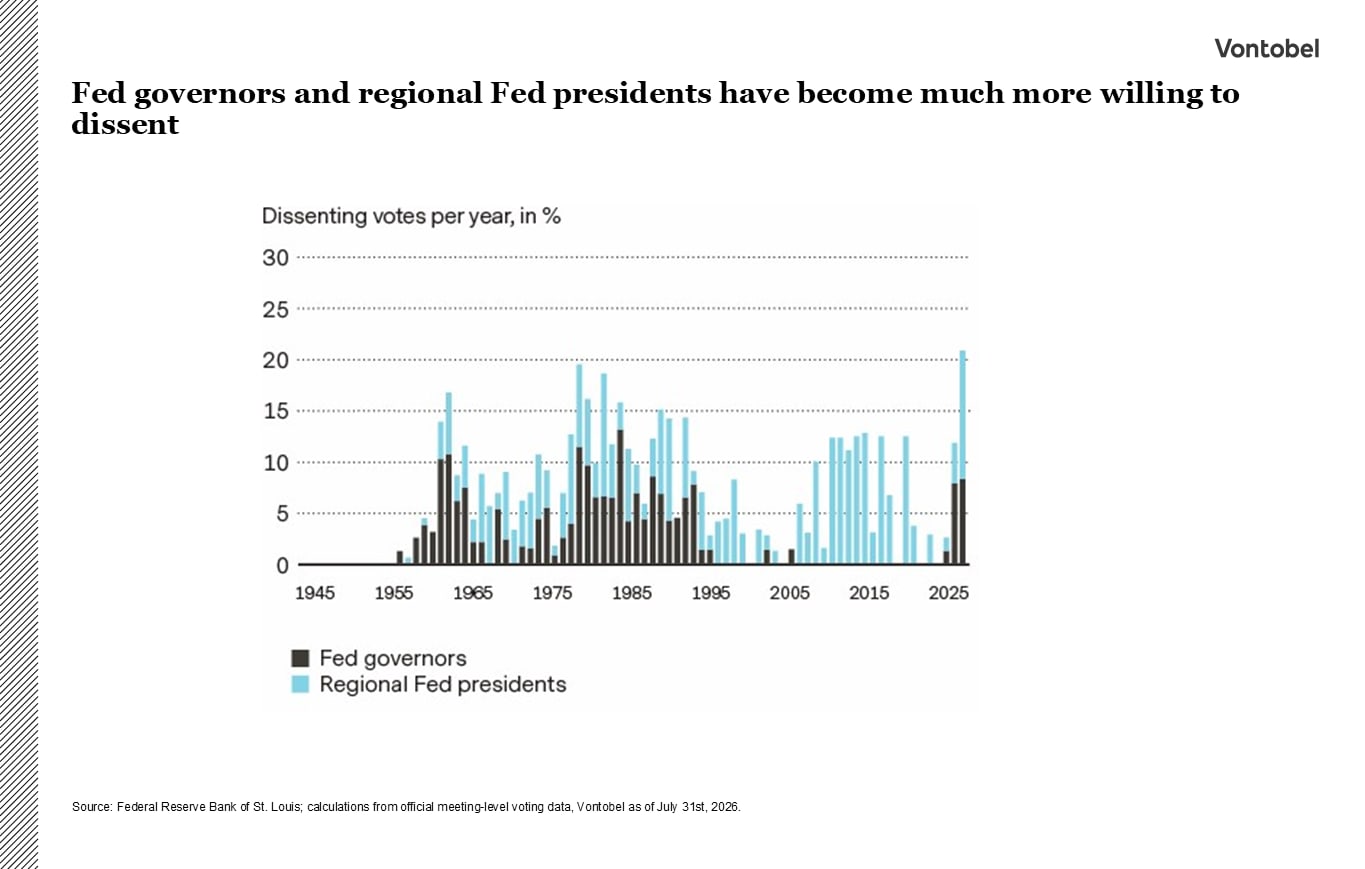
While Warsh casts himself as an agent of change, significant constraints are likely to limit his ability to remake the Fed in his image. First, monetary policy is not a one-man show. The Fed chair cannot govern by decree but must build consensus among the 11 other members of the FOMC. The July meeting underscored just how fraught the internal debate has become, with three policymakers dissenting from the decision to hold rates steady.
Second, draining liquidity from financial markets that have grown accustomed to abundant central-bank support is easier said than done . In 2013, then-Fed Chair Ben Bernanke’s suggestion that the central bank might begin tapering its asset purchases triggered the so-called taper tantrum, sending Treasury yields soaring and sparking capital outflows from emerging markets. Six years later, strains in US funding markets caused overnight repo rates to surge unexpectedly, forcing the Fed to intervene with large-scale liquidity injections. More recently, the collapse of Silicon Valley Bank in March 2023 showed how quickly financial stress can surface when higher interest rates expose vulnerabilities built up during long periods of monetary accommodation.
Third, Warsh must contend with the demands of an often-impatient White House. Although Donald Trump has publicly pledged to respect Warsh’s independence, the president has a long record of publicly pressuring the central bank. Jerome Powell repeatedly found himself in Trump’s crosshairs over interest-rate policy, and there is no guarantee that Warsh will be spared should the Fed fail to deliver the rate cuts Trump is seeking.
Yet constraints are not the same as irrelevance. Even if Warsh is unable to fully deliver on his vision, a shift at the margin in the Fed’s reaction function could still carry meaningful consequences for financial markets. Perhaps the most important implication for investors is that the famous Fed put, the belief that the central bank will ease monetary policy to support equity markets during sell-offs, effectively providing investors with a downside safety net, may become less dependable. A Fed that places greater weight on price stability would likely be less inclined to cushion every bout of market volatility, especially when inflationary pressures remain elevated.
The Fed is probably not just going to stand idly by in a financial crisis. If push comes to shove, it would still act as a backstop. But the bar for intervention could be higher, making policy support less automatic and increasing the importance of market fundamentals and active management.

Another consequence could be the return of a more meaningful term premium. Years of quantitative easing compressed long-term yields by reducing the compensation investors demanded for holding long-duration government debt. While practical constraints limit the speed of balance-sheet reduction, a Fed less willing to suppress long-term yields would generally leave private investors to absorb a larger share of Treasury duration risk. To be sure, the Treasury could partially offset such a shift through its issuance strategy, for example by relying more heavily on short-term bills and less on long-dated bonds. However, absent a complete offset, the balance of risks would still point to upward pressure on term premiums. Their eventual path will also depend on factors such as inflation expectations, inflation uncertainty, fiscal dynamics, and investor demand for safe assets. If a more disciplined Fed succeeds in anchoring inflation expectations, some of the upward pressure on term premiums could be offset. Even so, the overall outlook points to a higher equilibrium level for long-term yields, a steeper yield curve, and renewed focus on duration risk.
A Fed that prioritizes price stability should, in theory, be supportive of the US dollar and less favorable for non-yielding assets such as gold. In practice, however, the picture is more nuanced. A leaner Fed, if taken too far, could weigh on economic growth and weaken the dollar. Moreover, the Fed rarely operates in isolation.
Other major central banks are unlikely to stand idly by, meaning that relative policy decisions, rather than Fed policy alone, will continue to shape currency markets.
Warsh has repeatedly stressed that his critique comes from a place of admiration rather than antagonism. Reflecting on his G30 speech months later, he described it as “a love letter more than a cold critique”. He explained: “It’s a love letter because, if the institution can reform itself, there can be great things for both the institution and the country.”
Warsh has delivered his love letter. Now he must find out whether the recipient loves him back enough to change.

The Fed’s center of gravity tilts hawkish
Markets entered 2026 expecting Fed easing, but year-end policy expectations have moved decisively higher as inflation has stayed above target and the FOMC has turned more hawkish.
The July meeting made that change clear. Three policy-makers voted for an immediate 25-basis-point hike and several others signaled that tighter policy could be appropriate if disinflation stalls. More important than the dissent is the broader movement of the FOMC’s center of gravity: the debate is increasingly about when, and under what conditions, another hike might come. Chair Warsh’s reduced emphasis on forward guidance has also added to uncertainty around the policy path. Long-dated Treasury yields have risen amid higher expected policy rates, a larger term premium, heavy Treasury supply, and fiscal concerns. Long-term inflation expectations are comparatively anchored, suggesting investors are demanding more compensation for uncertainty, while confidence in the Fed’s credibility appears intact. Inflation is still the key consideration as the Fed weighs stubborn price pressures against a softening labor market.
Heavy supply in investment grade, low duration in high yield
US investment-grade issuance has passed USD 1.5 trillion year-to-date, ahead of the same point in 2020, the record year for supply. Hyperscalers make up a growing share as investment in AI and data centers drives funding needs. Demand has kept pace, but the steady flow of new debt has required greater new-issue concessions and weighed on parts of the technology sector. Large AI-related commitments point to more funding needs ahead, suggesting supply pressure could remain important even as balance sheets stay strong.
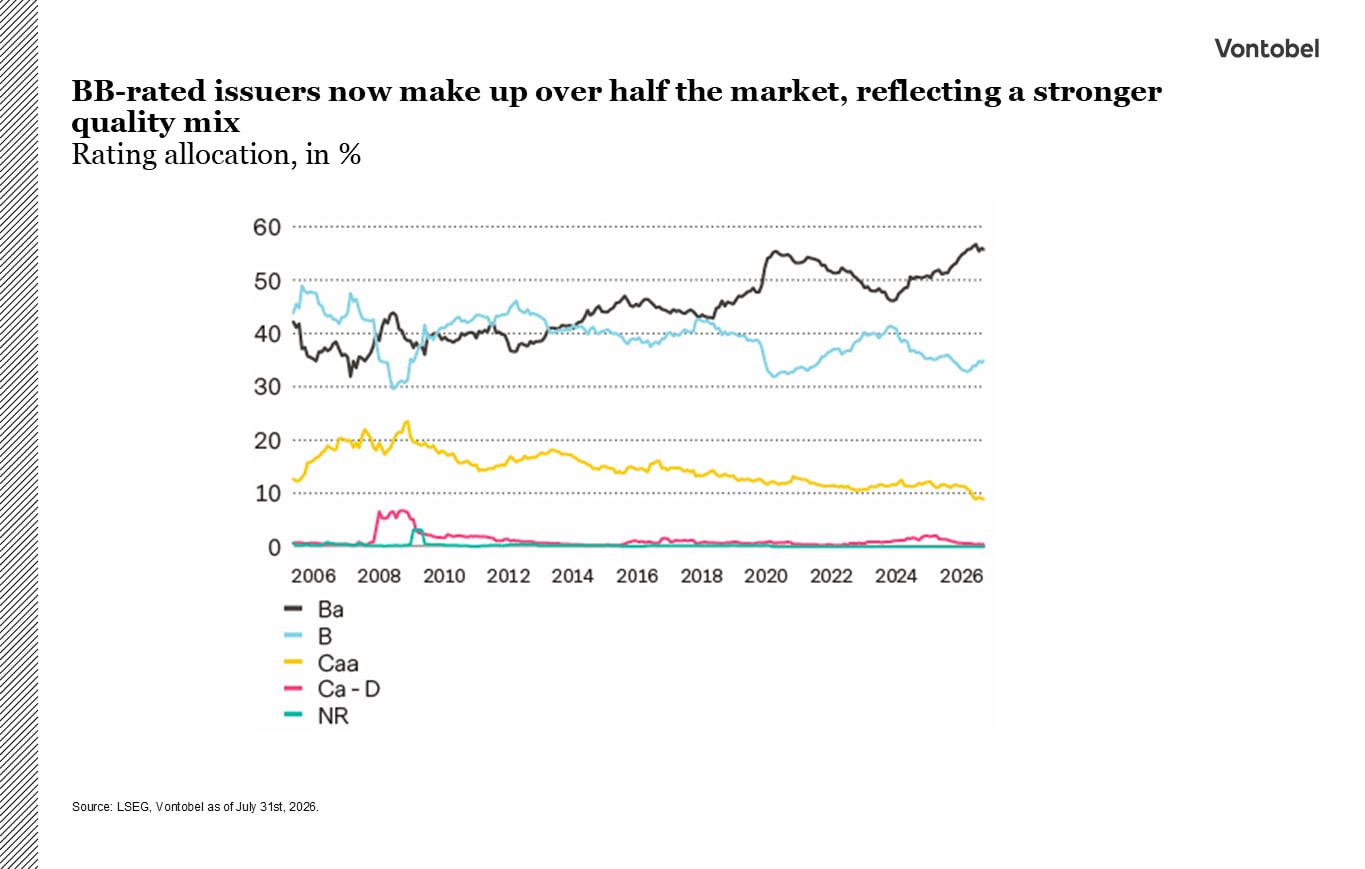
In high yield, spreads remain historically tight, but the market’s underlying quality has improved materially. BB-rated issuers now account for more than half of the index, high-yield issuers can tap the primary market with ease, and all-in yields are high by historical standards. Shorter duration also makes high yield less sensitive to moves in long-dated government bond yields. In fact, high-yield investors remain exposed to very little interest-rate risk by historical standards, with duration close to its lowest level in 15 years, although it was even lower at the end of last year. Coupled with better credit quality, that leaves income as an important return driver, even without further spread compression.
Equities’ summer storm
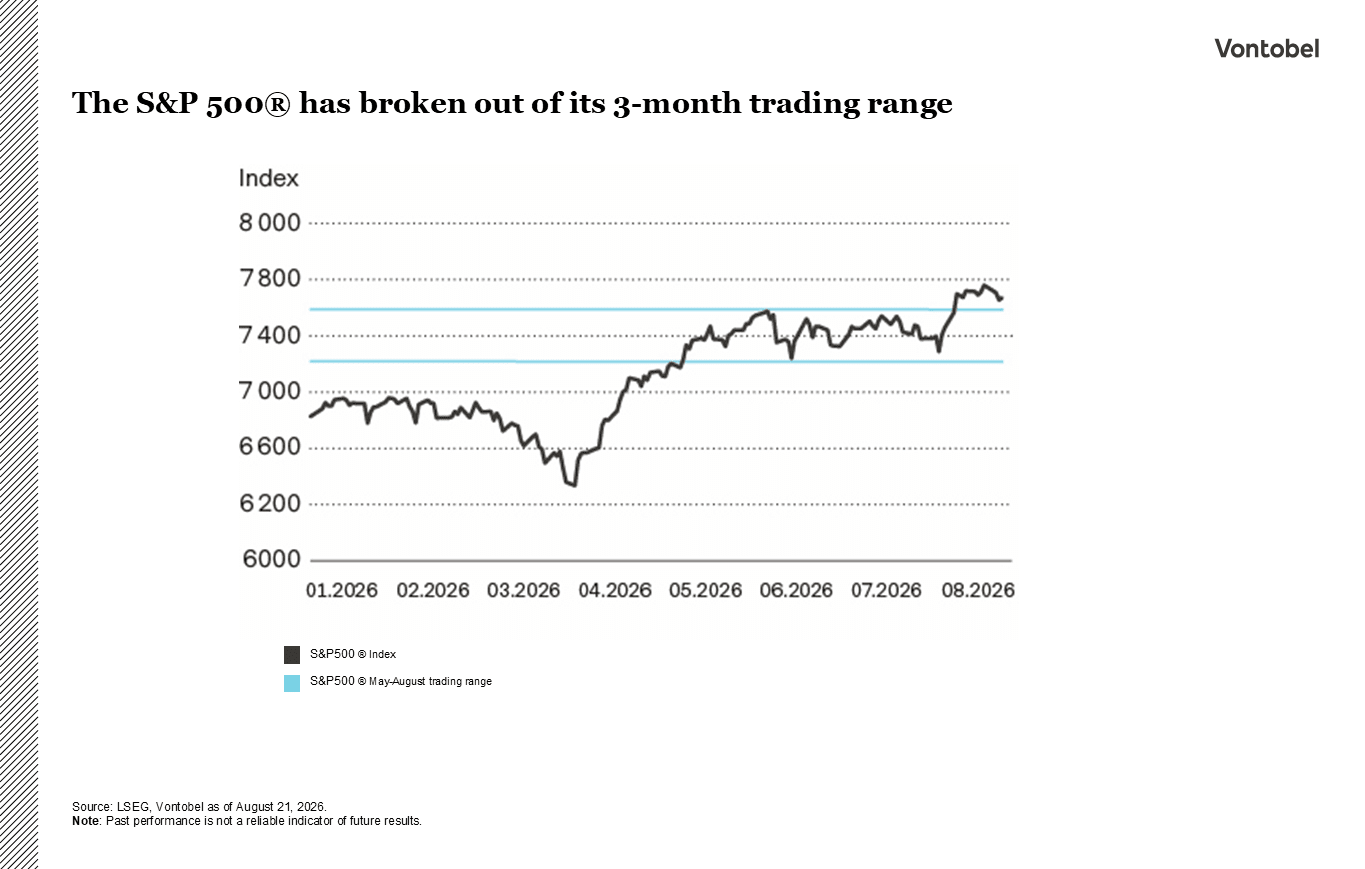
Global stocks traded sideways through June and July, with the technology sector giving back early gains as a sell-off swept through semiconductors. Then, in August, markets staged an impressive comeback, breaking out of that range and pushing back toward new highs.
Investors faced three main challenges in quick succession in the early summer months. First, positioning in chip-makers had become extremely crowded after a strong run, and the unwind was exacerbated as leveraged positions in South Korea were cut. At the same time, breakthroughs in AI in China revived a broader debate over the returns on the vast amounts of capital being poured into AI. Second, oil prices jumped back toward USD 100 per barrel in mid-July as tensions between the US and Iran flared again, fanning fears that inflation could reaccelerate. Third, those inflation risks led markets to price in a tighter path for Fed policy.
Some of these concerns eased over the course of August. The unwind in chip stocks appears to have run its course. The standoff in the Strait of Hormuz remains unresolved, but oil prices have stayed contained. While Fed Chair Warsh’s comments at the Jackson Hole symposium were more hawkish than expected, the bar for a Fed hike likely remains high.
The second-quarter earnings season provided further support, delivering about 50 percent earnings-per-share (EPS) growth, the strongest quarterly profit growth out-side of a post-recession recovery. It also confirmed that the AI cycle remains firmly intact. The “Big Four” hyperscalers rose around 10 percent as a group in July after reporting earnings. The key takeaway was computing demand, which remains exceptionally strong, while supply is still constrained. Order backlogs grew for another quarter, keeping capital expenditure elevated and revenue visibility high into next year. Perhaps the clearest evidence that AI spending is translating into revenue came from unexpected cloud growth of around 45 percent year-over-year , along with expanding margins.
But importantly, the strength was not confined to technology. Earnings surprises were broad-based across sectors, suggesting corporate profitability is improving across a wider swath of the market and providing a healthier, more durable foundation for equities.

When Bad News Is Good News
Gold bulls had a difficult year. After surging to record highs in the opening months of 2026, the metal spent much of the following months trapped in a prolonged and frustrating slump. Relief finally came with a series of weaker-than-expected economic data, lending credence to an old market adage: bad news for the economy is often good news for gold.
The weakness stemmed from an unusual mix of macro forces. As the Iran war escalated and oil prices surged, markets began pricing in a more hawkish Fed. Nominal Treasury yields rose faster than inflation expectations, pushing real yields higher. For gold, a non-yielding asset, that increases the opportunity cost of holding the metal. A stronger US dollar added another headwind, making gold less attractive for international buyers. Speculative investors unwound gold positions, triggering outflows from futures markets and gold-backed ETFs. Official-sector support also softened, with several central banks, including Russia and Turkey, reportedly selling gold to support their currencies and meet fiscal needs.
Sentiment began to turn in August. Softer-than-expected US macroeconomic data eased concerns about a more hawkish Fed and weighed on the US dollar. At the same time, growing concerns over fiscal sustainability and debt dynamics boosted gold’s appeal as a store of value. Central-bank buying continued too, with the People’s Bank of China purchasing a net 20 tons in July, and some investors returned to gold ETFs.
Fed policy is poised to remain the key cyclical driver. If markets price out further rate hikes and the prospect of rate cuts eventually grows, real yields would likely move lower and revive demand for gold through ETFs and physical bullion. Central-bank demand is also likely to continue to lend support. But after years of exceptionally strong purchases and significant reserve diversification, sovereign buying may struggle to match the record levels seen recently. While this does not imply the trend is reversing, it may leave private investors with a larger role in supporting prices, making the outlook for interest rates and real yields even more important.
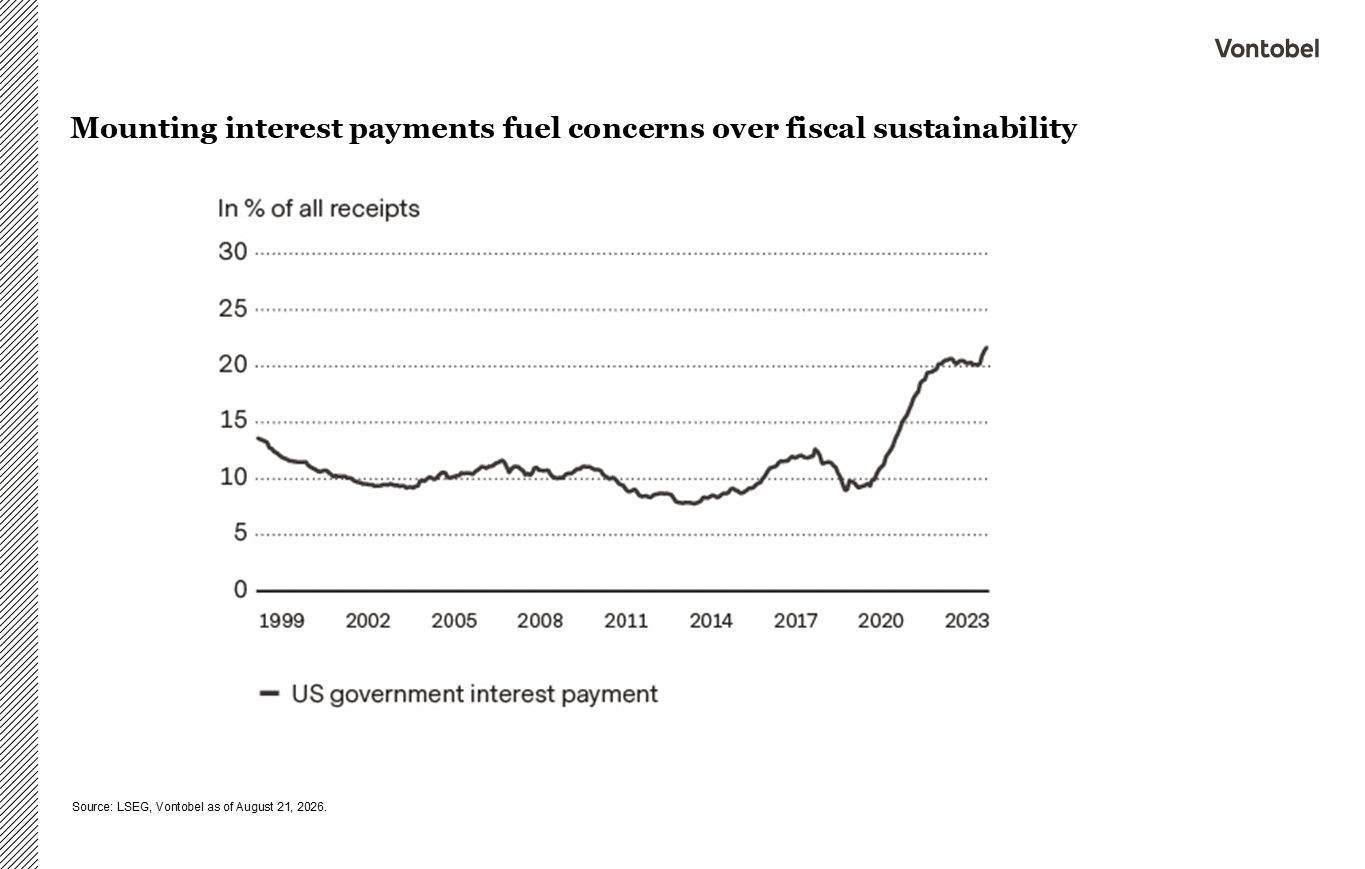
Beyond the cyclical outlook, fiscal and debt dynamics, particularly in the US, remain a key pillar of gold’s long-term investment case. Persistent budget deficits, rising debt-servicing costs, and questions over the sustainability of the US fiscal trajectory could erode confidence in fiat currencies and strengthen gold’s role as a store of value. Together with the gradual fragmentation of the dollar-centric financial system, these forces continue to provide a supportive structural backdrop.

Rates only tell half the story
The global rates picture has changed considerably since the end of 2025. Markets had been pricing in widespread rate cuts across developed economies, but those expectations have since reversed, with several central banks moving toward renewed tightening. This has generally helped currencies where relative carry has improved, with Australia, Norway, and New Zealand among the clearest examples.
But higher rate expectations have not helped every currency. The euro and sterling have lagged even as expectations have turned more hawkish, with the European Central Bank already raising rates and the Bank of England yet to do so. Fed rate expectations have also moved higher. In Europe and the UK, the prospect of tighter policy reflects renewed inflation pressure rather than stronger growth. Higher rates alone, whether anticipated or delivered, don’t necessarily make a currency more attractive. The reason rates are rising and what it means for relative growth and carry all play a role.
A little less dollar?
Reserve managers are starting to trim their dollar exposure. For the first time in three years, central banks surveyed by OMFIF20 say they expect to reduce their long-term dollar exposure, while increasing allocations to the euro and renminbi. Public pension and sovereign wealth funds are doing the same, which indicates that geopolitical considerations are becoming more important for currency exposure decisions alongside interest-rate differentials.
The change is gradual. The dollar still accounts for around 57 percent of global foreign-exchange (FX) reserves, and reserve managers expect its share to decline only to roughly 52 percent over the next decade. Its liquidity, market depth, and safe-haven role are unmatched, and neither the euro nor the renminbi offers a full alternative. In the near term, higher Fed rate expectations and geopolitical uncertainty are likely to support the dollar. Over the longer term, valuation, fiscal concerns, and a more diversified reserve system argue for a less one-sided picture. For the euro, we see some further near-term vulnerability. Relative rates have moved back in favor of the dollar, while higher energy prices are a particular problem for Europe because they make imports more expensive and weigh on growth. Over the medium term, stronger investment and greater fiscal support will likely be more supportive of the euro. The franc continues to benefit from safe-haven demand, but very low inflation, a sizeable rate disadvantage, and the risk of Swiss National Bank resistance to excessive appreciation could limit its upside.

