The «Moat» in the Age of Artificial Intelligence


Hardly any other technology is currently transforming everyday life and business models as fundamentally as artificial intelligence (AI). It writes code, generates analyses and takes on tasks that previously required entire teams. While some companies are feeling the impact less, others are faced with the need to rethink their business models. The difference often comes down to a single concept: the economic moat.
When AI Changes the Moat
AI is fundamentally changing the competitive landscape of the global software industry. What sounded like a distant dream just a few years ago is already a reality today: AI independently answers inquiries, generates analyses, and writes code. These are tasks that used to require entire teams. The speed at which this development has unfolded has surprised even many experts.
The first effects are already evident in the job market. For example, employment among young software developers aged 22 to 25 has declined by nearly 20 percent since 2024 (Stanford HAI, 04.2026). This has primarily affected those just entering the workforce, rather than the software industry as a whole.
But it’s not just the job market that’s changing. Capital markets are also beginning to price in the potential consequences of AI for the industry. The software sector’s share of the MSCI® World’s global market capitalization has now fallen by about three percentage points. Among other factors, this reflects investors’ concerns that the multi-billion-dollar investments by hyperscalers such as Alphabet or Microsoft might not fully pay off and that AI could put the traditional software business under fundamental pressure (Focus Money, 03.2026).
The most relevant question is: Which business models are capable of defending their competitive advantages even in the age of AI? This is because some business models, which were still considered structurally well-protected just two years ago, are coming under increasing pressure from AI-native alternatives, agent-based automation, and rapidly changing sales and distribution structures (Divizend, 02.2026).
However, it is not yet possible to definitively assess the extent to which this development will actually affect individual companies. The World Economic Forum in Davos expects up to 92 million jobs to be lost worldwide by 2030, but also anticipates the creation of 170 million new jobs (World Economic Forum, 2026).
One thing, however, is already clear today: the transformation driven by AI does not affect all companies and business models equally. While some will have to undergo fundamental changes, others will be able to hold their own to a large extent.
The difference often lies not in the industry itself, but in the resilience of the business model, and thus in its «economic moat».
Not all «moats» are the same
This is precisely where one of the most significant reassessments of competitive advantages in recent years comes into play. Morningstar analyzed the «economic moats» of 132 companies. For 22 companies, their «wide moats» were downgraded to «narrow moats» and for two of them, even to «no moat». Companies in the payroll, IT services, and enterprise software sectors were particularly affected, business models in which a significant portion of value creation relies on human labor and repetitive, automatable tasks. These industries are therefore especially vulnerable to automation.
At the same time, the analysis shows that the impact of AI is by no means the same for all companies. Companies with their own data, strong network effects, or a strategically important infrastructure position were even able to improve their ratings (Morningstar, 03.2026). The asset manager Sparkline Capital also paints a nuanced picture: Companies that adopt AI early and consistently, while also possessing competitive advantages that are difficult to replicate, are more likely to be among the winners than the losers (Sparkline Capital, 05.2026).
Thus, AI is not only changing competition among companies; it is also changing the companies themselves. One aspect is often overlooked in the public debate: Many companies are specifically using AI to make their own structures more efficient. Meta, for example, announced a restructuring in 2026: part of the workforce will be reassigned to new AI teams, while another part will be laid off. According to an internal memo, this affects about 20 percent of employees in total (Fox Business, 05.2026). The payment service provider Block took a similar approach and reduced its workforce by about 40 percent, citing the growing capabilities of AI tools (CNN Business, 02.2026).
Whether such changes will actually translate into higher margins in the long term and result in sustainably better returns cannot yet be conclusively assessed. However, these examples highlight a crucial trend: Companies are not merely potential victims of AI disruption. They can leverage AI themselves as a strategic tool to strengthen their existing competitive moat or create a new one. Morningstar analysts even reached the opposite conclusion for companies such as Cloudflare and CrowdStrike compared to the downgrades mentioned at the beginning: Their network and data advantages were upgraded as part of the reassessment (Morningstar, 03.2026).
The Solactive AI Disruptive Moat Index
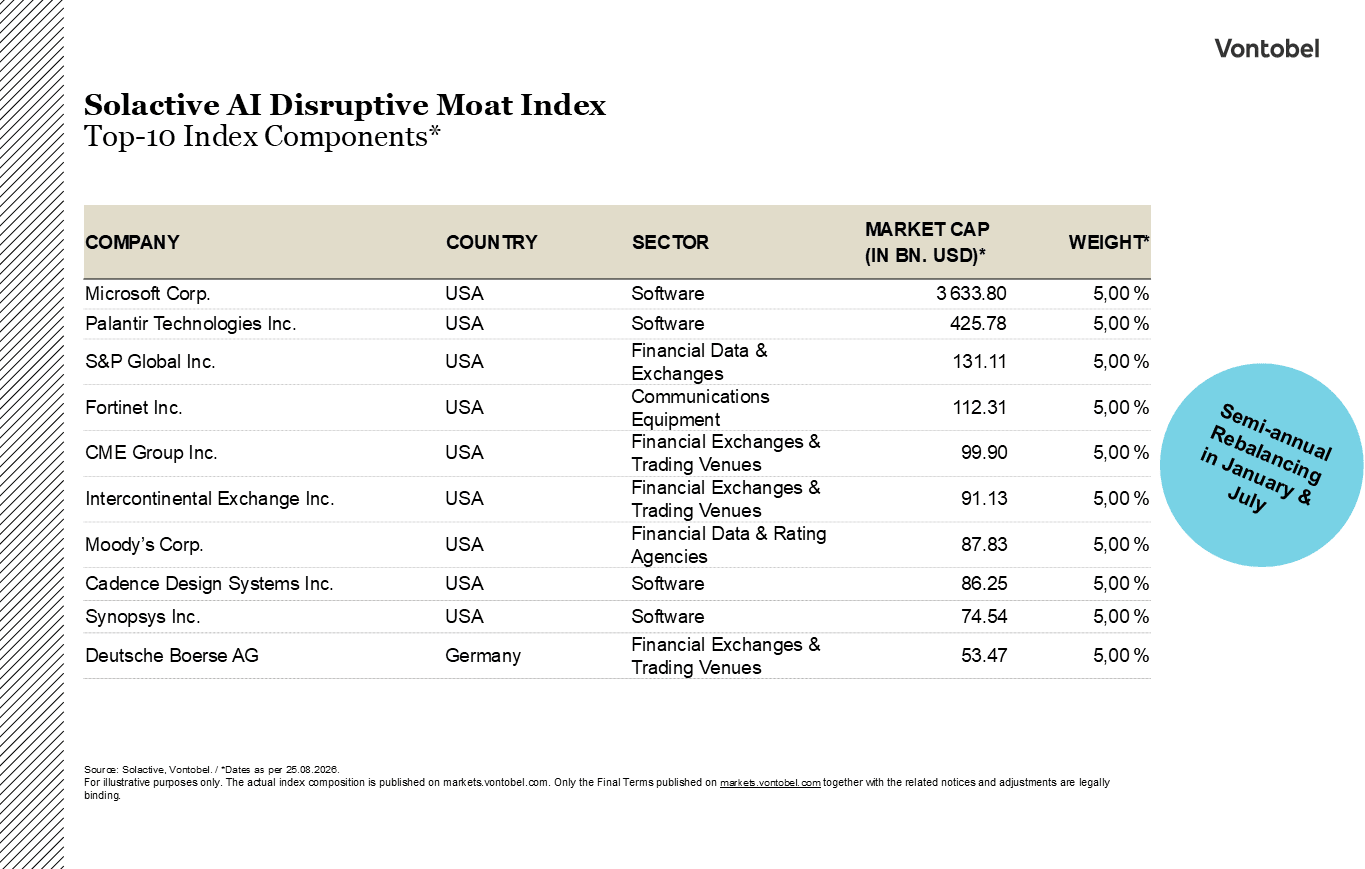
For investors, the tracker certificate based on the Solactive AI Disruptive Moat Index could offer an opportunity to participate in the performance of companies with structural resilience to AI disruption. Rather than relying on the performance of a single company, the certificate tracks a diversified portfolio of 20 companies whose business models demonstrate structural resilience to disruption caused by AI. The selection is made based on rules from sectors such as Internet software and services (Internet Software/Services), packaged software (Packaged Software), investment banks and securities brokers (Investment Banks/Brokers), financial publishing and financial services (Financial Publishing/Services), data processing services (Data Processing Services), and IT services and technology (Information Technology Services).
For inclusion, both a thematic score (Thematic Score) and a financial score (Financial Score) are evaluated. The Thematic Score is based on a proprietary model comprising six dimensions. It contrasts a company’s exposure to AI-driven disruption with its structural protection and maps this on a scale from 0 (high protection) to 100 (high exposure). The Financial Score assesses fundamental quality based on free cash flow, revenue growth, R&D expenditures, profit margin, and cash position. By combining both factors, the index aims to identify companies that combine structural resilience to AI-driven disruption with solid fundamental quality characteristics. The assessment of resilience to AI-driven disruption is based on a rule-based model and the underlying assumptions of the index methodology. The actual performance of individual companies may differ from these assessments.
Another key feature of the index is the equal weighting of all index constituents. This gives small and medium-sized companies a comparable influence to that of established market leaders, although this may also be accompanied by higher potential volatility from smaller companies. The performance of the index companies does not depend solely on their positioning with regard to AI. General market valuations, the interest rate environment, operational developments, and industry-specific risks can also play an important role. The index composition is reviewed and adjusted semiannually, in January and July.

Tracker Certificate
A Look Ahead
It is not yet possible to definitively predict the extent to which AI will transform the software industry and the valuation of individual companies in the long term. What is clear, however, is that this technological shift will not be limited to individual products or processes. It is increasingly altering the fundamentals of competition and, with that, the question of how sustainable a competitive moat actually is. In its analysis of 132 companies, Morningstar concludes that AI does not universally destroy existing competitive advantages, but rather distinguishes between business models with high and low resilience (Morningstar, 03.2026).
For investors, therefore, the decisive question is likely not so much whether AI will transform an industry, but rather which companies are capable of turning this transformation into a long-term competitive advantage. This is precisely where the central challenge for the coming years lies: Not every moat will survive the transformation, and not every new moat is already recognizable today. The Solactive AI Disruptive Moat Index offers an approach to systematically capture this change and evaluate companies based on how resilient their competitive advantages are against AI-driven disruption (Solactive, 2026).
Ultimately, therefore, it will not be enough to simply be the first to adopt AI. What will matter is who can turn it into a lasting competitive advantage.