Rocket Lab: A Beneficiary of the New Space Age?


Space exploration is no longer the exclusive domain of governments and space agencies. More and more private companies are entering a market characterized by satellite communications, Earth observation, and technological innovations. One company which is attracting particular attention in this field is Rocket Lab.
Rocket Lab was founded in 2006 and specializes in launching small satellites. With its «Electron» launch vehicle, the company is now one of the few private providers worldwide capable of regularly and successfully launching satellites into space. As a result, Rocket Lab has secured a firm foothold in a market that is growing steadily due to the rising demand for satellite services.
A key driver of growth is the increasing importance of satellites for communication, navigation and data analysis. Companies, governments, and research institutions need more and more satellites to build global networks and utilize information in real time. Rocket Lab benefits from this trend because the Electron rocket was specifically designed for smaller and more frequent missions. This allows customers to operate with greater flexibility than with the large consolidated launches offered by other providers.
In addition to its traditional rocket launch business, Rocket Lab is pursuing another exciting strategy. The company is increasingly evolving into an integrated space conglomerate. It not only provides transportation to space but also manufactures key satellite components and offers comprehensive space services. This diversification could lead to more stable revenue in the long term and reduce dependence on the launch business alone.
The development of the new «Neutron» rocket offers additional potential. It is designed to carry larger payloads and give Rocket Lab access to a significantly larger market. If this project is successfully implemented, the company could further strengthen its competitive position. Investors are therefore closely monitoring whether the development stays on schedule and within budget.
Despite the attractive growth prospects, the risks should not be underestimated. The space industry is capital-intensive, technically demanding, and highly competitive. Delays in rocket development, technical problems, or a more challenging financing environment could weigh on business performance. Furthermore, Rocket Lab competes with well-funded companies and established space providers.
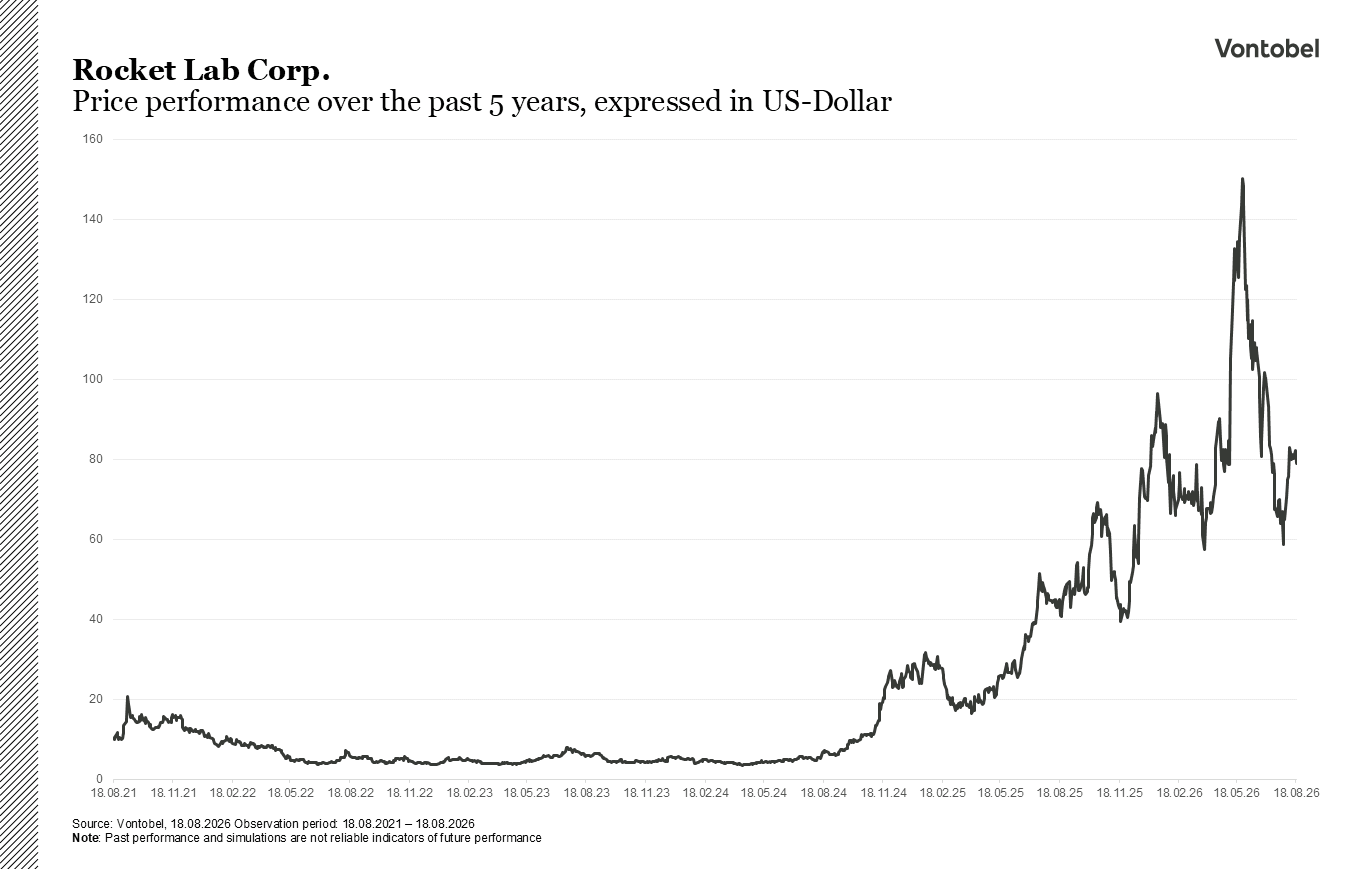
For investors who believe in the long-term growth of commercial spaceflight, Rocket Lab may therefore be an interesting stock to watch. The company combines an already established business model with the opportunity for further growth through new products and services. At the same time, the stock remains susceptible to volatility due to high expectations and the dynamic market environment.
When it comes to direct investments, some investors also consider leveraged products such as Constant Leverage Certificates (CLCs). These allow investors to participate in the daily performance of an underlying asset using a constant leverage (factor). As a result, both gains and losses can be disproportionately larger than with a direct investment. With high leverage, even small price movements in the underlying asset can lead to significant losses, including the total loss of the invested capital.
It is also important to note the path-dependent nature of these products: Since the daily performance of the underlying asset is leveraged, the long-term performance of a CLC cannot be simply determined by multiplying the total performance of the underlying asset by the leverage factor. Rather, the actual performance depends on the individual daily returns and their sequence. Constant Leverage Certificates are therefore not suitable for buy-and-hold strategies.