The price of cocoa isn't everything: a sweet business, a harsh reality

Historically high cocoa prices are driving up production costs for the chocolate industry. However, the impact varies depending on the business model: While some manufacturers are barely able to pass on the higher costs, others have more leeway in pricing thanks to their strong brands. For investors, therefore, it is not only the price of cocoa that is relevant, but also the question of which companies are best positioned to pass on the higher costs to their customers.
Cocoa: Between a Record High, a Plunge, and a New Rise
Over the past two years, the price of cocoa has experienced one of the most extraordinary fluctuations among agricultural commodities. By the end of 2024, prices on the New York Mercantile Exchange had climbed to a historic record high of around 11,900 U.S. dollars per metric ton. This was triggered by crop failures in Ivory Coast and Ghana, which led to the largest supply deficit in over 60 years (CNBC, 2024).
Over the course of 2025, this trend reversed significantly: Improved harvest conditions shifted the market into a supply surplus, causing prices to fall sharply and reach a multi-year low in early May 2026 (ING Think, 2025; The Cool Down, 2026). From that low point, the cocoa price—traded in U.S. dollars—has since risen by about 52 percent, recouping some of the previous losses (Investing.com, 2026). Despite this recovery, prices remain well below the record highs of 2024.
The high volatility in the cocoa market illustrates just how heavily supply depends on climatic and geographic factors. The latest jitters stem from warnings by the World Meteorological Organization and the U.S. National Oceanic and Atmospheric Administration (NOAA) about a possible strong El Niño event in the fourth quarter of 2026 (Ad hoc News, 2026). This weather phenomenon could once again put pressure on the cocoa harvest in West Africa and, consequently, on the cocoa processing industry.

Mini Futures on Cocoa Futures
Same Ingredient, Different Recipe
However, the extent to which price fluctuations in the cocoa market affect a company does not depend solely on the price of cocoa. Even for manufacturers for whom cocoa is one of the most important raw materials, higher procurement costs do not necessarily result in an equally high financial burden. Rather, the decisive factor is likely to be the importance of cocoa-based products within the business model and the extent to which rising raw material costs can be offset by price adjustments, efficiency gains, or a broader product portfolio.
Barry Callebaut and Lindt & Sprüngli: Two Swiss Companies with Different Strengths and Weaknesses
Barry Callebaut plays a unique role in the chocolate industry. As one of the world’s largest manufacturers of cocoa and chocolate products, the company primarily supplies industrial customers and brand manufacturers. This makes its business model distinctly different from that of companies that sell their products directly to end consumers (Barry Callebaut, Annual Report 2025).
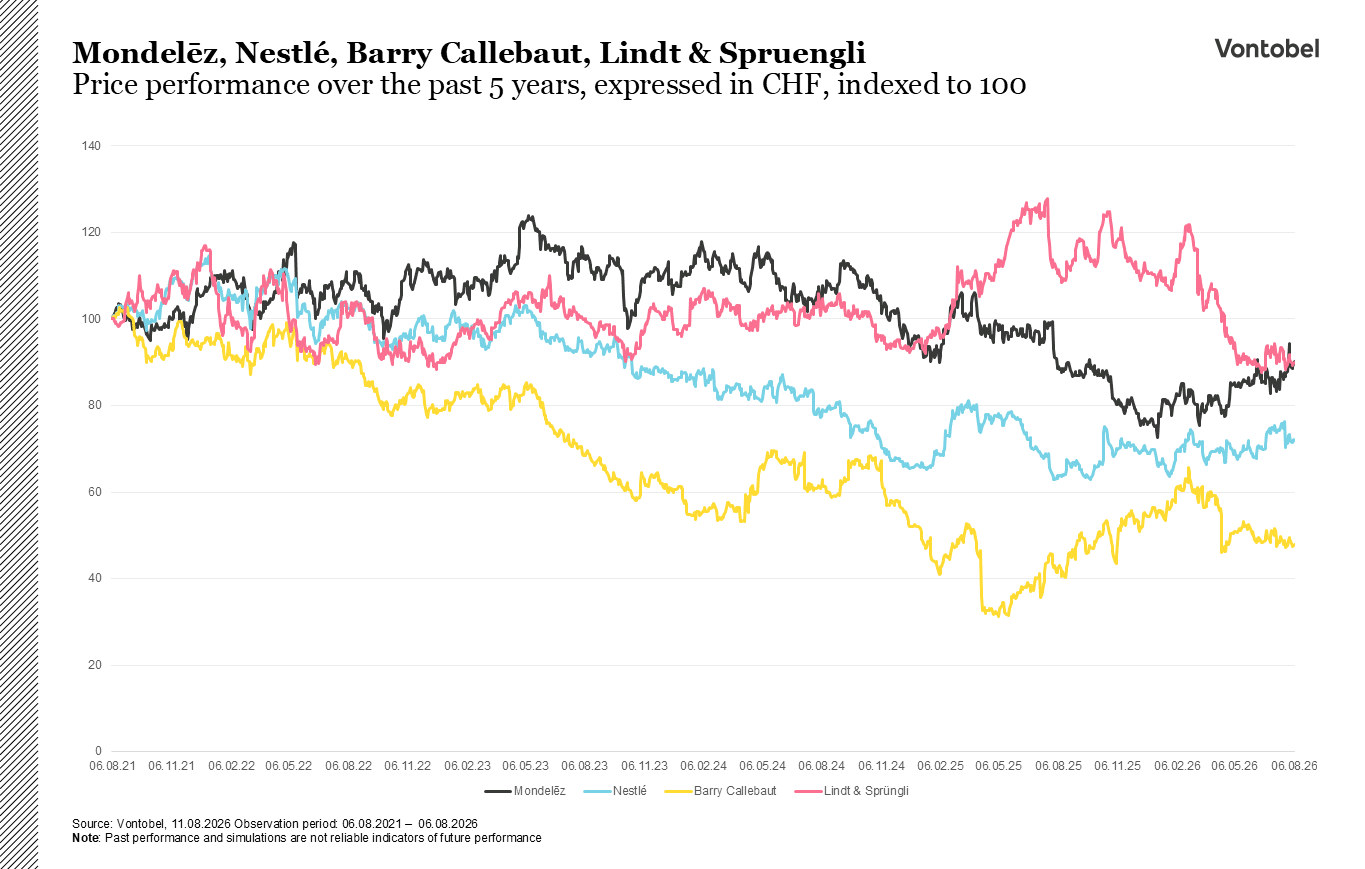
The sharp price fluctuations in the cocoa market have thus brought Barry Callebaut’s business model into sharper focus. To address these challenges, the company has focused on broader geographic diversification of its cocoa sourcing, adapting its procurement processes, and investing in a more robust supply chain. These factors could help better cushion the impact of future market movements and increase the company’s resilience (Barry Callebaut, Annual Report 2025). However, this does not fully resolve the challenges: As a processor with thin margins, Barry Callebaut can only pass on increased raw material costs to customers to a limited extent, which has recently weighed on operating profit. Furthermore, the company itself points out that another strong El Niño event in 2026 and 2027 could once again put pressure on cocoa availability, even though a global supply surplus expected for the current season should provide some relief for the time being (The Cool Down, 2026).
Lindt & Sprüngli, on the other hand, follows a different business model. The Swiss premium manufacturer sells its products under its own strong brand and positions itself in the higher-priced segment of the chocolate market. Since consumers in this segment tend to be less price-sensitive and remain more loyal to the brand, this brand strength could give the company greater leeway in passing on increased costs (Lindt & Sprüngli, Annual Report 2025).
Between Price Pressure and Pricing Power
The latest financial results also highlight how differently the two business models operate.
After a difficult previous year marked by declining sales volumes and significant cost pressure, Barry Callebaut has recently shown initial signs of operational recovery. Profitability, however, remains a challenge. The company continues to expect a decline in operating profit for the fiscal year, which could indicate ongoing margin pressure (FuW, 2026). In particular, the high-margin gourmet division has recently underperformed expectations. Competition in this segment has intensified, which could mean it takes longer to return to higher growth (FuW, 2026).
The stock’s performance also reflects this uncertainty: according to market observers, investors are paying particular attention in the short term to margin risks associated with Barry Callebaut’s B2B model and the company’s ability to pass on increased raw material costs to customers (ad hoc news, June 2026).
Lindt & Sprüngli was able to increase profitability in the first half of 2026—even though higher raw material costs, weaker consumer sentiment, and sluggish Easter sales weighed on revenue. Fewer travelers from Asia and the Middle East, as well as the heat wave, also had a negative impact. The company attributed the increased profitability to strict cost control and efficiency gains. Revenue rose by 4.3 percent, with the growth attributable entirely to higher selling prices and thus coming in weaker than in the previous year (FuW, 2026). In addition, the company announced plans to expand its collaboration with retailers. At the same time, targeted price adjustments and smaller package sizes are expected to help stabilize sales (FuW, 2026).
Diversification as a Competitive Advantage for Global Corporations
The differences between specialized chocolate manufacturers and broadly diversified food conglomerates are also evident on an international level. The key factors here are not only a company’s global presence but, above all, the structure of its business model and its ability to offset fluctuations in individual raw materials.
The Swiss food conglomerate Nestlé, for example, has a highly diversified portfolio with operations in areas such as coffee, pet food, nutrition, and other consumer goods. Chocolate represents only a portion of the group’s overall business. While rising cocoa prices can also lead to higher procurement costs for Nestlé, their impact on the company’s overall performance is relatively limited due to its broad portfolio. Diversification across various product categories and markets can help cushion the impact of fluctuations in individual commodity prices (Nestlé, Annual Report 2025).
The American company Mondelez, on the other hand, is more heavily focused on the global snack and chocolate business. With well-known brands such as Milka, Cadbury, and Toblerone, chocolate is one of the group’s key business segments. Consequently, fluctuations in the price of cocoa have a greater impact on its cost structure than they do for a broadly diversified conglomerate like Nestlé. At the same time, Mondelez benefits from its global presence, extensive procurement networks, and strong brand positioning. These factors enable the company to pass on a portion of the increased raw material costs to consumers through efficiency gains, hedging transactions, or price adjustments. Nevertheless, the company remains more closely tied to developments in the global cocoa market (Mondelez, Annual Report 2025).
Multi Callable Barrier Reverse Convertible
The New Reality of the Chocolate Industry
Persistently high cocoa prices are posing challenges for the entire chocolate industry, albeit to varying degrees. The impact is therefore unlikely to be equally severe for all market participants. While specialized manufacturers may come under greater pressure due to their higher dependence on specific raw materials, companies with established brands, broad diversification, or efficient procurement structures have additional options for cushioning rising costs to some extent.
The price of cocoa alone therefore provides only limited insight into the industry’s future development. The key factor will be how companies organize their supply chains, manage rising costs, and secure their margins in the long term. In an environment of structurally higher commodity prices, the focus should therefore not only be on the development of the cocoa market, but above all on the question of which business models possess the necessary resilience to remain successful even under changed conditions.