How Biosimilars Are Becoming a Growth Driver for Sandoz


Just a few years ago, Sandoz was known primarily as a generic drug specialist. Today, biosimilars are increasingly taking center stage. In the first half of 2026, they emerged as the company’s most important growth driver. While the traditional generic drug business faces price pressure, Sandoz is benefiting from a billion-dollar market that is rapidly gaining importance as numerous patents on biologic drugs expire.
From Generic Drug Manufacturer to Biosimilar Specialist
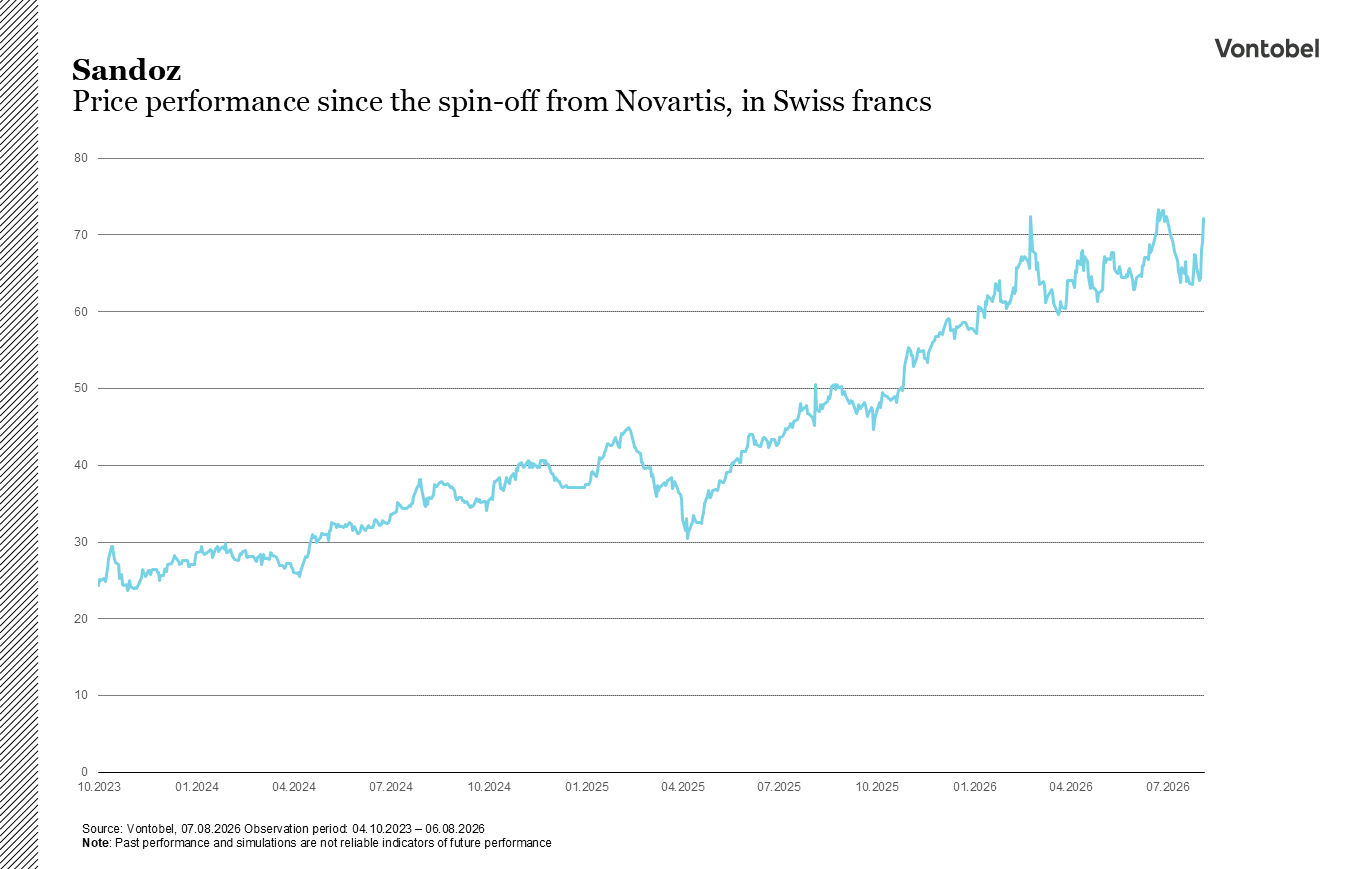
Sandoz has a long history, but until its spin-off from Novartis in 2023, it mostly operated in the shadow of its parent company. As an independent company, the Basel-based firm is pursuing a clear strategy: it aims to maintain its leading position in the generics market while significantly expanding its biosimilars business (Sandoz, Aug. 5, 2026).
Although generics and biosimilars are often mentioned in the same breath, they differ fundamentally. Generics are “copycat drugs” of chemically manufactured medications and can be produced to be virtually identical to the original. Biosimilars, on the other hand, are based on biotechnologically produced drugs. Since they are produced from living cells, they are inherently more complex. Biosimilars are therefore not exact copies; rather, they must demonstrate in extensive studies that they are comparable to the original drug in terms of efficacy, safety, and quality. It is precisely this higher barrier to entry that makes the market attractive. Development is more costly than for traditional generics, yet competition is often less intense. Manufacturers with many years of experience and a global production infrastructure thus have advantages over new market entrants.
The fact that this strategy appears to be paying off for Sandoz is reflected in the latest financial results. In the second quarter of 2026, consolidated revenue rose by 7 percent on a currency-adjusted basis to approximately 3.0 billion U.S. dollars. The biosimilar business performed particularly well, with revenue increasing by 22 percent. The traditional generics business also returned to a path of modest growth after a weak start to the year, posting an increase of 1 percent (Sandoz, August 5, 2026).
Biosimilars are becoming increasingly important
Patents for numerous biologic drugs that have generated billions in revenue are expiring worldwide. Once patent protection ends, competitors can develop comparable products and offer them at lower prices. Health care systems welcome this development because it lowers treatment costs and gives more patients access to modern therapies. For drug manufacturers, this creates attractive growth opportunities. At the same time, development requires significant investments in research, production, and regulatory approval processes. Not every company has the necessary financial and technological resources.
Sandoz is one of the established players in this market. The company now has one of the world’s largest biosimilar portfolios and regularly brings new products to market. Accordingly, their importance within the group is also growing. In the first half of 2026, biosimilars already accounted for 33 percent of total revenue—a new record high. A year earlier, this share was still at 29 percent (Sandoz, August 5, 2026).
North America saw particularly strong growth. There, biosimilar sales rose by 47 percent on a currency-adjusted basis in the first half of the year. Despite regulatory hurdles, the U.S. market is considered particularly attractive, as biologic drugs often command significantly higher prices there than in Europe. Consequently, the potential savings for health insurers and healthcare systems are substantial when more affordable alternatives become available (Sandoz, August 5, 2026).
Growth Meets Challenges
Despite this positive trend, the business environment remains challenging. The traditional generics business has been under significant price and competitive pressure for years. Health care systems are constantly trying to reduce drug costs, causing margins for many manufacturers to shrink. At the same time, production and quality requirements are increasing.
Geopolitical developments could also impact the industry. In the U.S., discussions continue regarding potential import tariffs on pharmaceuticals. For globally active companies such as Sandoz, the specific details of such tariffs would be crucial. Management therefore emphasizes that the impact cannot yet be reliably assessed and is maintaining its previous business outlook (Wall Street Journal, July 22, 2026).
Legal risks are also a factor. It was not until early August that Sandoz reached a settlement with numerous U.S. states in a long-running antitrust case involving the generic drug market. The settlement payments are expected to total $450 million, though the company expressly does not admit to any wrongdoing. According to Sandoz, the settlement affects neither the outlook for 2026 nor the company’s medium-term goals (Reuters, August 3, 2026).
Operationally, however, Sandoz is showing progress. Profitability continued to improve in the first half of the year, and adjusted operating income (core EBITDA) rose by 15 percent to over 1.2 billion U.S. dollars, while the corresponding margin increased to 20.9 percent. At the same time, the company confirmed its full-year forecast (Sandoz, August 5, 2026).
A market with long-term potential
The coming years are likely to be marked by a large number of additional patent expirations for biologic drugs. Some industry observers therefore refer to this as a particularly dynamic phase for biosimilars. This could open up additional market opportunities for established providers, provided they can successfully expand their product pipelines and bring new products to market quickly (Wall Street Journal, August 5, 2026).
Whether Sandoz can fully capitalize on this potential will likely depend on several factors. In addition to successful product launches, regulatory decisions, price trends, and the acceptance of biosimilars among physicians, patients, and healthcare systems will play a key role. At the same time, the traditional generics business remains a significant revenue driver, even if its growth prospects appear more limited. While generics continue to form the foundation, the biosimilars business is increasingly becoming a growth engine for Sandoz.