Optical Networks: A Key Technology of Growing Importance


For decades, copper was the backbone of data centers. Now it’s becoming the bottleneck of the AI revolution. The industry’s response: light instead of electricity. Instead of sending data as electrical signals through copper, the industry is increasingly turning to optical networks that transmit data as light pulses through fiber-optic cables. This enables the fast and energy-efficient exchange of massive amounts of data and makes optical technologies a key requirement for cloud infrastructures and modern AI applications. With the global expansion of this infrastructure, the importance of photonic technologies is likely to continue to grow. A look at the structural growth trend that is rewiring digital infrastructure.
From a Niche Topic to a Cornerstone of AI Infrastructure
A copper cable connecting servers in data centers is reaching a physical limit given today’s data volumes. The more bits per second that are transmitted, the more energy is lost as heat. As transmission rates increase, this effect grows disproportionately. With the rise of artificial intelligence (AI), this very problem has become one of the biggest bottlenecks in digital infrastructure. When training large AI models, tens of thousands of graphics chips must continuously exchange data, pushing the cables between them to their breaking point. The industry is therefore turning to optical data transmission via fiber optics instead of electrical signals. This shift is already well underway: Among optical transceivers, the modules that connect servers and switches in data centers, the share of those with a transmission rate of 800 gigabits per second is expected to rise from 19.5 percent in 2024 to over 60 percent in 2026, according to TrendForce. These forecasts are based on estimates by external market observers. Actual developments may differ from these projections.
Three Stages of a Value Chain
The value chain of optical technology itself can be broken down into three stages: At the very beginning are basic photonic components such as lasers, modulators, and photodiodes, which generate light signals and make them readable. Building on this, transceivers and optical modules follow, which convert between electrical and optical signals and thus serve as the link between servers. The third stage comprises complete network systems that enable telecommunications providers and hyperscalers—that is, large corporations such as Amazon, Microsoft, or Google, which operate vast cloud and data center capacities, to transmit large volumes of data over long distances.
How Demand Is Reflected in Course Enrollment
These market dynamics have become clearly visible on the stock market. Hardly any other segment of the broader technology market has shown such strong price performance in recent quarters as optical stocks, driven by companies that have already been able to back up their growth promises with hard numbers.
According to a press release dated May 5, 2026, Lumentum reported revenue of $808.4 million in the third fiscal quarter of 2026, a 90 percent increase over the previous year, supported by an order backlog for optical switching systems exceeding $400 million (Lumentum Holdings, press release, May 2026). Japanese fiber-optic manufacturer Fujikura is also benefiting from the boom: Driven by demand for optical cables for AI data centers, revenue rose by 20.7 percent in the fiscal year ending in March 2026, according to Fujikura (annual financial statements, May 2026), and operating profit by as much as 39.2 percent—marking the fifth consecutive record year. The stock had multiplied in value over the previous two years, albeit with significant corrections along the way (Reuters, 2025). Applied Optoelectronics, in turn, reported revenue growth in the first quarter of 2026 for the fourth consecutive time—a 51 percent increase over the previous year—driven primarily by growth in the data center business (Applied Optoelectronics, press release, May 2026). Individual stocks in the sector recorded substantial price increases at times. However, the performance of individual companies can be subject to significant fluctuations and does not allow for conclusions about future developments. What is striking about these examples is that several companies were able to report actual revenue growth.
However, just how quickly this picture can take a turn for the worse was demonstrated only recently: Within a few trading days, stocks such as Applied Optoelectronics and Lumentum gave back a portion of their previously achieved price gains, after a general phase of risk aversion set in across the semiconductor markets, even though there had been no negative company-specific news (24/7 Wall St., 2026).

Technological Leaps as Drivers of Growth and Their Risks
Another growth driver for the optical industry is the ongoing shift toward ever-higher transmission standards. Following the widespread adoption of 400G systems, the next stage of expansion is now gaining traction.
800G modules currently represent the industry standard in large AI data centers. However, even this capacity appears to be reaching its limits. For the further development of the optical networking industry, one question is therefore likely to be decisive: What comes after 800G?
The answer is already taking shape: the transition to 1.6-terabit transmission standards—twice the speed of 800G. This new standard is already in the qualification phase at several hyperscalers, meaning they are currently testing it in their own data centers before it is deployed on a large scale. If this process goes as planned, it could lead to higher demand for the corresponding network components (Dataintelo, 2026).
At the same time, so-called co-packaged optics are coming to the forefront. In this approach, the optical components are no longer placed as separate plug-in modules but are positioned directly next to the computing chip. This approach could be seen as a logical next step, as it would further reduce energy consumption per transmitted bit by a noticeable margin. This is an aspect that is likely to gain importance given the enormous power requirements of data centers. Every technological leap could increase the demands placed on optical modules, transceivers, lasers, photonic chips, and network components. Companies along the entire value chain could thus benefit from recurring investment cycles. Whether and to what extent this will result in economic advantages, however, depends on numerous factors.
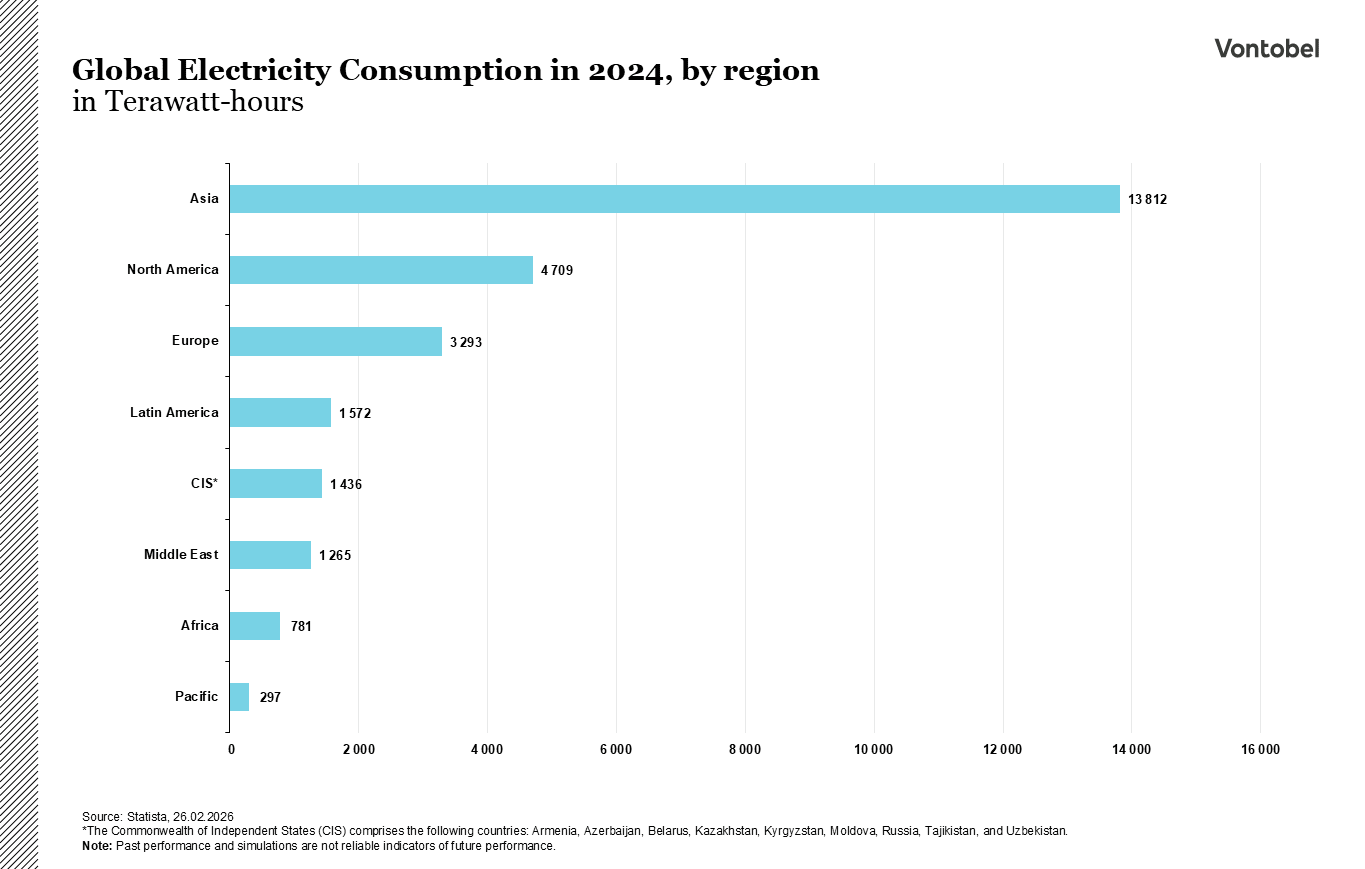
Regional electricity consumption illustrates just how unevenly global energy demand is distributed even today: In 2024, Asia, at around 13,812 terawatt-hours, was well ahead of North America and Europe, at 4,709 and 3,293 terawatt-hours, respectively (Statista, 2026)—precisely where a large portion of the new data center capacity is being built.
However, these potential opportunities are offset by real risks. On the supply side, shortages of upstream components such as indium phosphide lasers are seen as a potential bottleneck that could slow the industry’s scaling. Added to this is a certain degree of customer concentration: Many companies depend on a manageable number of large hyperscaler customers, which makes individual stocks vulnerable to shifts in those customers’ investment plans. Visibility into short-term revenue trends is also limited, as a significant portion of the order backlog is not scheduled to be fulfilled until the coming fiscal year. Should the fulfillment of the order backlog be delayed, this could weigh on market expectations.
The Solactive Optical Networks Technology Index
Investors who wish to participate in this growth without committing to specific stocks may find a suitable investment option in a certificate tracking the Solactive Optical Networks Technology Index: From the three stages of the value chain described above, the index uses a text-based analysis method called ARTIS to select the 15 most relevant companies and weights them based on free float, with a 20 percent limit on any single stock (Solactive, 2026). These 15 companies cover the three stages of the value chain described above, ranging from photonic components to transceivers to network systems.
Two Perspectives on the Same Trend
For investors looking into this sector, the primary question is likely not whether the underlying demand for optical connectivity will continue to grow. Both technical arguments and the historical financial results of the index’s heavyweights support this view. Rather, the focus is likely to be on how evenly this growth is distributed and how resilient the supply chains for photonic components actually are. It also remains to be seen how quickly the cloud providers’ announced investments will translate into usable capacity and whether the industry can manage this transition without major bottlenecks.

