Swiss Industrial Champions and the Hidden Strengths of the Swiss Industrial Sector


When people think of Swiss publicly traded companies, pharmaceutical companies or banks often come to mind. Less in the spotlight are numerous industrial companies whose products are used in data centers, semiconductor factories, logistics centers, and production facilities around the globe. Many of these companies are among the leading providers in their fields and often generate a large portion of their revenue abroad. Following a challenging market phase, some of these industrial champions could now return to the spotlight.
A location with substance
Swiss industry is characterized by one distinctive feature: many of its most successful companies are virtually unknown outside their respective sectors. While international attention often focuses on pharmaceutical companies or the financial center, numerous industrial firms have established strong positions in highly specialized markets.
Swiss industry is frequently praised for its innovative strength and international competitiveness. It is shaped by leading technology companies, specialized niche providers, and established quality-oriented firms that have been operating successfully in international markets for decades. Following a challenging market phase, select Swiss industrial stocks could now return to the spotlight: For some companies, current stock prices are trading below the price targets published by Vontobel Equity Research. Price targets are based on assumptions and forecasts and do not constitute a guarantee of corresponding price performance.
Against this backdrop, a stock basket has been developed that focuses on three key investment themes: companies with structural growth potential, attractively valued stocks, and specialists that could benefit from long-term trends such as automation, digitalization, and efficiency gains.
The basket includes, for example, the companies Belimo, Bossard, Bucher Industries, Forbo, Georg Fischer, Huber+Suhner, Kardex, VAT, and Zehnder. Despite being diversified across multiple companies, the basket is focused on a single industry and a single market. Its performance therefore depends largely on the performance of the Swiss industrial sector.
Growth Driven by Major Issues
Many technology trends benefit more than just the companies in the spotlight. The expansion of data centers and the rising demand for computing power also create opportunities for specialized suppliers. Two companies in the portfolio serve as examples of how Swiss industrial firms could benefit from these developments.
Belimo manufactures actuators and valves that control air and water in buildings. Data centers generate an enormous amount of heat, and someone has to dissipate it. In the first half of 2026, revenue in local currencies rose by 29,6 percent. Data center cooling accounted for just over half of that growth (Belimo, 20.07.2026).
VAT plays a different role within the value chain. The company supplies vacuum valves, without which modern chips cannot be manufactured. In the third quarter of 2026, order intake reached a record high in the company’s history. For 2027, VAT is projecting revenue significantly above its previous target range (VAT Group, 15.10.2026).
Belimo and VAT demonstrate how strongly individual Swiss industrial companies can benefit from long-term technology trends. At the same time, the example of VAT illustrates that structural growth is not synonymous with linear development. The semiconductor industry remains cyclical. Just one year ago, the company had reported a decline in orders (Reuters, 16.10.2025). High order intake provides visibility, but must first be converted into revenue and profit. Accordingly, such stocks could be subject to greater volatility than other companies in the portfolio, despite attractive growth prospects.
Evaluation as a Starting Point
While Belimo and VAT are primarily focused on long-term growth drivers, the situation is different for other companies. Here, the focus is less on the pace of growth and more on whether a challenging market phase is already factored into the stock price.
Not every investment idea needs a growth story. Sometimes it starts with the question of what the market has already priced in. Bucher Industries illustrates how this can play out. The company operates in sectors including agricultural machinery, hydraulic systems, and municipal vehicles. The first half of 2026 was marked by a slump in profits and a downward revision of the outlook (Bucher Industries, 30.07.2026). In the meantime, the first signs of stabilization are emerging. Demand has stabilized, driven primarily by business segments outside of agriculture (Bucher Industries, 27.10.2026). After nine months, revenue fell by only 1,1 percent on a currency-adjusted basis (AWP, 27.10.2026).
This example illustrates a different starting point than that of growth companies. The focus is less on the question of new megatrends and more on valuation following a weaker market phase. If demand and willingness to invest recover, cyclical companies could benefit from this to an above-average extent. Whether and when this will happen remains to be seen. The company itself continues to expect slightly lower revenue for 2026 (Bucher Industries, 27.10.2026). A low valuation is not yet a guarantee of a turnaround. It would be more of a starting point than the argument itself.
Points to Consider When Classifying
For investors, the tracker certificate on the Swiss Industrial Champions Basket could be a way to participate in the performance of the Swiss industrial sector. Rather than betting on the performance of a single company, it tracks a diversified basket of nine companies that combines technology leaders, niche providers, and established quality companies. The selection is based on three investment themes: companies with structural growth potential, attractively valued stocks, and specialists in automation, digitalization, and efficiency improvements. Investors bear the issuer risk as well as the risk of price losses, up to and including the total loss of the capital invested. The certificate’s performance depends on the performance of the stocks included in the basket.
When evaluating companies, Vontobel Equity Research’s price targets play just as important a role as the companies’ positioning relative to the aforementioned trends. The assessment of companies is based on an analysis of their market position, business performance, and long-term industry trends. The actual performance of individual companies may differ from expectations.
Many of the companies hold strong competitive positions in their respective markets. Their future success is likely to depend on how well they can maintain their market position in a challenging environment.
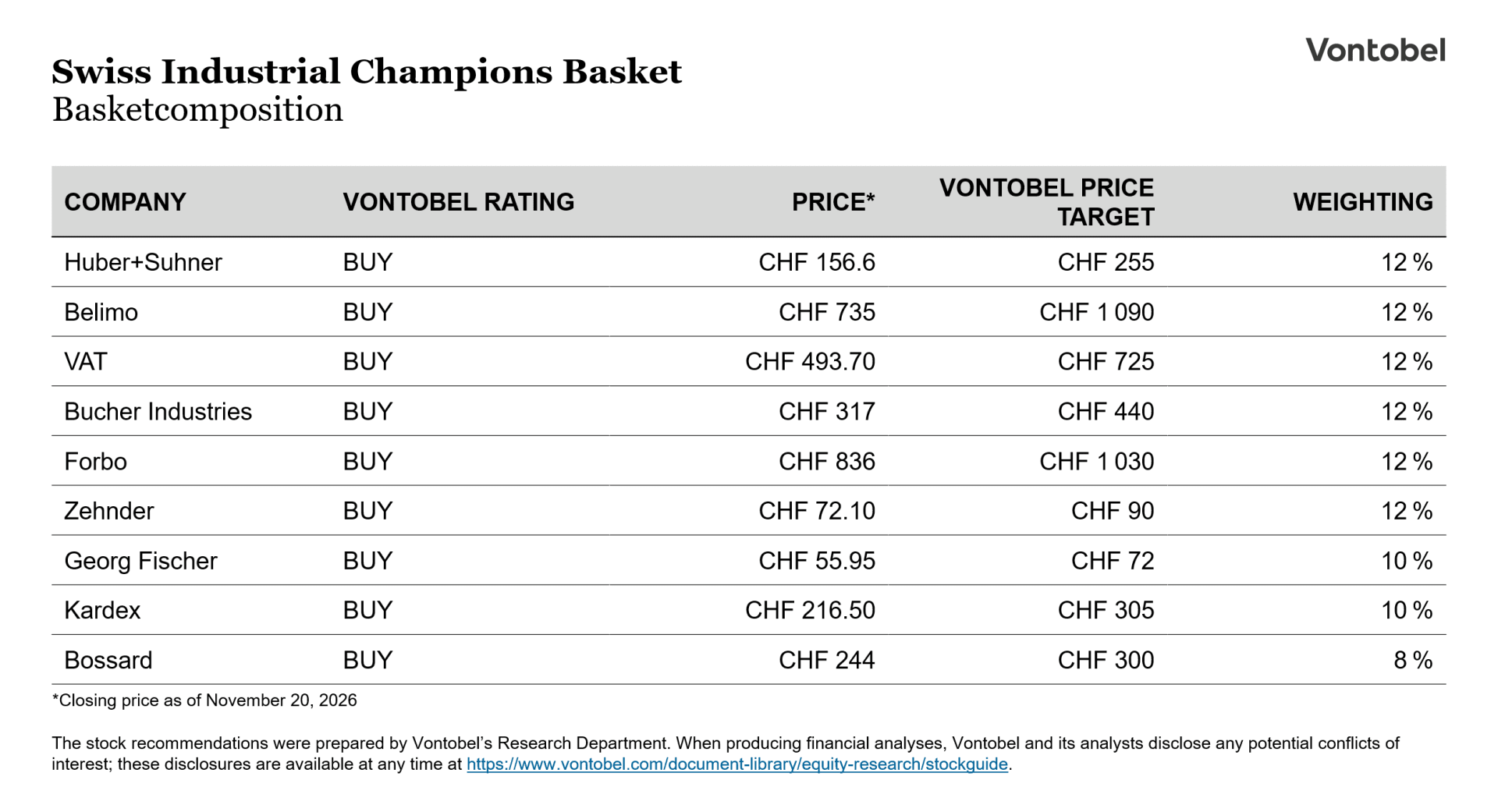
Swiss Industrial Champions Basket Tracker Certificate
The stock recommendations were prepared by Vontobel’s Research Department. When preparing financial analyses, Vontobel and its analysts disclose any potential conflicts of interest; these disclosures are available at any time at https://www.vontobel.com/document-library/equity-research/stockguide/.