How Digitalization Is Transforming the Defense Industry


Rising defense spending is often associated with the procurement of vehicles, aircraft, or weapons systems. At the same time, the digital transformation of modern armed forces is gaining in importance. Software, data analysis, cybersecurity, and networked communication systems are becoming key components of military capabilities and are thus increasingly coming into focus from an investor’s perspective as well.
Software Is Gaining Importance in the Defense Sector
When people talk about rising defense spending, many investors initially think of tanks, fighter jets, or other traditional military equipment. At the same time, however, another sector is emerging that is becoming increasingly important: defense software. Modern armed forces are increasingly relying on digital technologies to analyze information more quickly, connect systems, and support decision-making processes (Palantir Technologies Annual Report 2025, 17.02.2026; Thales Consolidated Financial Statements 2025, 3.12.2025).
This increasing digitalization is thus changing not only the way military operations are planned and conducted, but also the requirements placed on the companies that provide the corresponding solutions (Palantir Technologies Annual Report 2025, 17.02.2026; Thales Consolidated Financial Statements 2025, December 31.12.2025).
Data is becoming a key factor in modern armed forces
Modern defense systems generate large amounts of information. This information comes from sources such as satellites, reconnaissance drones, radar systems, and communications networks. The challenge lies in processing the data as quickly as possible and deriving relevant insights from it (Palantir Technologies Annual Report 2025, 17.02.2026).
This is where specialized software solutions come into play. They help consolidate information from various sources and present it in a clear and organized manner. The goal is to improve decision-making processes and create a more comprehensive situational picture. Accordingly, numerous countries are investing in digital capabilities that complement traditional military equipment (Palantir Technologies Annual Report 2025, 17.02.2026).
Which companies might be affected by this trend?
Various companies are active in the field of digital defense technologies. Among the best-known players is Palantir Technologies, whose software solutions are used, among other things, to analyze and correlate large volumes of data. The company has been collaborating with government agencies and defense institutions for many years and is considered one of the leading providers in the field of data-driven decision support (Palantir Technologies Annual Report 2025, 17.02.2026).
The Government segment, which also includes defense and security agencies, increased its revenue in fiscal year 2025 from $1.57 billion to $2.43 billion, representing 55 percent growth compared to the previous year. Revenue from U.S. government agencies rose during the same period from $958 million to $1.60 billion USD, representing a 67 percent increase. This trend underscores the growing importance of data and AI-powered analytics platforms in the government and defense sectors (Palantir Technologies Annual Report 2025, 17.02.2026).
The French technology group Thales is also active in this market. Among other things, the company offers solutions for communications, sensor technology, cybersecurity, and defense electronics. Thanks to its broad portfolio, Thales is active in various areas of digital defense infrastructure (Thales Consolidated Financial Statements 2025, 31.12.2025).
The Cyber & Digital business segment increased its revenue in fiscal year 2025 from 3.49 billion EUR to 3.85 billion EUR, representing year-over-year growth of 10.3 percent. At the same time, order intake in this segment rose from 3.62 billion to 3.87 billion EUR, representing an increase of approximately 7 percent. This trend points to sustained demand for cybersecurity, data, and digitalization solutions in the security sector (Thales Consolidated Financial Statements 2025).
The Italian group Leonardo also possesses expertise in the fields of electronics, sensor technology, and command and communication systems. In addition to its activities in the aerospace sector, the company develops technologies relevant to the networking and digitization of modern defense systems (Leonardo Annual Report 2025).
In its Cyber & Security Solutions business segment, Leonardo increased its revenue in 2025 from 648 million EUR to 798 million EUR, representing year-over-year growth of 23.1 percent. At the same time, order intake rose from 840 million EUR to 1.02 billion EUR, an increase of 21.4 percent. This trend points to rising demand for cybersecurity and digital security solutions and underscores the growing importance of this business segment within the Group. However, the future development of this business segment depends on various economic, technological, and regulatory factors (Leonardo Annual Report 2025).
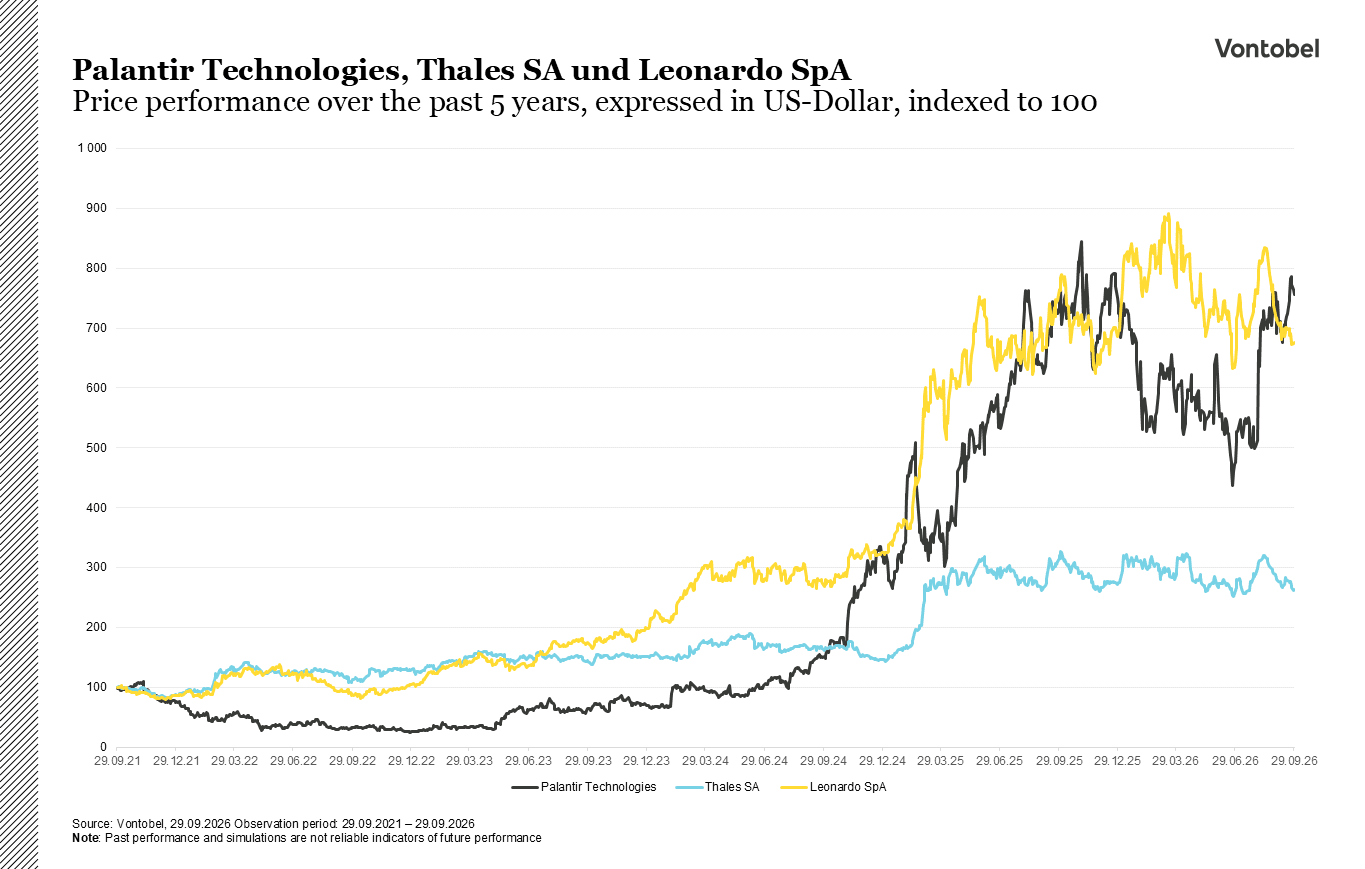
Networked systems are shaping development
Another trend is the increasing interconnectivity of military platforms. Vehicles, aircraft, ships, and unmanned systems should be able to exchange information as seamlessly as possible. This gives rise to complex digital ecosystems that require high-performance software and robust communication solutions (Leonardo Annual Report 2025, Thales Consolidated Financial Statements 2025, 31.12.2025).
However, developing such systems involves significant investment. In addition, the solutions must be regularly updated and adapted to new technological standards. The long-term success of individual providers is therefore not guaranteed and depends on various factors (Leonardo Annual Report 2025, Thales Consolidated Financial Statements 2025, 31.12.2025).
A lesser-known addition to traditional armor stats
For investors, the defense software sector can be an attractive complement to traditional defense contractors. In addition to manufacturers of military equipment, providers of data analytics, sensor technology, communications solutions, and cybersecurity could also benefit from rising investment in digital defense capabilities (NATO Defense Expenditure of NATO Countries (2014–2025)).
At the same time, the sector’s specific characteristics should be taken into account. Many companies are highly dependent on government contracts. Changes in political priorities, budget cuts, or regulatory requirements can impact business performance. Furthermore, geopolitical events can have both positive and negative effects on demand (NATO Defense Expenditure of NATO Countries (2014–2025)).
Digitalization is becoming increasingly important in the defense sector
While traditional military hardware often takes center stage, the technological infrastructure behind modern defense systems is becoming increasingly important. Companies such as Palantir, Thales, and Leonardo are examples of players active in areas such as data analysis, cybersecurity, communications, and sensor technology. Whether this will result in attractive long-term business prospects, however, depends on numerous factors, including technological developments, regulatory frameworks, and government investment decisions. Investors should therefore weigh both the opportunities and risks equally (NATO Defense Expenditure of NATO Countries (2014–2025)).