Between Hype and Semiconductors: The New Order in the Smartphone Market


A folded cell phone the size of a passport, another that unfolds into a tablet: That’s how the latest smartphones from China were unveiled on September 7, 2026. Xiaomi and Huawei had set the stage with these devices, just before Apple unveiled its new generation of iPhones. By September 9, it was clear how Apple would respond: The company unveiled its first foldable smartphone, the iPhone Duo. Behind this lies a fundamental shift: whoever controls a larger portion of their own chip development and supply chain could gain a strategic advantage that extends beyond a single product.
The Chinese response comes first
With the “18 Fold,” Xiaomi unveiled a device that, when folded, is barely larger than a passport, but when fully opened, is capable of running three apps simultaneously. At its heart is a processor developed in-house, combined with memory chips from the domestic manufacturer CXMT. Huawei went one step further with the double-foldable “Mate XT2”: when unfolded, the screen approaches the size of a small tablet; here, too, the entire chip architecture is produced in-house (FuW, 7.09.2026).
It is telling that both companies explicitly addressed the increased price pressure on memory chips. A starting price of $1 540 for Xiaomi and $2 980 for Huawei indicates where things might be headed: Foldable devices are apparently not intended primarily to generate high unit volumes, but rather higher margins. Samsung still holds the lead in the global foldable segment with the Galaxy Z Fold8, but in China alone, Huawei already has a market share of 68 percent, according to industry observers (FuW, 7.09.2026).
Apple is late to the game
Apple has now provided the answer. On Wednesday evening, September 9th, 2026, new CEO John Ternus unveiled the first foldable iPhone as part of the iPhone duo. With this move, Apple is entering a market that other manufacturers have been tapping into for years. Samsung introduced a mass-market foldable device as early as 2019, and Huawei, Xiaomi, and Honor also offer similar devices. Apple is thus not taking on the role of innovator, but rather that of a latecomer (Reuters, 9.09.2026).
When folded, the iPhone Duo can be used like a regular iPhone, and when unfolded, it becomes a device the size of an iPad Mini. In Switzerland, the price ranges from 1 999 to 3 199 francs, depending on the model (FuW, 10.09.2026). This puts the Duo’s price roughly on par with the combined cost of an iPhone and an iPad Mini. However, due to high memory prices resulting from AI expansion, analysts had expected even steeper price increases. Many Apple products had already become more than 30 percent more expensive this summer (FuW, 10.09.2026).
This late entry, however, need not be a disadvantage for Apple. The company has already demonstrated with smartphones, tablets, and headphones that it doesn’t necessarily have to be the first to shape a market.
Analysts’ expectations are also high. UBS anticipates that approximately 10 million iPhone Duo devices will be sold in the first year following the October 23 launch. By comparison, Apple sells about 250 million iPhones annually. Relative to its overall iPhone business, the foldable model would thus remain a niche product for the time being. Due to its high price, however, it could still become an important driver of revenue and margins for Apple. According to market researchers at IDC, Apple’s entry into the foldable segment could also serve as a catalyst for the entire device category. Although sales won’t begin until late October, Apple is expected to account for 44 percent of global revenue from foldable smartphones for the full year (FuW, 10.09.2026).
Why the timing is probably no coincidence
The fact that two major Chinese manufacturers are unveiling new foldable models just before the industry’s biggest event can hardly be dismissed as a coincidence. At the same time, the trend toward in-house chip development suggests that part of the value chain could become re-anchored within China, shifting away from external specialists and toward vertically integrated corporations. This development is likely to continue regardless of how Apple positions itself in the market (FuW, 8.09.2026).
The fact that Apple is now also embracing this form factor is also linked to the evolution of the classic iPhone. The iPhone 18 Pro looks almost identical to its predecessor. The main new features are the colors, the chip, and the camera. This suggests that the potential for innovation in the classic smartphone design is increasingly being exhausted. The form factor thus offers one of the few remaining avenues for a visible technological leap forward (FuW, 10.09.2026).
A Leadership Change Amid Cost Pressures
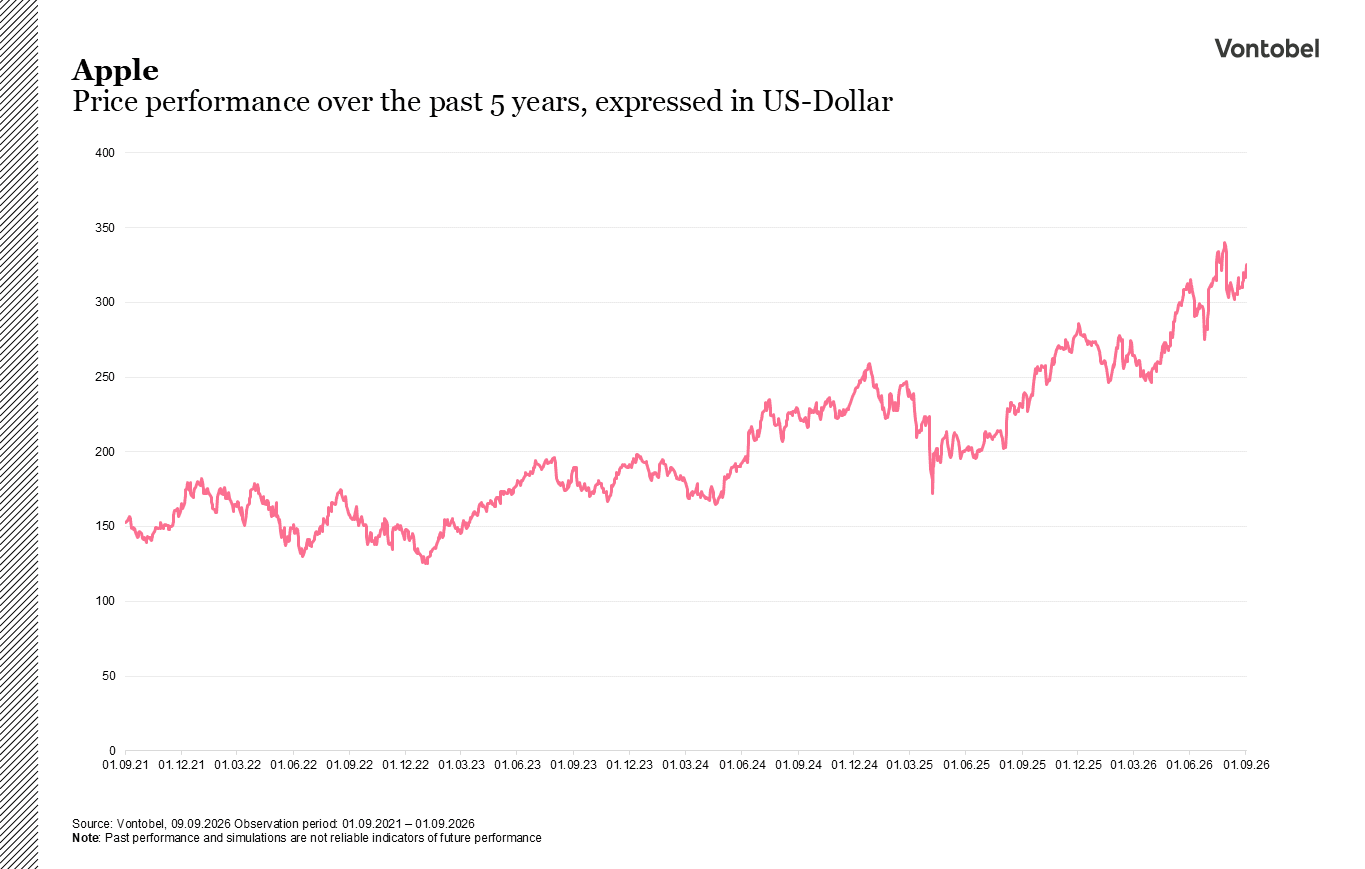
For Apple, this product push coincides with a change in leadership. At the end of August, Tim Cook stepped down after 15 years as CEO. Under his leadership, annual revenue quadrupled to an estimated $477 billion, while the stock price rose 24-fold. He also significantly expanded the services business. However, there has been no new product success on the scale of the iPhone (FuW, 10.09.2026).
The bar is therefore set high for his successor. John Ternus has been with Apple since 2001 and headed the hardware division until his appointment as CEO in April. As a product executive, he is likely to shape the company’s next phase more strongly through new devices. The iPhone Duo thus also serves as an initial test of his new leadership (Reuters, 1.09.2026).
More Than Just a New iPhone
For Ternus, this isn't just about the foldable iPhone. Apple also needs to catch up in the field of artificial intelligence. This was already evident during the presentation: According to an analysis by the online tool Buzznote, terms related to Apple Intelligence were mentioned more frequently than hardware terms (FuW, 10.09.2026).
Apple now relies on Google technology for Siri to avoid falling further behind in the AI race. Many of the AI features showcased sounded promising, but the promises made during the first major AI push two years ago were just as compelling. In Switzerland, Siri AI is currently available only in English; in the EU, it is not available at all. The revamp of Siri could thus become a major test for Ternus (Reuters, 8.09.2026). Competition could thus increasingly shift from the question of who builds the most attractive smartphone to the question of who controls the key technologies behind it.
The New Order
Competition in the smartphone market could thus change on several levels. Xiaomi and Huawei are focusing on developing their own chips and gaining greater control over the supply chain, while Apple is relying on the strength of its ecosystem. The next wave of value creation could thus increasingly arise where manufacturers control not only the device but also the key technologies behind it.
For John Ternus, this is likely to mark the beginning of a challenging new phase. Tim Cook is leaving him one of the most profitable ecosystems in tech history. The iPhone duo could serve as the first major test of whether Apple, even under a new CEO, can generate new growth momentum in an already established market.