Bitcoin: What Last Week's Rally Really Changed


Bitcoin made a remarkable comeback last week. Between August 17 and 21, the price rose by more than 20 percent, reaching around $79.500 at one point (Reuters, 08.2026). On August 25, Bitcoin even briefly surpassed the $80.000 mark. At the same time, U.S. spot Bitcoin ETFs, that is, exchange-traded funds that directly hold Bitcoin and are designed to track its price as closely as possible, recorded the strongest weekly inflow of the year, totaling approximately $1.9 billion (SoSoValue, 08.2026). At first glance, one might simply see this as a return of risk appetite. What is more interesting, however, is that several previously separate factors converged simultaneously: U.S. fiscal policy, regulatory developments, and institutional demand.
The Macro Catalyst: Fiscal Policy Instead of Crypto Euphoria
The initial impetus came from U.S. fiscal policy. On August 19, the U.S. Treasury Department announced that, starting in September, it would double its repurchases of longer-term Treasury bonds to at least $4 billion per operation. One of the triggers was the tense situation at the long end of the yield curve: The yield on the 30-year U.S. Treasury bond had previously reached a 19-year high. Although the buybacks are small relative to the total U.S. debt mountain and by no means equivalent to quantitative easing, their significance lies less in the immediate injection of liquidity than in the signal they send to the market.
This brings a question relevant to Bitcoin to the forefront: How will U.S. policymakers react when high government debt and persistently high long-term interest rates become increasingly incompatible? The higher the government’s borrowing costs rise, the greater the political pressure to cap long-term yields.
Should this lead to a form of financial repression in the long term, for example, through lower real interest rates or a more significant expansion of the nominal money supply—Bitcoin could evolve from a previously rather abstract hedge against «dollar debasement» that is, a potential loss of value of the U.S. dollar resulting from money supply expansion, rising government debt, and expansionary fiscal policy, into a concrete bet on the political response to the U.S. fiscal situation.
Regulation as a Second Tailwind
Even more interesting is that Bitcoin’s price movement last week coincided with a second catalyst: regulation.
At a meeting at the White House on August 20, President Trump once again urged the passage of the CLARITY Act, which is intended to provide greater regulatory clarity in the U.S. crypto market and clearly define the responsibilities of regulatory agencies. The bill has not yet been passed; the decisive vote in the Senate is scheduled for September 15.
The market thus received not just the message that «crypto is being accepted by regulators» but a concrete political timeline for a potential clarification of regulatory responsibilities.
This is relevant for Bitcoin because the regulatory risk premium could become increasingly measurable. Institutional investors need not only access to Bitcoin but also legal certainty regarding custody, trading, accounting, and risk management. If the CLARITY Act does indeed make progress, it would not necessarily cause demand to skyrocket. It is more likely, at first, that a barrier to existing demand will be lowered. Capital that would otherwise be allocated to Bitcoin would then have to factor in less regulatory uncertainty.
ETF Inflows: How Sustainable Is the Demand?
The third factor is the actual flow of capital. Last week’s strong ETF inflows show that the price rise was further supported by traditional financial markets. However, they should not be hastily interpreted as evidence of a structural increase in institutional demand. Rather, some of the inflows were likely procyclical: The sharp price rise made Bitcoin more attractive again to momentum investors and may have triggered additional purchases via ETFs.
At the same time, the rally was amplified by extensive short covering. In this process, market participants who had bet on falling prices must buy back their positions as prices rise in order to limit losses. The resulting purchases can further amplify the upward movement. Within a short period of time, billions in leveraged short positions were liquidated.
But this is precisely where the most intriguing investment question for the next six to twelve months lies: Will demand persist once the short-term tailwind subsides?
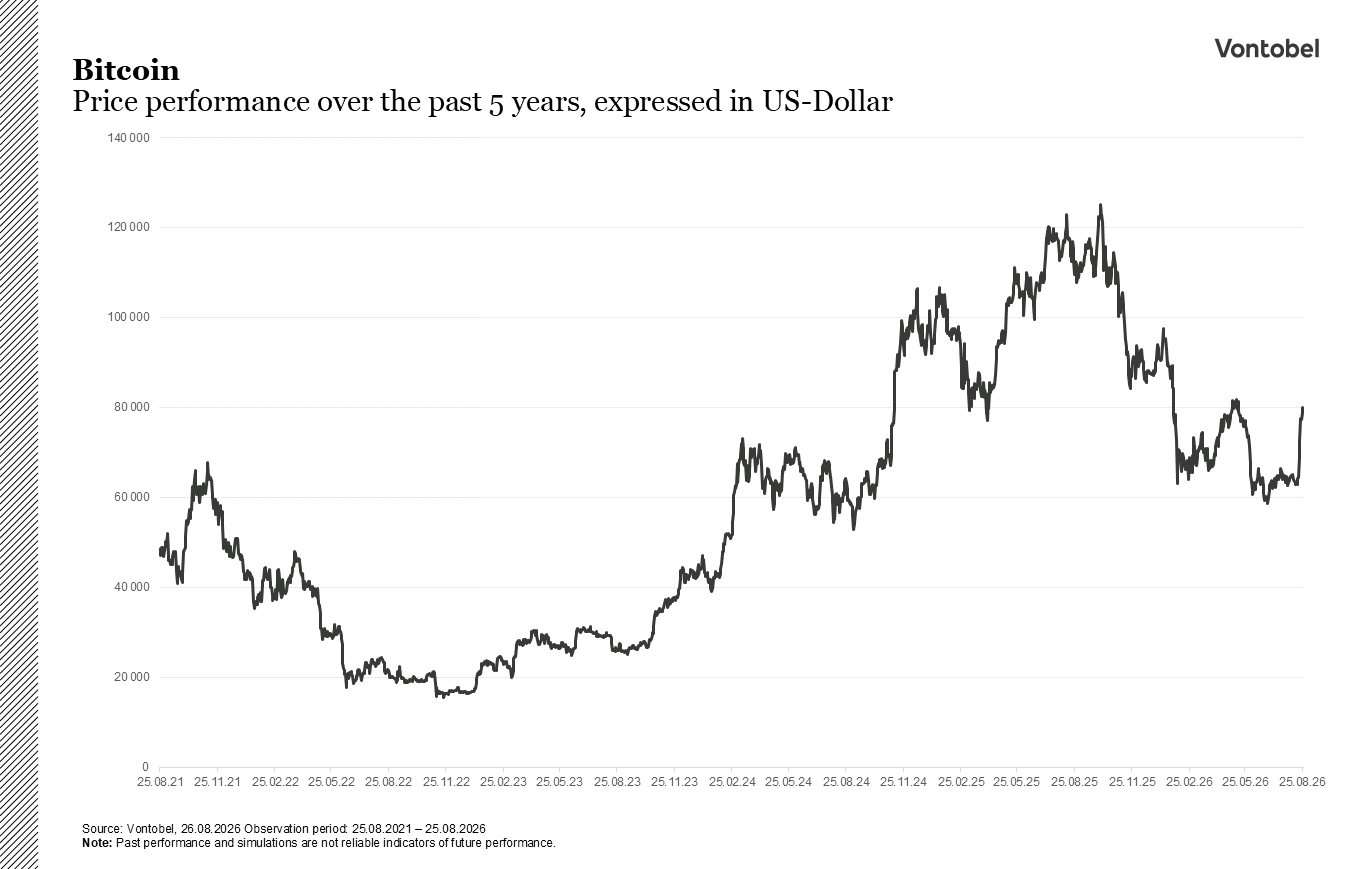
The real test begins now
If ETF inflows remain stable even during a potential correction, this would be far more significant than another billion-dollar inflow during a dynamic uptrend. It would suggest that some investors are not merely buying Bitcoin because of rising prices and short-term momentum signals, but are increasingly viewing it as a strategic position. If, on the other hand, inflows remain closely tied to price movements and turn negative again during a correction, this would indicate that institutional demand remains predominantly procyclical.
This also changes the key benchmark. Institutionally, Bitcoin is no longer competing solely with other cryptocurrencies or tech stocks, but increasingly with U.S. Treasury bonds and gold. The crucial question, therefore, is no longer whether Bitcoin can be «digital gold», that narrative has long been established. What’s far more interesting is whether investors are increasingly viewing Bitcoin as insurance against the long-term consequences of U.S. fiscal policy.
Is Bitcoin's role in the portfolio changing?
Last week, therefore, may have been less the beginning of a new Bitcoin narrative than its first serious test. Treasury buybacks, political signals surrounding the CLARITY Act, and strong ETF inflows coincided, creating an environment that market participants interpreted as supportive of digital assets. However, this does not yet indicate a structural shift in valuations. Rather, the past week has shown how quickly various positive factors can reinforce one another—and thus also how difficult it is to separate the fundamental component of the rally from technical and procyclical effects.
Whether this develops into a sustainable trend will therefore depend largely on what happens after the initial upward move. Will ETF inflows remain robust even as prices fall? Will the regulatory risk premium actually recede as further progress is made on the CLARITY Act? And will Bitcoin remain in demand even if long-term U.S. yields rise again and traditional liquidity support wanes? Only when several of these conditions are met simultaneously would the thesis of a structural shift in valuation be more convincing.
From an investor’s perspective, the question of what role Bitcoin will play in institutional portfolios going forward could thus become particularly relevant. While some market participants continue to view Bitcoin primarily as a risky growth asset, others increasingly see it as a potential diversification component in an environment of fiscal and monetary policy uncertainty. What will therefore be decisive is not whether Bitcoin continues to rise, but why. It is precisely this distinction that is likely to become more important in the coming months than the next price target.
Note: The leveraged products described below have an elevated risk profile. Due to the leverage effect, both gains and losses can be disproportionately large. In the event of unfavorable market conditions, a substantial loss, up to and including the total loss of the invested capital, is possible.