Why trading times of the underlying asset play a role in leverage products


For individuals who invest in Knock-Out products such as Warrants with Knock-Out or Mini Futures, it is crucial to know when and under what conditions their product can be knocked out. But what many do not know: The trading times of the underlying asset play a decisive role here. If the underlying is not a share or an index, the trading times of the underlying and the product may diverge.
Trading hours for leverage products
Vontobel leverage products (in Switzerland) are listed on the SIX Swiss Exchange or can be traded on Swiss DOTS. As a result, the regular trading hours of the Swiss stock exchange apply to products traded on SIX. Typically, trading in leveraged products on SIX is possible from 09:15 to 17:15. The trading days are determined by the Exchange's official trading calendar. In certain situations, the Exchange may adjust the trading hours or modify the exchange and clearing days as needed.
Trading hours on the Swiss DOTS trading platform
Swiss DOTS (Swiss Derivatives OTC Trading System) is an exclusive platform on which Swissquote and Postfinance clients can trade leveraged products directly with the issuer ("over the counter", better known as OTC). Swiss DOTS clients can benefit from extended trading hours as they have the possibility to trade via the Swiss DOTS platform from 8:00 to 22:00. Over 90,000 leveraged products are available on the Swiss DOTS platform, including Warrants, Warrants with Knock-Out, Mini Futures and Constant Leverage Certificates from well-known issuers such as Vontobel, UBS, BNP Paribas, Société Générale and Goldman Sachs. Another advantage of Swiss DOTS are particularly narrow spreads and lower transaction costs.
Trading hours of selected underlyings
The value of a leveraged product is derived directly from the performance of the underlying asset. For this reason, it is essential in order to get a better understanding of the price performance of a leverage product that the price performance of the corresponding underlying is considered. Information regarding the underlying to which the leverage product under consideration is linked can generally be found in the Final Terms in the "Description of the Underlying" section. In addition to a brief description of the underlying, you will also find its ISIN ("International Security Identification Number") so that the product can be clearly identified and distinguished. Furthermore, details of the fixing agent or reference exchange are also provided here.
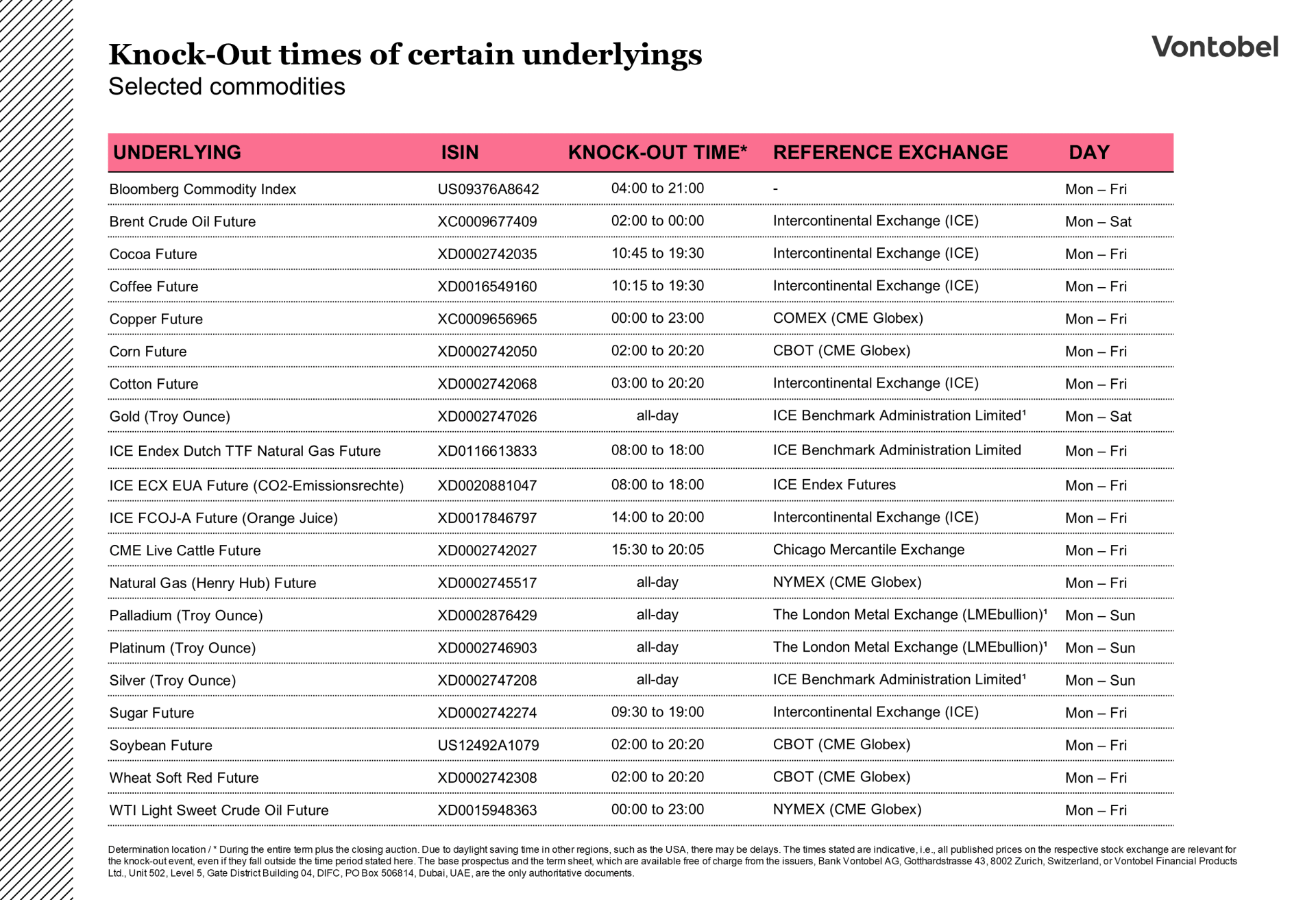
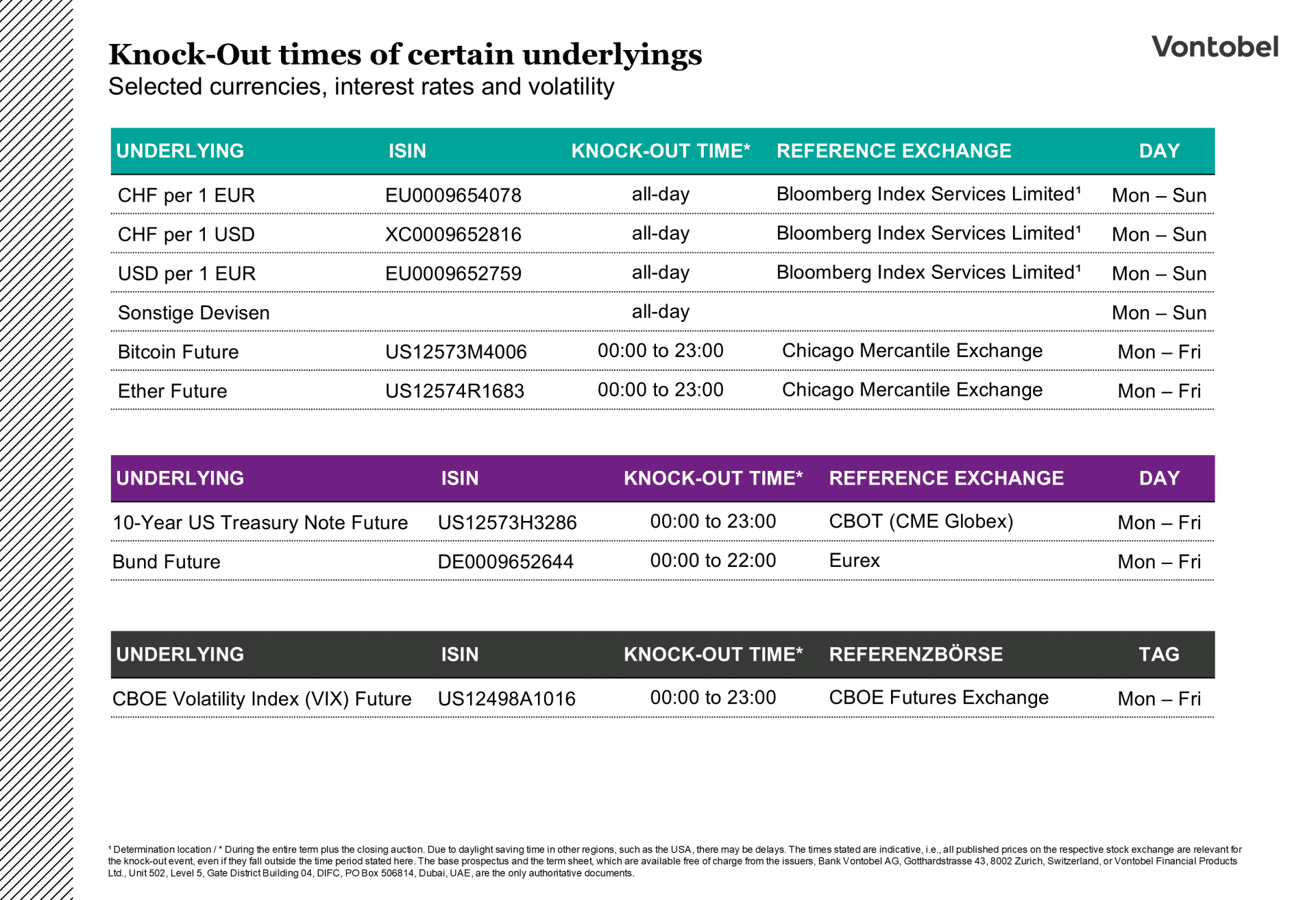
Depending on whether the underlying asset is a share, index, currency or commodity, the trading times of the leverage product and the trading times of the underlying asset may differ. It is important here that the Knock-Out mechanism always takes effect during the trading hours of the underlying. Depending on the trading hours of the underlying, it is therefore possible that an underlying reaches the Knock-Out level without the product having been tradable.
The best way to illustrate this is with an example. Suppose an investor holds a Warrant with Knock-Out on the Dow Jones®. The product is listed on the Swiss Stock Exchange and can therefore be traded on the SIX during trading hours from 09:15 - 17:15. The Dow Jones®, a price index, comprises 30 US companies traded on the NYSE ("New York Stock Exchange") and is one of the best-known American stock market indices. The Dow Jones® usually starts trading at the opening of the US stock exchange (15:30, CET) and then closes at 22:15 (CET). This clearly shows that there is a time window of a good five hours after 17:15 CET every weekday during which the underlying continues to trade and can potentially knock without the associated leverage product being tradable on SIX.
An even more impressive example is a Warrant with Knock-Out on foreign currencies such as the EURCHF exchange rate. The foreign exchange market is the world's largest financial market with the highest liquidity. This could also be due to the fact that foreign exchange is traded around the clock, 24 hours a day, seven days a week. For holders of a leveraged product on foreign exchange, this could mean that their product could knock in the middle of the night or even at the weekend. For this reason, investors should be well informed about the trading hours during which the underlying can knock. If investors deliberately do not want to bear this risk, they should consciously limit the holding period of the product.

Conclusion
Vontobel offers a range of leverage products on extensive underlyings in various categories. Whether stocks, indices, commodities, foreign exchange, interest rates or volatility - the universe offers many possibilities. Depending on the type of underlying, however, investors should be aware that the trading times may differ depending on the product and the underlying. The specific characteristics and trading times of the underlying should be taken into account before buying a leveraged product.