How Goldman Sachs shaped the global financial markets


When something big happens on Wall Street, there is a good chance that the American investment bank Goldman Sachs is involved in some way. Hardly any other investment bank has such a high-caliber and widespread network. A look behind the scenes and at the share.
From a merchant bank to one of the most powerful investment banks in the world
Back in 1848 - the year of the European revolution - a man named Markus Goldman emigrated to the USA, the land of "unlimited" opportunity, with a dream. in 1869, this same man rented a small office building in Pine Street (New York City), a street parallel to Wall Street. The nameplate on the outside of the door read "Marcus Goldman & Co" and gave no hint of the enormous success the company that later evolved from it would one day enjoy in the world of international finance.
Markus Goldman worked as a broker and traded in promissory bills from tobacco and diamond traders (Süddeutsche Zeitung, 11.01.19). The enterprising Goldman recognized a gap in the market: many small and medium-sized companies needed short-term financing but had no access to established banks. At the time, the US economy was expanding rapidly due to industrialization, railroad construction and growing trade flows. The demand for companies' commercial paper (short-term debt instruments) was correspondingly high. Goldman bought up the promissory bills at a discount and sold them on to investors. In doing so, he laid the foundation for today's investment banking.
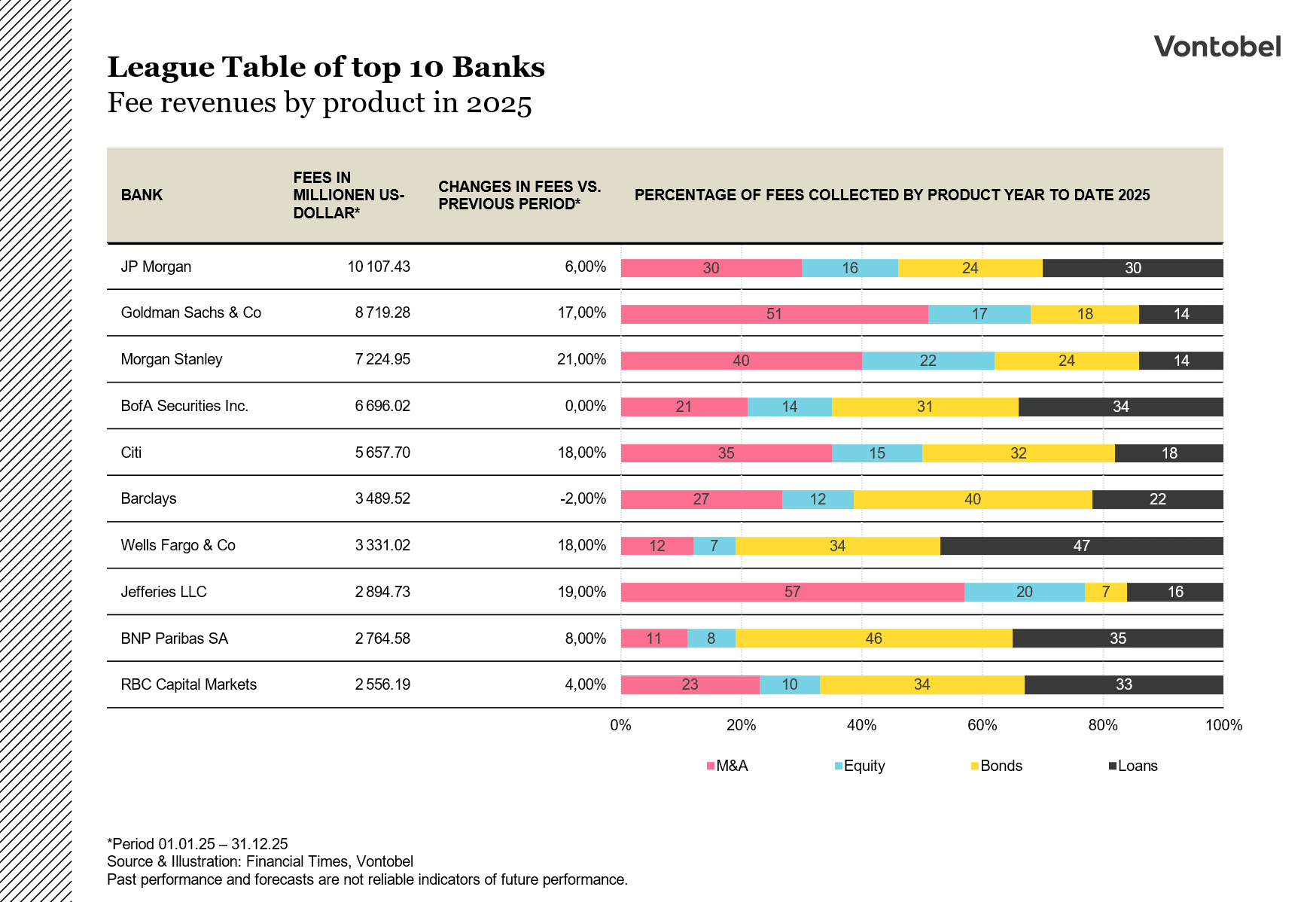
Due to the business success, Goldman Sachs' son-in-law Samuel Sachs joined the company in 1882, whereupon the company changed its name to "Goldman, Sachs & Co." in 1896 (Süddeutsche Zeitung, 11.01.19). In the course of this, Goldman Sachs' institutional structure continued to develop and the improved network also enabled access to larger and more prestigious clients. The company also began to support IPOs, which marked the decisive step from trader to issuing house. By the end of the 19th century, Goldman Sachs was already one of the largest commercial paper dealers in the USA and was heavily involved in the financing of growing industries and closely intertwined with the development of the American capital market. The IPO of "Sears, Roebuck & Co." in 1906 marked a milestone and catapulted the company into the premier league of investment banks. in 2019, around 150 years later, after Markus Goldman arrived in New York, Goldman is one of the largest and most successful investment banks in the world in the league tables year after year (Financial Times, 31.12.25).
The "Goldman DNA"
What made Marcus Goldman stand out still characterizes the corporate culture at Goldman Sachs today: entrepreneurial pragmatism paired with a strong network orientation laid the foundation for the bank's direction. Early on, Goldman focused on the capital markets and developed a partnership model that combined a performance-oriented culture and personal responsibility. This partnership structure remained in place for over a century and shaped Goldman Sachs' notorious internal "elitist culture", which still characterizes the bank's thinking, actions and decision-making processes to this day.
For more than a century, Goldman Sachs operated as a partnership, as established by Marcus Goldman and later Samuel Sachs. In this model, the senior partners owned the firm, were personally responsible for profits and losses and made strategic decisions internally. This system promoted performance orientation and network building, as success was directly linked to partner participation.
However, as the bank grew and the global financial markets became increasingly complex, the partners reached their limits: Capital for expansion and larger deals was limited in some cases and external investors were difficult to involve. In order to remain competitive and mobilize new funds, Goldman Sachs decided to go public in 1999. With the Initial Public Offering (IPO), the bank became publicly tradable on the stock exchange for the first time, received fresh equity capital and was able to finance its expansion into new business areas at the same time.
Despite the stock market listing, the cultural DNA of the partnership remained intact. Management retained strong control over strategic decisions and performance-oriented incentive systems for managers were maintained. The transformation thus marked less a break than an evolution, allowing Goldman Sachs to remain competitive in an increasingly globalized financial world without abandoning the roots of its own corporate culture.
Current developments
Goldman Sachs has shown remarkable development in recent years and months. For the 2025 financial year, the bank reported strong results, particularly in Investment Banking and Global Markets, while announcing a dividend increase, underlining confidence in the stability of earnings. Net profit attributable to shareholders amounted to USD 4.4 billion, up 12% on the previous year. For the full year 2025, profit increased by more than 20% to USD 16.3 billion. Total revenues increased by nine percent to USD 58.3 billion in the same period. In the trading business, Goldman achieved an increase of around 25 percent with USD 4.31 billion - no other US bank has ever earned more in a quarter (Der Aktionär, 15.01.26). The company was able to consolidate its position as a leading provider in investment banking and achieved stable earnings in advisory, underwriting and capital market business. Goldman Sachs also showed relative stability in asset management compared to its competitors, with returns in the private credit area remaining moderate.
At the beginning of 2026, the share price reached an all-time high of around USD 961, driven by solid operating performance and positive market sentiment (Barron's, 27.02.26). A look at the share shows a significantly above-average performance for the financial year 2025 compared to broader stock indices, with a one-year return of around 40% (Yahoo Finance, 03.03.26).
At the same time, there were short-term challenges. The share price has been more volatile in the interim and some senior managers have moved to competitors, raising questions about talent management and internal dynamics. Operating costs also increased by around 18 percent to 9.71 billion US dollars. Overall, Goldman Sachs shows itself to be a bank that, despite short-term volatility and personnel changes, retains both operational strength and strategic positioning and continues to be perceived as one of the most influential institutions in the global financial world.
