Strategic Bitcoin holdings in company balance sheets


Cryptocurrencies, above all the most prominent representative Bitcoin, have not only become the focus of the general public. Confidence in the digital currency is also growing in companies, funds and among institutional investors. Individual companies are integrating Bitcoin into their balance sheets as a strategic reserve instead of holding their liquidity exclusively in traditional currencies or asset classes. The aim is to use Bitcoin as a store of value and to participate in its further establishment in order to create potential added value in the long term. Vontobel has developed the Bitcoin Holder Index in collaboration with the index provider Solactive, which enables investors to participate in the price performance of companies that strategically hold Bitcoin.
Bitcoin as a strategic reserve on the balance sheet
The concept for Bitcoin ("BTC") was published in November 2008 under the pseudonym Satoshi Nakamoto, and the first block was created in January 2009. A lot has happened since then and cryptocurrencies have become increasingly important and relevant. Bitcoin in particular is enjoying growing acceptance and in recent years has developed from a pure cryptocurrency into an important part of some companies' corporate strategy. As part of their business policy, companies are increasingly making a conscious decision to include Bitcoin in their balance sheets - not just to speculate on future increases in value, but as a long-term store of assets and value. From the companies' perspective, cryptocurrencies can usefully complement traditional asset classes such as shares or bonds on their balance sheets. But why are companies investing in Bitcoin?
One of the main reasons is the unique properties of Bitcoin. Cryptocurrencies such as Bitcoin fulfill some of the functions that traditional "FIAT" currencies offer. These include the so-called monetary functions: Store of value, unit of account and means of payment. However, there are differences in the degree to which the individual monetary functions are fulfilled. A central argument for many companies to hold Bitcoin is the protection against inflation. In contrast to many conventional currencies, Bitcoin is characterized by a fixed total supply of 21 million units and is - at least from this perspective - protected against devaluation due to a constantly increasing money supply. Bitcoin offers an opportunity to protect assets from inflationary currency devaluation in the long term. In addition, the addition of Bitcoin can provide a sensible diversification of assets. Instead of investing everything in cash or traditional investments, companies spread their capital across different asset classes, which in turn can increase financial stability and reduce risks.
In addition, companies with Bitcoin holdings also send a signal to customers, partners and investors: a sense of innovation, openness to technology and a willingness to invest in the future. Especially in an increasingly digitalized world characterized by artificial intelligence and technological progress, this can mean a significant competitive advantage. In addition, Bitcoin could become increasingly important as a digital, globally accepted means of payment. Companies that invest in Bitcoin at an early stage could thus expand their business opportunities and tap into new customer groups.

Exploiting potential
For private investors looking to invest in Bitcoin, the direct purchase and safekeeping of cryptocurrencies can be complex and risky. Companies with strategic holdings of Bitcoin could offer an attractive alternative. Instead of buying individual bitcoins directly via a wallet, investors can invest in listed companies or indices that bundle these companies into a basket. This has several advantages: Firstly, investors achieve diversification - they are not putting all their eggs in one basket, but in a basket of different companies that use bitcoin in different ways. Secondly, these companies have professional teams and technologies that ensure the secure management of digital assets. This could significantly reduce risks such as loss or theft of the coins.
As digital assets increasingly enter the financial mainstream, companies are taking a more active role in shaping the future of Bitcoin. By including Bitcoin directly on their balance sheets, these companies are signaling their long-term confidence in decentralized financial systems, alternative stores of value and the growing importance of digital assets in global markets. This behavior reflects broader changes in corporate treasury (funding) strategy, financial infrastructure and corporate innovation. At the same time, a new category of risk and opportunity is emerging where equity performance could increasingly correlate with the performance of Bitcoin. As institutional adoption grows, these companies are positioning themselves not only as early adopters, but also as key players in the next phase of financial transformation. Furthermore, these companies combine the potential of Bitcoin with an operational business model - be it in technology, finance or other sectors. Investors could therefore benefit both from the companies' business development and from the increase in the value of their Bitcoin holdings. Last but not least, listed companies are subject to strict transparency and reporting obligations, which creates an additional layer of security for private investors.
For private investors, investments in such companies or corresponding indices offer an opportunity to participate in the growth in awareness and acceptance of Bitcoin - with more security, diversification and convenience than buying Bitcoin directly.
Transactions and blockchain
When Bitcoin changes hands, a new transaction is created in the blockchain, the digital ledger. To ensure that no one can spend bitcoins without permission, this transaction is digitally signed with the sender's private key. The signed transaction is then sent to the Bitcoin network - a global network of computers, known as "nodes", which constantly communicate with each other.
Special participants in the network, known as miners, verify the transaction. They ensure that the sender actually has the corresponding bitcoins and that the transaction is correct. The miners collect many such transactions and combine them into a so-called "block". In order to permanently add the block with the transactions to the blockchain, the miners have to solve a complex mathematical task - the so-called "Proof of Work" (PoW).
Once a miner has successfully solved the task, the block is added to the existing blockchain. The transaction is then considered confirmed. As soon as the transaction is contained in a block, all participants in the network can see that the bitcoins have been successfully transferred.

USA makes headway in crypto regulation
During the so-called "Crypto Week" from July 14 to 18, 2025, initiated by the US government, three bills were introduced to create a comprehensive regulatory framework for the digital asset industry in the US. These bills, which have been developed over several years, bring much-needed clarity regarding the issuance of stablecoins and the legal classification of tokens. In addition, the US government's position on central bank digital currencies has been clearly defined. This package of measures underlines the strategic shift of the US and its intention to take a leading role in shaping the global financial infrastructure - with the aim of making the US, as Donald Trump put it, the "crypto capital of the world".
The Digital Asset Market Clarity Act ("CLARITY Act"), which is still awaiting Senate approval, creates a clear distinction between digital commodities and securities and provides a legal framework for the issuance of tokens and trading on secondary markets - an important step in promoting innovation in the altcoin space. The consequences of these new US legal changes will be felt worldwide. For established crypto centers such as Singapore, Switzerland and Dubai, the US's increasing leadership in crypto policy could trigger a global regulatory domino effect. These countries could be prompted to further adapt and expand their existing regulatory frameworks in order to secure their competitiveness and avoid being left behind.
Solactive Bitcoin Holder Index
As the digital asset market matures, investors are increasingly interested in companies that are shaping the future of blockchain and crypto infrastructure. With a tracker certificate, investors have the opportunity to participate in the performance in this area. The Solactive Bitcoin Holders Index offers the new opportunity to participate in the performance of selected listed companies that strategically hold Bitcoin on their balance sheet and could therefore benefit from the developments surrounding Bitcoin. One prominent representative of this is MicroStrategy (now trading under the name Strategy). MicroStrategy began buying Bitcoin as part of its corporate strategy back in August 2020. The company sees Bitcoin as a long-term store of value and a hedge against inflation.
The Solactive Bitcoin Holder Index tracks the price performance of a stock portfolio of companies that are relevant to the topic of strategic blockchain holdings on the balance sheet. More than just a measure of holdings, the index reflects how corporate behavior, innovation and long-term commitment to digital assets can be combined.

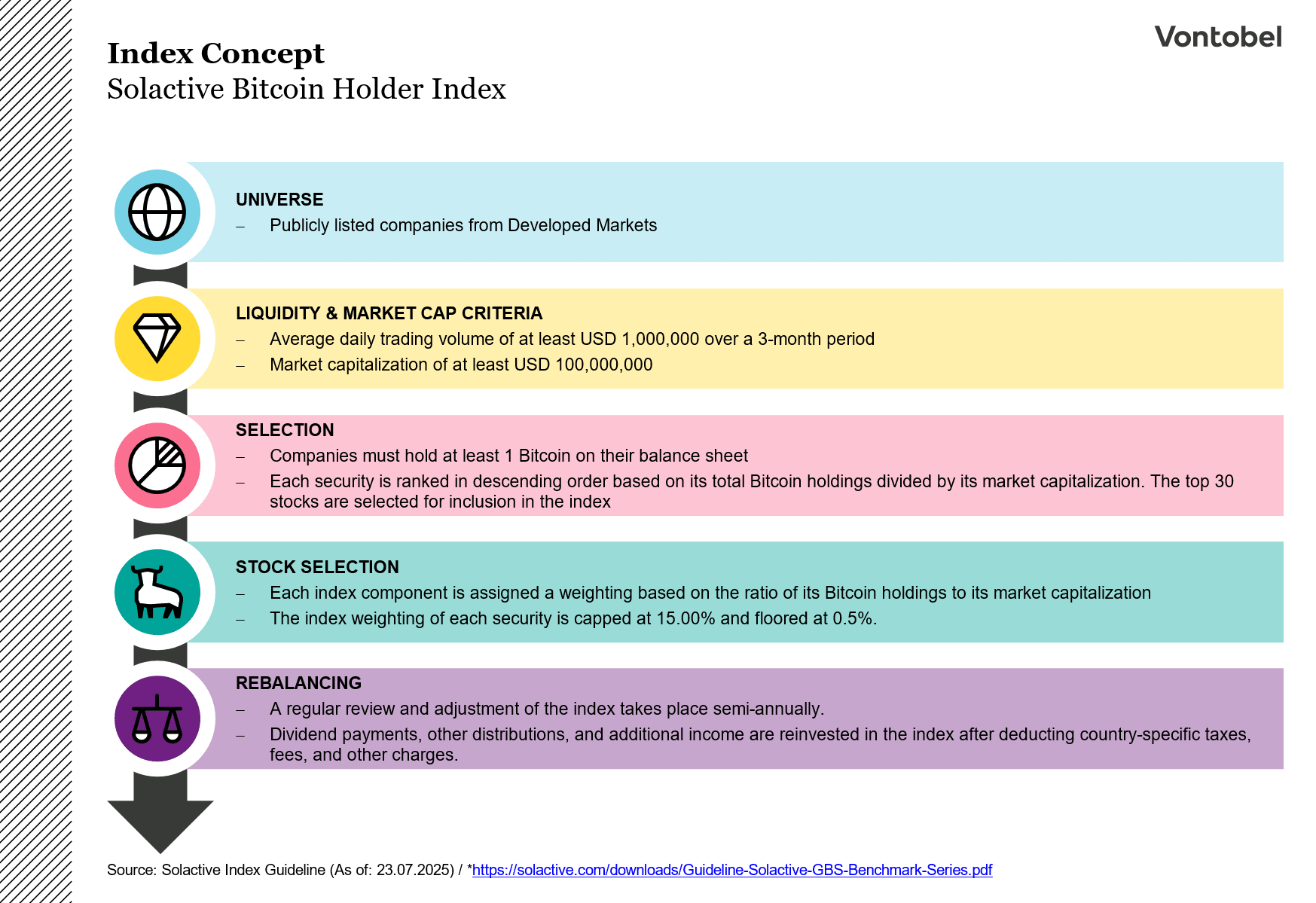
Index concept of the Solactive Bitcoin Holder Index
Investments are made in a maximum of thirty companies with significant Bitcoin holdings (at least 1 Bitcoin). The companies included are weighted in the ratio of their Bitcoin holdings to their respective market capitalization. This ensures that the bitcoins have strategic relevance for the company compared to its market capitalization. The weighting of an individual company is a maximum of 15 percent and a minimum of 0.5 percent. The index is calculated by the index sponsor Solactive, adjusted every six months and dividends and other distributions are reinvested in the index on a net basis. A management fee of 1.00 % p.a. is charged on the index product.
Open End Tracker Certificates on the Solactive Bitcoin Holder Index
License notice and disclaimer
Solactive AG ("Solactive") is the licensor of the Solactive Bitcoin Holder Index (the "Index"). The financial instruments based on the Index are in no way sponsored, endorsed, promoted or sold by Solactive and Solactive makes no representation, warranty or guarantee, express or implied, as to: (a) the advisability of investing in the Financial Instruments; (b) the quality, accuracy and/or completeness of the Index; and/or (c) the results that may be obtained or will be obtained by any person or entity from the use of the Index. Solactive does not guarantee the accuracy and/or completeness of the Index and shall not be liable for any errors or omissions in relation to the Index. Without prejudice to Solactive's obligations to its licensees, Solactive reserves the right to change the methods of calculation or publication in relation to the Index and Solactive shall not be liable for any incorrect calculation or any incorrect, delayed or interrupted publication in relation to the Index. Solactive shall not be liable for any loss or damage of any kind, including, without limitation, any loss of profit or business interruption or any special, incidental, indirect or other consequential damages suffered or incurred as a result of the use of (or inability to use) the Index.