British banks in focus: silent winners of the tariff conflicts?


The global financial markets are in a phase of realignment. While US stocks have formed the backbone of international portfolios for decades, current geopolitical developments and trade policy uncertainties are forcing investors to rethink. The search for diversified investment opportunities beyond the US market is intensifying, with European markets - and the UK in particular - suddenly coming back into focus.
Investors seek alternatives to US stocks
Due to the ongoing tariff disputes and ever-changing statements by US President Donald Trump, investments in the United States pose an uncertainty risk. While American stocks are traditionally overweighted in many international indices such as the MSCI World, many investors are trying to reduce their exposure. In this context, European equities are experiencing a renaissance and the British stock market is being rediscovered by investors. London as a financial center and British banks in particular could benefit from this development.
Isolation from the EU as an advantage in the trade dispute?
When the UK signed the agreement to leave the EU on January 24, 2020, there was a lot of chaos. Instead of an orderly transition, there was talk of a hard cut with the EU and a policy of isolation. As a financial hub, London in particular has suffered as a result and many companies have relocated to the EU. Against the backdrop of the ongoing customs conflict with the United States, the low level of integration with the EU states, which has been criticized by many, could now represent a key locational advantage. While the USA is in a recurring customs conflict with the European Union, the United Kingdom was one of the few countries to negotiate a lasting solution with US President Donald Trump.
Barclays - Diversification and investment banking as a strength
In view of the ongoing volatility on the market, Barclays is focusing strongly on investment banking and trading activities, which are proving to be very profitable in this phase. This was also evident in the first quarter of 2025: pre-tax profit amounted to around 2.7 billion pounds - well above the previous year's figure of 2.3 billion pounds. The trading business with equities and bonds developed particularly strongly, as did advisory income in investment banking. Barclays is also well diversified with important markets in Europe and North America and a stable deposit business in the UK.

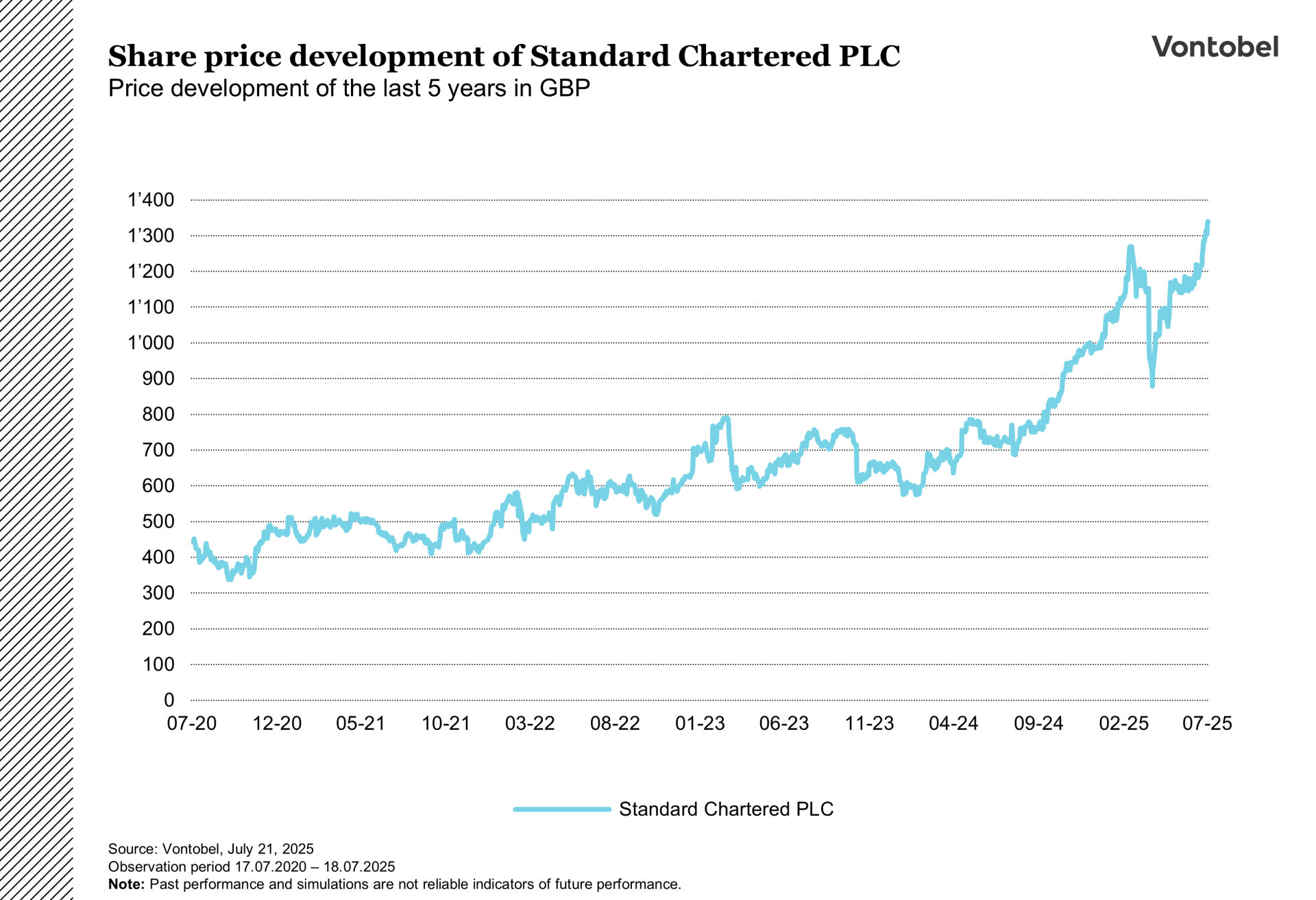
Standard Chartered - Focus on growth markets
Standard Chartered is primarily active in Asia, Africa and the Middle East - regions less affected by the Western trade conflicts. The bank specializes in corporate banking and trade finance, which provides it with stable earnings. By focusing on emerging markets, Standard Chartered benefits from long-term growth potential while remaining relatively unaffected by political tensions between major economic areas. This makes the business model particularly robust in uncertain times.
However, the wealth management business is booming in particular: in the first quarter of 2025, the Wealth and Retail Banking (WRB) unit generated a pre-tax profit of USD 671 million, an increase of 22 percent compared to the previous year.
Lloyds - Solid domestic market focus
Lloyds focuses on the UK private and corporate customer business, which means it benefits directly from a stable domestic economy as well as expectations of lower interest rates. The loan portfolio is primarily focused on consumer and real estate loans, which is less affected by international trade conflicts. In addition, the strong local market position ensures reliable income. Conservative risk management and an efficient cost structure make Lloyds a stable value that will endure even in geopolitically tense times.
