Oil – What does really influence it?


Since our last article on oil, many of the factors we highlighted have become important pillars in the development of its price. Previously, we discussed geopolitical tensions, supply chain disruptions, and oversupply as the main drivers behind the price, however have their importance changed?
When discussing war from an economic perspective, it’s easy to come across as insensitive, as economic analysis primarily focuses on market reactions and material consequences rather than human suffering. That said, the aim of this article is to explain why oil has been particularly volatile recently. To do so, it is essential to understand how pricing works in an open market. Commodities, like other asset classes, base their value on a mix of expectations and fundamentals, which can explain why last month’s Iranian missile strike on Israel can cause future prices to change. The retaliation from Israel was anticipated and thus, already priced into the market, and due to the fear of supply disruptions, prices initially increased. However, Israel responded relatively below expectations, causing prices to decrease. This is also why a company can perform well in a Q3 report, but if expectations were higher, the share price can still fall.
Competing Forces
These forces compete against each other: geopolitical tensions potentially causing supply chain disruptions and Organization of the Petroleum Exporting Countries (OPEC) causing oversupply. Currently, the fear of the conflict escalating has decreased, and thus OPEC is more central in influencing the future of oil prices. While no further information regarding OPEC's stance on oversupply is known, a presidential election, with Donald Trump currently leading in the polls, suggests a continued fierce competition between the two. Donald Trump is keen on oil, and thus it can be expected that oil production will remain high, especially since one of OPEC's fundamental reasons for increasing production was the U.S. gaining market share.
Related Products
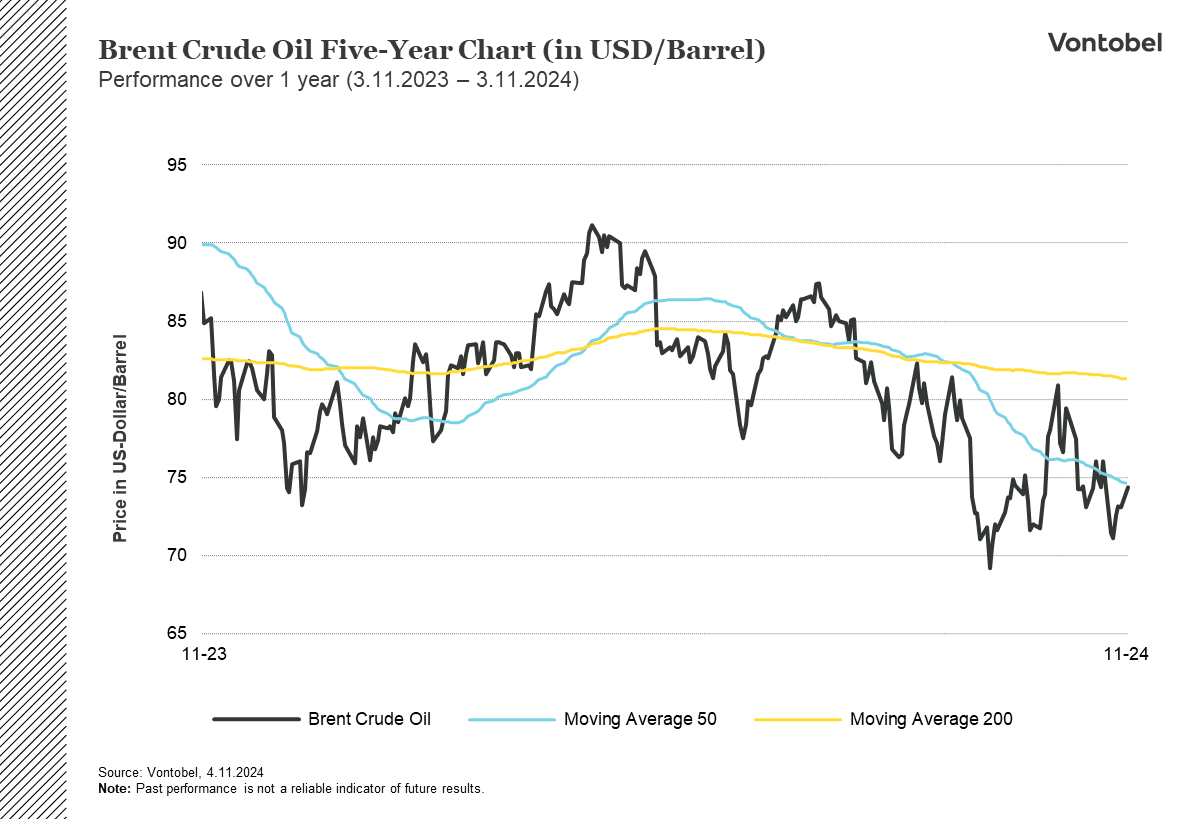

Furthermore, according to several experts, the future outlook for oil remains low due to weakening demand. Currently, oil is beginning the month at a low level, closing below the 200-day moving average, which may come as a surprise considering that the Hamas attack on Israel was a year ago and was believed to keep oil prices higher. However, this highlights something important—namely, that, as mentioned before, our expectations constitute a large part of what determines these prices. We must repeatedly adjust our expectations based on the developments of uncertain events, but perhaps most importantly, weigh them against each other to determine which one will have the greatest influence. It should be noted that the importance of these factors can change, and very quickly. As the decline observed in oil over the last few years was suddenly disrupted by heightened geopolitical tensions, it should be clear that nothing is certain. While many anticipate a rough short-term performance for oil, the uncertainty of the various factors influencing its price will present opportunities for investors who understand them.
Risks
Credit risk of the issuer:
Investors in the products are exposed to the risk that the Issuer or the Guarantor may not be able to meet its obligations under the products. A total loss of the invested capital is possible. The products are not subject to any deposit protection.
Currency risk:
If the product currency differs from the currency of the underlying asset, the value of a product will also depend on the exchange rate between the respective currencies. As a result, the value of a product can fluctuate significantly.
External author:
This information is in the sole responsibility of the guest author and does not necessarily represent the opinion of Bank Vontobel Europe AG or any other company of the Vontobel Group. This information is sponsored by Bank Vontobel Europe AG, which may be a counterparty to transactions involving the financial instruments discussed in this information. The further development of the index or a company as well as its share price depends on a large number of company-, group- and sector-specific as well as economic factors. When forming his investment decision, each investor must take into account the risk of price losses. Please note that investing in these products will not generate ongoing income.
The products are not capital protected, in the worst case a total loss of the invested capital is possible. In the event of insolvency of the issuer and the guarantor, the investor bears the risk of a total loss of his investment. In any case, investors should note that past performance and / or analysts' opinions are no adequate indicator of future performance. The performance of the underlyings depends on a variety of economic, entrepreneurial and political factors that should be taken into account in the formation of a market expectation.
Market risk:
The value of the products can fall significantly below the purchase price due to changes in market factors, especially if the value of the underlying asset falls. The products are not capital-protected
Product costs:
Product and possible financing costs reduce the value of the products.
Risk with leverage products:
Due to the leverage effect, there is an increased risk of loss (risk of total loss) with leverage products, e.g. Bull & Bear Certificates, Warrants and Mini Futures.
Disclaimer:
This information is neither an investment advice nor an investment or investment strategy recommendation, but advertisement. The complete information on the products (securities) mentioned herein, in particular the structure and risks associated with an investment, are described in the base prospectus, together with any supplements, as well as the final terms relating to the securities. The base prospectus and final terms constitute the solely binding sales documents for the products mentioned herein. It is recommended that potential investors read these documents before making any investment decision. The documents and the key information document are published on the website of the issuer, Vontobel Financial Products GmbH, Bockenheimer Landstrasse 24, 60323 Frankfurt am Main, Germany, on https://prospectus.vontobel.com and are available from the issuer free of charge. The approval of the prospectus should not be understood as an endorsement of the securities. The securities are products that are not simple and may be difficult to understand. This information includes or relates to figures of past performance. Past performance is not a reliable indicator of future performance. This information may only be distributed or published in countries where such distribution or publication is permitted by applicable law. As stated in the relevant base prospectus, the distribution of the securities mentioned in this information is subject to restrictions in certain jurisdictions. This advertisement may not be reproduced or redistributed without prior permission by Vontobel.
© Bank Vontobel Europe AG and / or affiliated companies. All rights reserved.