Movement of capital


For several decades, countries that mainly export services have been high on lists of countries with the strongest GDP, now that seems to be turning around.
It was long rumored that the BRICS countries would present a new, potentially gold-backed currency during their meeting in South Africa at the end of August. There was no new competitor to the US dollar as a global reserve currency and instead it was announced that the BRICS - Brazil, Russia, India, China and South Africa - invited six more countries to join, namely Argentina, Egypt, Ethiopia, Iran, Saudi Arabia and the UAE. The former member states and the six invitees are on the surface very different but have an important common denominator that may set the tone for what will be important to a country's wealth in the future: they all produce and export several key commodities.
Argentina is an important global producer and exporter of, for example, soybeans and corn, Egypt is an important player in terms of petroleum and cotton, Ethiopia is the world's ninth largest coffee exporter, and Iran, Saudi Arabia and the UAE are, as you know, big in energy and oil.
The new BRICS composition would mean that the 11 member countries account for 46 percent of the global population, measured in US dollars, 38 percent of global GDP and 23 percent of global exports. By comparison, the G7 countries account for only 10 percent of the global population, 29 percent of global GDP and 29 percent of global exports. But, perhaps most important to note is that if Iran, Saudi Arabia and the UAE join BRICS, BRICS' total oil production will account for 43 percent of global production compared to 20 percent before.
The question now is what this could mean for the future? As commodities wake up from their slumber after an extended bear market, more and more people have begun to accept that we are probably at the beginning of a secular bull market for commodities. Rising prices of raw materials also mean that the countries that produce and export the raw materials become richer, which also gossips that what we are seeing now is the beginning of an era where commodity producers rather than service exporters get a bigger share of the pie.
What should we pay with?
Now for the big question: What currency will we settle the majority of international trade with?
As mentioned at the beginning of the article, the gold-backed currency that the world was expecting was not presented during the meeting held at the end of August. However, this does not mean that a currency backed by "hard" money is out of the question. Instead, China continues to signal that gold will continue to fulfill an important function as a store of value in the future.
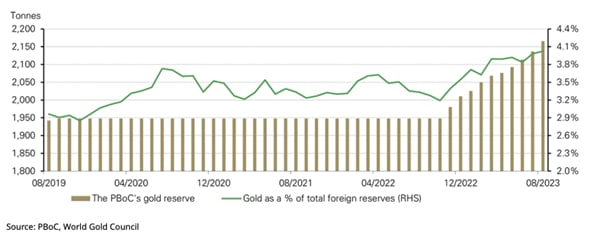
For the first time since 2019, China reports how much gold it buys, and it's a lot. For the tenth month in a row, China bought gold, 155 tons to be exact, and the total share of gold in China's foreign exchange reserves is over 4 percent, which is the highest measured share in China ever. What China's public purchase of gold means in the long term, we can only speculate today, but for those who believe in a future with hard currencies, it is of course possible to see China's gold purchase as proof that an RMB backed by gold is a possible scenario in the future .
But how much is RMB actually used globally today?
The renminbi is the fifth most used currency globally today with a share of 1.91 percent in January 2023. Slowly we can see the RMB taking a bigger place in international trade and for the first time ever, China settled more cross-border transactions in its local currency rather than with the US dollar in the first quarter of this year.
It appears that the general trend in international trade is for parties to more often choose one of the currencies of the countries they trade with rather than just the USD. With China as the world's largest exporter, it is not unreasonable to imagine that the proportion of trade settled in RMB could grow even larger.
Risks
External author:
This information is in the sole responsibility of the guest author and does not necessarily represent the opinion of Bank Vontobel Europe AG or any other company of the Vontobel Group. This information is sponsored by Bank Vontobel Europe AG, which may be a counterparty to transactions involving the financial instruments discussed in this information. The further development of the index or a company as well as its share price depends on a large number of company-, group- and sector-specific as well as economic factors. When forming his investment decision, each investor must take into account the risk of price losses. Please note that investing in these products will not generate ongoing income.
The products are not capital protected, in the worst case a total loss of the invested capital is possible. In the event of insolvency of the issuer and the guarantor, the investor bears the risk of a total loss of his investment. In any case, investors should note that past performance and / or analysts' opinions are no adequate indicator of future performance. The performance of the underlyings depends on a variety of economic, entrepreneurial and political factors that should be taken into account in the formation of a market expectation.
Disclaimer:
This information is neither an investment advice nor an investment or investment strategy recommendation, but advertisement. The complete information on the products (securities) mentioned herein, in particular the structure and risks associated with an investment, are described in the base prospectus, together with any supplements, as well as the final terms relating to the securities. The base prospectus and final terms constitute the solely binding sales documents for the products mentioned herein. It is recommended that potential investors read these documents before making any investment decision. The documents and the key information document are published on the website of the issuer, Vontobel Financial Products GmbH, Bockenheimer Landstrasse 24, 60323 Frankfurt am Main, Germany, on https://prospectus.vontobel.com and are available from the issuer free of charge. The approval of the prospectus should not be understood as an endorsement of the securities. The securities are products that are not simple and may be difficult to understand. This information includes or relates to figures of past performance. Past performance is not a reliable indicator of future performance. This information may only be distributed or published in countries where such distribution or publication is permitted by applicable law. As stated in the relevant base prospectus, the distribution of the securities mentioned in this information is subject to restrictions in certain jurisdictions. This advertisement may not be reproduced or redistributed without prior permission by Vontobel.
© Bank Vontobel Europe AG and / or affiliated companies. All rights reserved.