Interest rate - winds suggest better buying opportunities ahead

Will interest rates come down again soon? Is it as usual that the Fed is forced to stimulate or is it different this time? Why would the situation have changed this time? It is more interest rate sensitive than ever due to higher debt than ever, so the central banks will probably pull out all the tools they have to save their own and other politicians' skins as soon as things look weak enough. There are no real inflation fighters left. But what should you own in the different scenarios? What is priced in? What are investors prepared for?
The stock market does not seem to be worried about a recession. The Nasdaq and S&P are near highs and well above the 200-day mark. The OMX is also high, but unfortunately below the 200-day mark in recent weeks. This could be a sign that a long negative trend has begun. In addition, OMX (2190) is way too far above its long trend bottom in the form of the 200-month at 1437 which the index usually touches in negative times. A decline of about 33% would look completely normal in the graph in retrospect. Sweden is already in recession, but in the US, it looks much stronger so far. When the US also loses altitude, there is almost nothing to hold up in Sweden. Maybe the currency in and of itself, but that is little comfort and only applies to the most prominent export companies.
There is simply a big difference between the constant tailwind of low and falling interest rates and more normal levels. Consumers have less money to spend; companies have both lower revenues and higher costs, and more difficulty growing through acquisitions; and investors have both better and safer options and less appetite for leverage. Thus, interest rates are a headwind for growth, profitability and valuation of earnings, unlike previous tailwinds on all counts.
The Fed is unlikely to have any alternatives to stimulating regardless of what inflation looks like, but as we know, lowering the policy rate did not help in 2002 and 2008. It turned up rather quickly in 2016, 2018 and 2020, creating reflexive buying since the bottom of the financial crisis in 2008. But the bounce back in 2022 now seems to have been too far ahead of events. The recession hasn't even arrived, let alone new stimulus to acknowledge the weakness. All this is ahead of us. It is unreasonable to think that the stock market can whistle past economic realities without a rebound.
OMX Stockholm 30

Related Products
Trends typically continue until something clearly stops them, so it may continue up for a while longer this fall. That's what I've been saying for the past month. But it is a chicken race, and that was before the OMX fell below the 200-day. So, this may not be the time to be a hero or to be fully invested in stocks. There are times when you should push extra hard, e.g., after major downturns, when there is panic, when the central banks have been forced into the race in earnest, when there are no alternatives to shares. Like in 2003. Like 2009. Like 2020, but certainly not like the corresponding peaks in 2000, 2007, 2021. The market is sometimes stretched on the upside, sometimes on the downside. Today's valuations, the optimistic look of the graph, the rapidly rising interest rates and record debt levels make it unlikely that the stock market is resilient to bad news. And bad news is more likely now than normal, not least because of the interest rate headwinds. The February banking crisis looks increasingly like the same kind of warning shot as Bear Stearns early in the financial crisis. I do not believe in a new sudden Lehman Brothers, no more than the Chinese real estate giants. However, the entire global banking sector continues to be squeezed by the new interest rate environment, not least because of weak real estate owners.
OMX Stockholm 30

The value of cash is how much more you can buy with your money after a downturn. A 50% fall in the share price allows you to buy twice as many shares, i.e., an immediate 100% gain in the amount of future cash flow you get for your money. Money should not be valued on the basis of the interest you get on it, but on the return, you can get on bargain purchases in the future.
Of course, a cheap share is always worth buying, provided you have made the right calculations and are not unlucky. Ericsson, for example, is attractive at SEK 56, roughly the same price as 30 years ago and more than halved since its peak 1-2 years ago. If even more rot is not exposed in the form of money laundering, bribery, and terrorist links in the company, and if Cevian at the same time contributes to cost focus, the share is in practice bought at less than Price-to-Earnings ratio (P/E) of 10 for 2024, a profit that may also be distributed in full in the event of subdued growth dreams. It should be able to be valued at least 50% higher than today. In Ericsson and similar cases, you can start building a position now, despite the obvious risk of a general stock market decline, but even here, of course, even what is already cheap can become even cheaper, so it is important to save some dry powder for real bargains.
The stock market seems to be living in a kind of echo of the 2021 rise, a reflexive bounce based on the fact that the economy doesn't look so bad after all. Yet. In the US, the current mortgage rate is about 7.5 percent. The average interest rate, on the other hand, is only 3.5 percent, so the pain will come later. It is somewhat similar in Sweden with a lag in interest rate increases of a year or two as various lags work out (for example, bond issues, fixed interest rates and slowly increased deposit rates). The policy rate is still being raised, so there is still a long way to go to maximize the real economic impact on households, companies, property owners and banks. The interest rate is a constant headwind that works slowly in reality. The H1 2022 stock market decline on inflation and the start of interest rate hikes were a couple of steps ahead of real-world cash flows. It is likely that the current bounce is also too far ahead of what is actually coming soon.
US 3-months bond yield

Related Products
The more days and weeks OMX spends below the 200-day average (at 2207) and the closer we get to year-end and more obvious economic weakness, the more immediately negative I become about the stock market. This is particularly true of the OMX. What can save the stock market in the short term is the weak Swedish krona, which benefits the profits of all our export companies. Perhaps this is why the stock market is as high as it is now before the end of the third quarter. Unfortunately, however, I believe that too much has been taken too early and that the currency gains will be seen through, and the focus will instead quickly shift to a negative outlook for 2024.
It could simply be time for a period of risk-off. Perhaps it will be as short-lived as 2016, 2018, 2020 and 2022, perhaps more prolonged and deep as after the interest rate hikes in 2000 and 2006. The latter would be the most reasonable and purifying for the markets and would be consistent with record debt levels and higher interest rates. In any case, now is not the time to take extra risk in your equity portfolio. Remember, it is when central banks cut interest rates that stock markets tend to fall the most. Like in 2002 and 2008. This is because the cuts come only after the damaging effects of the increases have begun to manifest themselves with a time lag, and the central banks then finally admit publicly how bad things are. Dash for cash and safety and, in some cases, forced liquidation of leveraged positions can lead to a downward spiral until the few who have cash become hungry for genuine bargain buying.
Of course, you can have a strategy with 100% equity exposure at all times. But if you actually want to vary your exposure depending on the general stock market situation, i.e., valuation, alternatives and sentiment, this may be the time to have minimal exposure. Price/Sales are extremely high and interest rates are high and rising. In my view, today you should rather have your lowest market weight and, in any case, extra focus on buying real assets with a safety margin to the value, rather than hoping that your growth companies will continue to conjure up revenues from squeezed customers and that other investors will keep up already high multiples right through the likely economic downturn. The least you can do is create optionality in your portfolio with a negative index position if you are allergic to pure cash and gold. However, shorting can prove expensive and reduce your psychological resilience during periods of boom.
Unfortunately, real assets such as commodities and mines also tend to perform poorly in a recession, no matter how cheap they are to begin with. So, there is probably nowhere to hide in an absolute sense in a severe downturn. However, cheap is cheap. If you buy below P/E of 10 at a representative and sustainable profit level, as for many mines and oil companies, you have built in a good long-term total return. Energy and metals are also solid long-term cases that retain their value in times of inflation should it return. Of course, even better than owning something cheap that falls anyway is if you can have cash ready to buy twice as many shares in your favorite companies when the almost inevitable panic comes.
S&P Regional Bank ETF

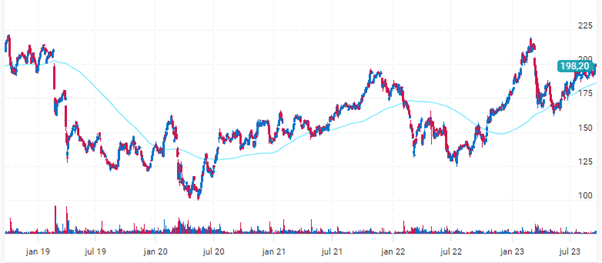
Incidentally, I am belatedly beginning to worry about profits and valuations in Swedish banks as well. No, the really cheap shares can probably be found among bombed-out smaller companies, but then it requires careful and specific analysis to find the right one among the sometimes-hidden risks. The most likely scenario is, as usual, neither an outright rise nor fall but a sideways trader's market. However, the macro situation means that my focus is mainly on freeing up dry powder as soon as possible to buy on the downside, and I require quite large ones to open the whole wallet. 200-day in OMX is currently showing the way. I should buy again in earnest when the Fed has finished cutting in a year or so.
Swedbank AB
Risks
External author:
This information is in the sole responsibility of the guest author and does not necessarily represent the opinion of Bank Vontobel Europe AG or any other company of the Vontobel Group. This information is sponsored by Bank Vontobel Europe AG, which may be a counterparty to transactions involving the financial instruments discussed in this information. The further development of the index or a company as well as its share price depends on a large number of company-, group- and sector-specific as well as economic factors. When forming his investment decision, each investor must take into account the risk of price losses. Please note that investing in these products will not generate ongoing income.
The products are not capital protected, in the worst case a total loss of the invested capital is possible. In the event of insolvency of the issuer and the guarantor, the investor bears the risk of a total loss of his investment. In any case, investors should note that past performance and / or analysts' opinions are no adequate indicator of future performance. The performance of the underlyings depends on a variety of economic, entrepreneurial and political factors that should be taken into account in the formation of a market expectation.
Disclaimer:
This information is neither an investment advice nor an investment or investment strategy recommendation, but advertisement. The complete information on the products (securities) mentioned herein, in particular the structure and risks associated with an investment, are described in the base prospectus, together with any supplements, as well as the final terms relating to the securities. The base prospectus and final terms constitute the solely binding sales documents for the products mentioned herein. It is recommended that potential investors read these documents before making any investment decision. The documents and the key information document are published on the website of the issuer, Vontobel Financial Products GmbH, Bockenheimer Landstrasse 24, 60323 Frankfurt am Main, Germany, on https://prospectus.vontobel.com and are available from the issuer free of charge. The approval of the prospectus should not be understood as an endorsement of the securities. The securities are products that are not simple and may be difficult to understand. This information includes or relates to figures of past performance. Past performance is not a reliable indicator of future performance. This information may only be distributed or published in countries where such distribution or publication is permitted by applicable law. As stated in the relevant base prospectus, the distribution of the securities mentioned in this information is subject to restrictions in certain jurisdictions. This advertisement may not be reproduced or redistributed without prior permission by Vontobel.
© Bank Vontobel Europe AG and / or affiliated companies. All rights reserved.