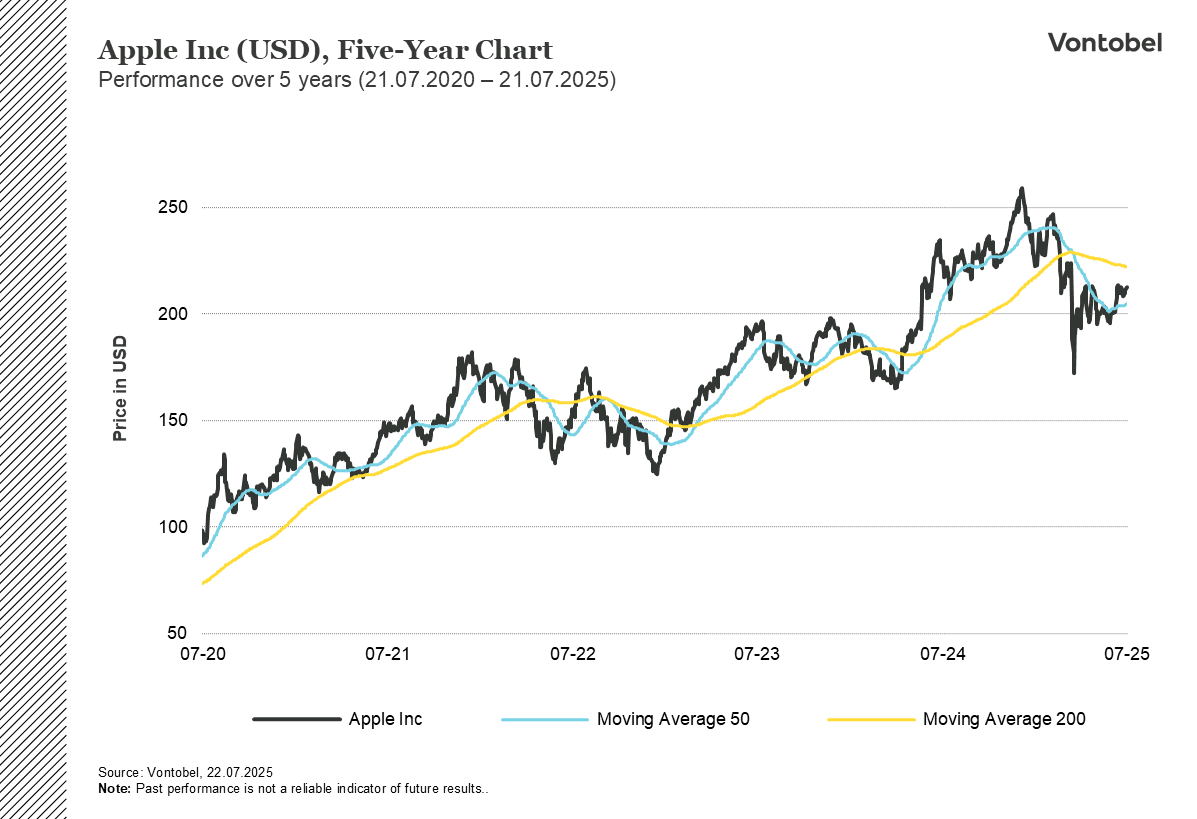
Apple’s Competitive Structure: External Risks and AI Technology Outlook


Apple isn’t just a tech giant; it’s a status symbol, a closed but highly attractive ecosystem, and a margin powerhouse that defies economic cycles. Yet behind this $3 trillion brand lie structural vulnerabilities that are becoming increasingly clear, from a supply chain exposed to geopolitical tensions to a late start in the race for artificial intelligence.
Apple: An Integrated Giant of Hardware, Software, and Services
What makes Apple unique isn’t just the sleek design of its products. It’s the way the company has built one of the most efficient business models in the world. Apple isn’t only about the iPhone. It has created a fully integrated ecosystem where hardware, software, and services work together so smoothly that the user barely notices. In 2024, Apple’s market value hit $3 trillion, making it a benchmark for long-term competitive strength.
The iPhone remains Apple’s biggest moneymaker, bringing in more than half of the company’s $391 billion in revenue for fiscal year 2024. Other products like the iPad, Mac, Apple Watch, AirPods, and Apple TV round out the lineup, along with accessories and peripherals. But in recent years, Apple has been shifting more focus toward its services business, which includes the App Store, iCloud, Apple Music, Apple Pay, AppleCare, and Apple TV+. Services now account for nearly 25 percent of total revenue and come with much higher profit margins than hardware.
A big part of Apple’s strength lies in its closed ecosystem. Its operating systems, iOS, macOS, and watchOS, are closely connected, making Apple devices work seamlessly together. That creates a kind of loyalty loop where users find it hard to switch to other platforms. As a result, Apple has some of the highest customer retention rates in the industry. Most of its revenue comes from the Americas, about 43 percent, followed by Europe and China. China, in particular, is key, not just as a market, but also as a major production hub.
From a Financial Perspective, Apple Is a Cash-Generating Machine
Apple produced over $108 billion in free cash flow in 2024, with an operating margin of 31.5% and a return on equity boosted by one of the most aggressive buyback programs ever seen. Even though Apple’s business is global, it still depends heavily on two regions: the Americas and China.
How U.S.-China Tariffs Impact Apple’s Supply Chain
In 2025, Apple is dealing with a more complicated trade environment due to a new wave of tariffs introduced by the Trump administration. Starting in April, the U.S. implemented fresh duties, including a 30 percent tariff on Chinese imports and a 10 percent tariff on U.S. exports. While Trump mentioned a 55 percent overall rate, that figure combines new and existing tariffs, including a 10 percent general duty, a 20 percent China-specific surcharge, and a 25 percent tariff already in place from earlier trade rounds.
Apple is particularly exposed here, since much of its manufacturing still takes place in China. While the company has started shifting production to places like India and Vietnam, these transitions take time. China remains the heart of Apple’s supply chain, with many essential components made locally and long-term supplier relationships in place. The new tariffs could raise production costs, which would squeeze profit margins and potentially make Apple’s products more expensive in the U.S.
The growing tension between the U.S. and China poses a real challenge. Apple now has to navigate this uncertainty while finding ways to protect its operations and financial performance from the impact of rising trade barriers.
Apple Intelligence: Balancing Data Control and Innovation
At the same time, Apple is making its first real move into the world of generative AI with something it calls Apple Intelligence. This system, which combines on-device processing with Apple’s own private cloud, was introduced at WWDC 2024 and rolled out in beta that summer. It became available in the U.S. in October and in Italy in March 2025. But it only works on newer devices, those with Apple Silicon (M1 or later) and the iPhone 15 or 16 Pro. Staying true to its focus on privacy, Apple processes most AI tasks directly on the device. When more power is needed, the job is handled by Apple’s private cloud, which runs on custom chips and uses end-to-end encryption and data anonymization. Users can also choose to connect with ChatGPT-4o, but only with clear, opt-in permission for each interaction, and with IP addresses hidden to protect their identity.
Application Capabilities Include Writing, Rewriting, and Contextual Summaries
Apple Intelligence offers tools like rewriting, summarizing, and proofreading in apps like Mail and Notes. It can generate images and personalized emojis through Image Playground. It also brings better search, video editing, and photo cleanup features to the Photos app. Siri gets a major upgrade too, with the ability to understand context, schedule tasks through voice, and respond in a more natural way.
Yet, despite a Solid Architecture, Technical Limits Are Clear
Still, the technology isn’t leading the pack. Independent tests show that Apple’s AI models, whether running on the device or in the cloud, are closer to mid-range systems like Mistral or GPT-3, rather than the top-tier performance seen with models like GPT-4. On top of that, the features only work on the latest devices, leaving out much of Apple’s user base. And many of the biggest updates, especially to Siri, won’t arrive until 2026.
In Conclusion, Apple Intelligence Reflects a Delicate Balance
In the end, Apple Intelligence reflects a careful balance between protecting user privacy and embracing new technology. But the slow rollout and relatively limited capabilities could make it harder for Apple to keep up with more aggressive competitors. While the approach fits with Apple’s brand and values, it may not be enough to stay ahead in the rapidly evolving AI race.
Related Products