A Promising Development in the Blockchain World: WhatsApp Meets Solana


An exciting innovation is emerging in the blockchain space: a potential link between the globally popular messaging app WhatsApp and the Solana blockchain. This development could allow users to trade cryptocurrencies directly through WhatsApp messages—without needing to open a separate app. The vision of such seamless integration could revolutionize access to digital assets and make crypto trading much more user-friendly.
WhatsApp as a Gateway for Crypto Transactions
By potentially connecting WhatsApp’s messaging servers to the decentralized exchange (DEX) Jupiter Exchange, users could soon be able to carry out crypto transactions directly within their chat interface. Jupiter Exchange is currently the most widely used application on the Solana blockchain. Solana itself would serve as the technical foundation, known for its low transaction fees and ease of use.
This innovative connection could make it possible to swap tokens, receive trade confirmations, or perform other blockchain-based actions via a simple text message. Users wouldn’t need to leave their familiar WhatsApp chats, which would significantly lower the entry barrier for many.
Scalability Remains a Major Challenge
For Solana to succeed, scalability and performance under high traffic are critical. This is especially important given Solana’s stated goal of attracting a large number of new users. In contrast, other blockchains such as Ethereum often face steep spikes in transaction fees when traffic surges. Solana’s main promise is to offer lower costs—even when demand is high.
Despite Solana’s theoretical capacity of up to 65,000 transactions per second, the network has experienced performance bottlenecks in the past. For example, in December 2024, several high-profile token launches caused network congestion, resulting in delays for some users. In response, the developer community introduced several technical upgrades, including improvements to the consensus mechanism and increased validator capacity.
Layer-2 Solutions to Address Scalability
Much like Ethereum, Solana is now exploring Layer-2 solutions. These projects aim to bundle transactions off-chain before finalizing them back on the main chain. This helps reduce pressure on the core network and offers a potential fix for scaling issues. Layer-2 solutions may also allow cross-chain transactions—for instance, between Solana and Ethereum.
Crypto Markets Influenced by Many Factors
In addition to technical innovation and attracting new users, the crypto market is heavily influenced by macroeconomic conditions. The actions of the U.S. Federal Reserve and trends in major economies — especially the United States — play a significant role. Former President Donald Trump has also weighed in, frequently mentioning digital currencies as potential reserve assets. Alongside Bitcoin, he has referenced Solana and Ethereum and has pledged to make the U.S. the global center for crypto. In January 2025, Trump even introduced a new currency based on Solana.
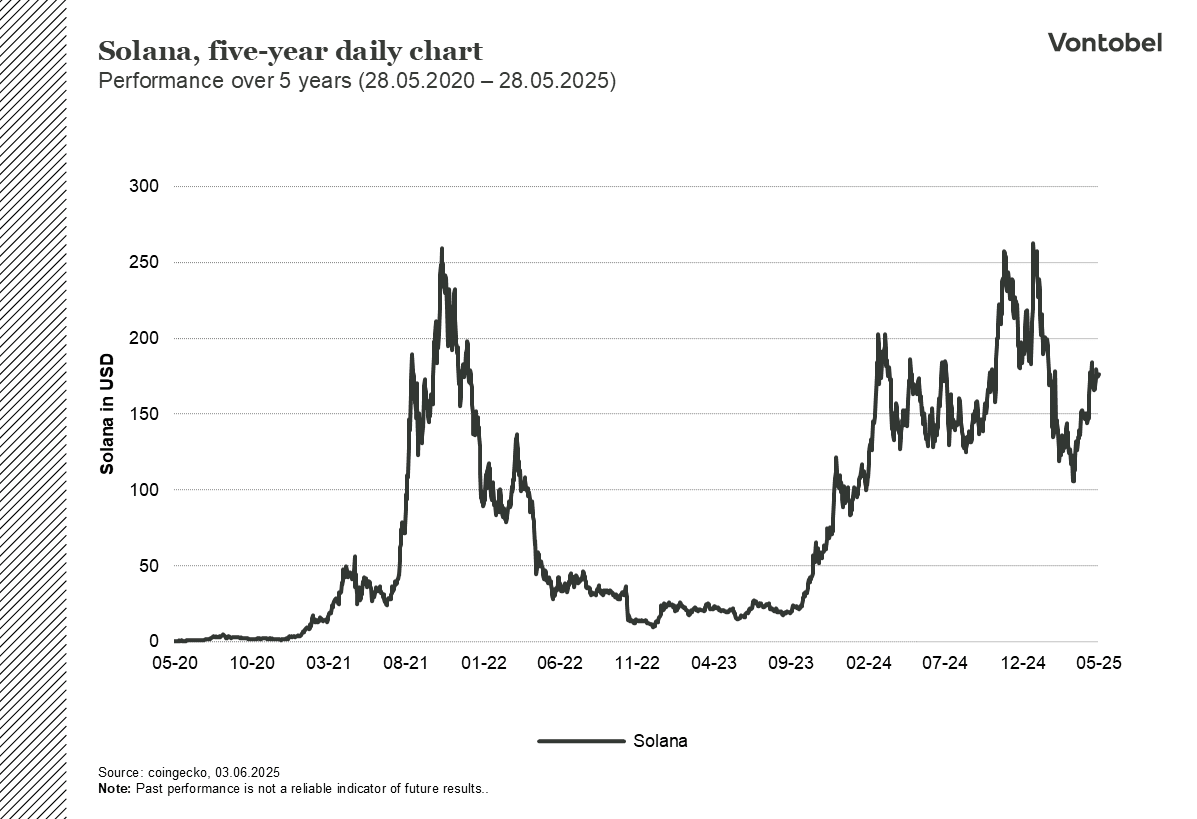
Meanwhile, crypto regulation continues to evolve rapidly. Some countries are taking a more open approach, while others remain cautious or restrictive. These different regulatory stances significantly impact where and how projects like the WhatsApp–Solana integration can move forward.
Vontobel Launches Mini-Futures on Solana Future
Vontobel has long been a pioneer in the crypto space, offering early access to digital assets through Mini-Futures on Bitcoin futures. Now, as the landscape continues to evolve, Vontobel is expanding its offering with Mini-Futures on Solana futures, giving you the tools to act on future price movements.
Risks
Credit risk of the issuer:
Investors in the products are exposed to the risk that the Issuer or the Guarantor may not be able to meet its obligations under the products. A total loss of the invested capital is possible. The products are not subject to any deposit protection.
Currency risk:
If the product currency differs from the currency of the underlying asset, the value of a product will also depend on the exchange rate between the respective currencies. As a result, the value of a product can fluctuate significantly.
Market risk:
The value of the products can fall significantly below the purchase price due to changes in market factors, especially if the value of the underlying asset falls. The products are not capital-protected
Product costs:
Product and possible financing costs reduce the value of the products.
Risk with leverage products:
Due to the leverage effect, there is an increased risk of loss (risk of total loss) with leverage products, e.g. Bull & Bear Certificates, Warrants and Mini Futures.
Disclaimer:
This information is neither an investment advice nor an investment or investment strategy recommendation, but advertisement. The complete information on the products (securities) mentioned herein, in particular the structure and risks associated with an investment, are described in the base prospectus, together with any supplements, as well as the final terms relating to the securities. The base prospectus and final terms constitute the solely binding sales documents for the products mentioned herein. It is recommended that potential investors read these documents before making any investment decision. The documents and the key information document are published on the website of the issuer, Vontobel Financial Products GmbH, Bockenheimer Landstrasse 24, 60323 Frankfurt am Main, Germany, on https://prospectus.vontobel.com and are available from the issuer free of charge. The approval of the prospectus should not be understood as an endorsement of the securities. The securities are products that are not simple and may be difficult to understand. This information includes or relates to figures of past performance. Past performance is not a reliable indicator of future performance. This information may only be distributed or published in countries where such distribution or publication is permitted by applicable law. As stated in the relevant base prospectus, the distribution of the securities mentioned in this information is subject to restrictions in certain jurisdictions. This advertisement may not be reproduced or redistributed without prior permission by Vontobel.
© Bank Vontobel Europe AG and / or affiliated companies. All rights reserved.