Oil price rockets above $110

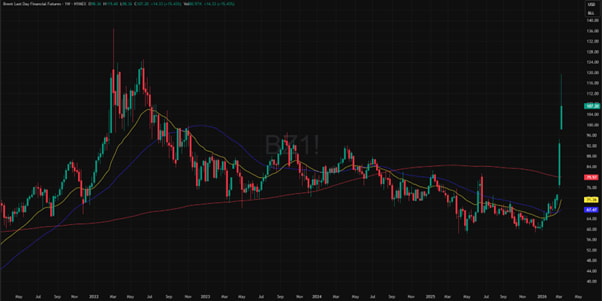
The oil market has seen exceptionally strong and rapid movements in recent weeks and especially in recent days. The price of Brent crude oil has made a huge leap, rising from a price level of $70 to over $110 per barrel in a short time. The price spike seen in early March is the largest since the 2022 energy crisis, and it is having a significant impact on the entire global economy.
Reasons behind the price rally: Middle East conflict and the Strait of Hormuz
The sharp price oil fluctuations are directly attributable to the escalating conflict in the Middle East involving the United States, Israel and Iran. The situation escalated to a critical level when traffic on one of the world's most important oil routes, the Strait of Hormuz, came to a virtual standstill.
The Strait of Hormuz normally carries about a fifth of the world's oil and natural gas. The closure of this route has led to a rapid chain reaction in the markets:
● Stockpiles are filling up and production is falling: With oil unable to be shipped out of the region, the inventories of major producing countries’ inventories are filling up, forcing them to cut production significantly.
● Immediate supply shock: Fears of a prolonged supply shortage have emerged in the market. Although the United States, for example, has granted exemptions and removed tariffs to ease the situation, global supply remains tight.
Broader economic impacts and market reactions
The rapid rise in oil prices has sent shockwaves through stock markets around the world, causing broader economic impacts and market reactions.
Related Products
Brent oil, 1-year chart

Brent oil, 5-year chart
Market uncertainty is most clearly visible in three areas:
Return of inflationary pressures: Rising energy and fuel prices threaten to accelerate global inflation again, directly impacting consumer purchasing power and corporate margins.
Postponed interest rate expectations: At the beginning of the year, investors expected the US Federal Reserve (Fed) to start cutting interest rates in early summer. Now, with renewed inflation fears, these expectations have been postponed to the fall, keeping financial conditions tight.
Stock market plunge: Increased geopolitical and economic uncertainty has caused investors to retreat from risky assets.
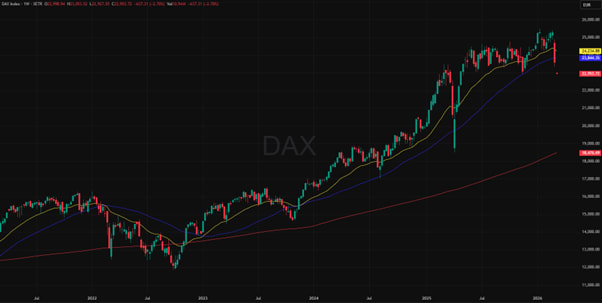
Stock market reactions: S&P 500 fears interest rates, DAX under pressure from industry
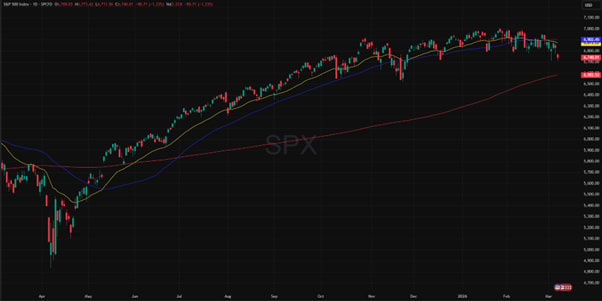
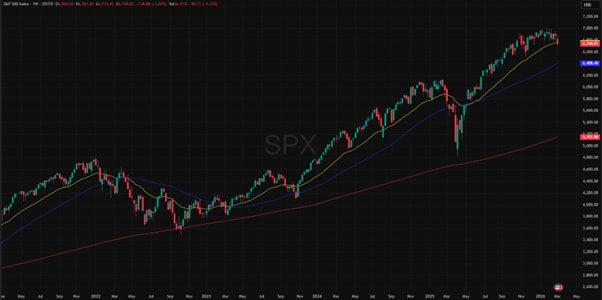
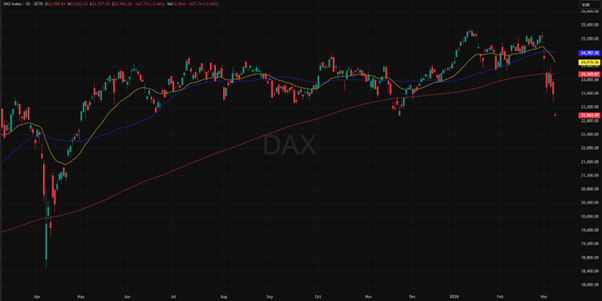
The uncertainty caused by the oil crisis is clearly visible in the sharp decline in the world's major indices, such as the German DAX and the US S&P 500. However, there are clear regional differences in market reactions:
● DAX index and Europe's energy dependence: Germany's export-driven industry is highly sensitive to rising imported energy prices. The DAX index has been plunging as investors fear that expensive oil will quickly eat into the margins of heavy industry and push Europe's largest economy into recession. Markets are now quickly pricing in a slowdown in European economic growth.
● S&P 500 and changing interest rate expectations: Thanks to the US's own strong energy sector, the US stock market has been somewhat resileint. However, the S&P 500 index has also turned downward. In the US, it is primarily about inflation fears: rising oil prices are forcing investors to abandon their hopes for interest rate cuts by the US Federal Reserve (Fed).
Related Products
S&P 500, 1-year chart
S&P 500, 5-year chart
Related Products
DAX, 1-year chart
DAX, 5-year chart
What's coming?
Markets are now focused on how long the disruptions in the Strait of Hormuz will continue and when any ceasefire talks can take place. The United States is currently the world's largest oil producer, with record shale oil production. While this capacity could balance the market in the long term, the market is very sensitive to headlines in the short term, and news about opening up shipping traffic can cause rapid, large-scale movements.
Indicators shown on the graphs:
● SMA200: 200-Day Moving Average, red.
● SMA50: 50- Day Moving Average, blue.
● EMA25: 25-Day Exponential Moving Average, yellow.
Risks
Credit risk of the issuer:
Investors in the products are exposed to the risk that the Issuer or the Guarantor may not be able to meet its obligations under the products. A total loss of the invested capital is possible. The products are not subject to any deposit protection.
Currency risk:
If the product currency differs from the currency of the underlying asset, the value of a product will also depend on the exchange rate between the respective currencies. As a result, the value of a product can fluctuate significantly.
Market risk:
The value of the products can fall significantly below the purchase price due to changes in market factors, especially if the value of the underlying asset falls. The products are not capital-protected
Product costs:
Product and possible financing costs reduce the value of the products.
Risk with leverage products:
Due to the leverage effect, there is an increased risk of loss (risk of total loss) with leverage products, e.g. Bull & Bear Certificates, Warrants and Mini Futures.
External author:
This information is in the sole responsibility of the guest author and does not necessarily represent the opinion of Bank Vontobel Europe AG or any other company of the Vontobel Group. This information is sponsored by Bank Vontobel Europe AG, which may be a counterparty to transactions involving the financial instruments discussed in this information. The further development of the index or a company as well as its share price depends on a large number of company-, group- and sector-specific as well as economic factors. When forming his investment decision, each investor must take into account the risk of price losses. Please note that investing in these products will not generate ongoing income.
The products are not capital protected, in the worst case a total loss of the invested capital is possible. In the event of insolvency of the issuer and the guarantor, the investor bears the risk of a total loss of his investment. In any case, investors should note that past performance and / or analysts' opinions are no adequate indicator of future performance. The performance of the underlyings depends on a variety of economic, entrepreneurial and political factors that should be taken into account in the formation of a market expectation.
Disclaimer:
This information is neither an investment advice nor an investment or investment strategy recommendation, but advertisement. The complete information on the products (securities) mentioned herein, in particular the structure and risks associated with an investment, are described in the base prospectus, together with any supplements, as well as the final terms relating to the securities. The base prospectus and final terms constitute the solely binding sales documents for the products mentioned herein. It is recommended that potential investors read these documents before making any investment decision. The documents and the key information document are published on the website of the issuer, Vontobel Financial Products GmbH, Bockenheimer Landstrasse 24, 60323 Frankfurt am Main, Germany, on https://prospectus.vontobel.com and are available from the issuer free of charge. The approval of the prospectus should not be understood as an endorsement of the securities. The securities are products that are not simple and may be difficult to understand. This information includes or relates to figures of past performance. Past performance is not a reliable indicator of future performance. This information may only be distributed or published in countries where such distribution or publication is permitted by applicable law. As stated in the relevant base prospectus, the distribution of the securities mentioned in this information is subject to restrictions in certain jurisdictions. This advertisement may not be reproduced or redistributed without prior permission by Vontobel.
© Bank Vontobel Europe AG and / or affiliated companies. All rights reserved.