Brent near $110
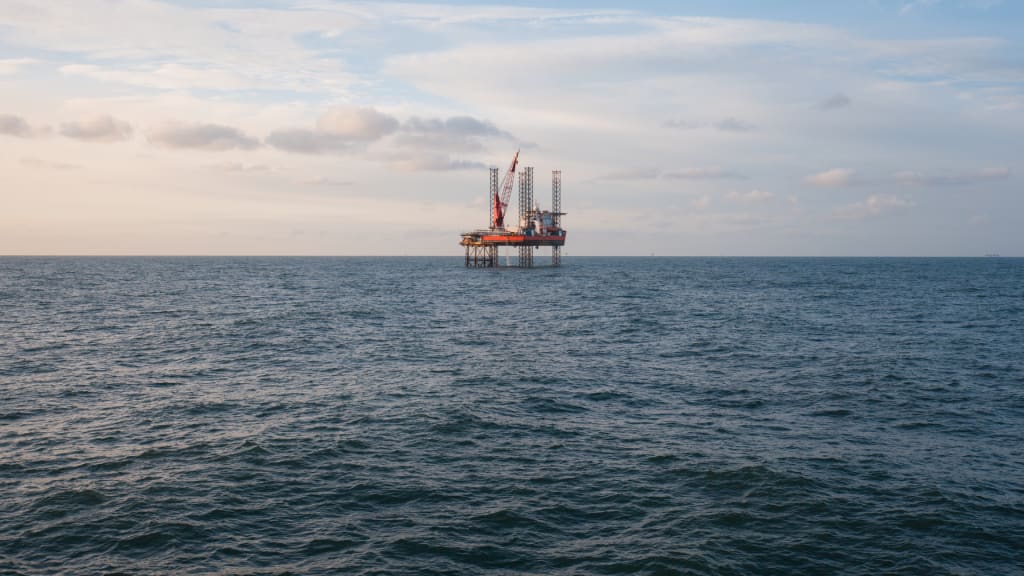
The price of Brent crude oil rose to around $110 towards the end of last week, with further gains seen early this week. This is driven by a deteriorating security situation in the Persian Gulf, attacks on tankers, and disruptions to shipping in the Strait of Hormuz. While concerns over supply are keeping crude oil prices nearly 80 percent higher than at the start of the year, high fuel costs have begun to curb global consumption (Bloomberg). The underlying tension in the oil markets is currently exceptionally clear-cut: crude oil flows from the Persian Gulf are being held hostage by military strikes and mines, while buyers around the world are cutting back on consumption due to high fuel prices.
Five-month highs
In early October, the price of Brent crude hovered around $100 for an extended period, but the upward trend has since accelerated rapidly. On Monday, October 19, the Brent futures contract for December closed at $109.55 per barrel, having reached nearly $110 earlier, marking its highest level since mid-May. Meanwhile, the U.S. WTI crude contract for November closed at $103.66, its highest closing price since mid-September (Bloomberg).
The Strait of Hormuz is the most critical bottleneck for the markets.
The Persian Gulf, and the Strait of Hormuz in particular, remains the greatest enigma and risk factor for the oil markets. According to data from Kpler, crude oil flows from the Persian Gulf fell to an average of approximately 8.5 million barrels per day during the second week of October, down from over 20 million barrels the previous week. Attacks on commercial vessels in the region have also been confirmed, and Iran’s Revolutionary Guard reported that a tanker struck a naval mine in the southern part of the strait (Financial Times).
Efforts have been made to smooth out the business cycle through political measures:
- Easing of US sanctions: In mid-October, President Trump signed an order deferring certain tariffs and sanctions targeting Russia’s energy trade in order to bring additional diesel to the market (though the decision faces strong opposition in Congress).
- Strategic reserves and IEA coordination: At the end of September, the United States announced an emergency release of 40 million barrels from its Strategic Petroleum Reserve (SPR). This is complemented by a joint approach among G7 nations and a decision, confirmed by the IEA in October, to accelerate the release of emergency stocks by member countries in order to alleviate diesel shortages.
Demand is falling, but inventories are low.
At the same time as supply falters, high energy costs are acting as a brake on both consumers and industry. In its October report, the International Energy Agency (IEA) once again lowered its demand forecast for 2026. The agency expects global oil consumption to contract by as much as 2.6 million barrels per day this year, falling to approximately 102.4 million barrels per day. A decline in diesel consumption, in particular, accounts for a quarter of this slowdown (IEA).
Under normal circumstances, such a sharp drop in demand would cause the price of crude oil to collapse. This has not happened, however, because global oil inventories are already exceptionally low. The IEA estimates that global observed oil stocks are more than 500 million barrels below their February levels. Inventories held in various countries are near their lowest levels since 2016.
In its latest forecast, the U.S. Energy Information Administration (EIA) has raised its estimate for the price of Brent crude for the remainder of the year (Q4) to $105 per barrel. However, the EIA anticipates that the average price will fall to approximately $84 by 2027, as production disruptions ease and inventories are replenished.
Related Products
OPEC+’s influence is being put to the test
In early October, the oil-producing group OPEC+ kept its production quotas for November unchanged (OPEC, 2026). This put an end to the phasing out of the 1.65 million barrel-per-day voluntary production cut that had been agreed upon in 2023. Currently, however, these decisions have exceptionally little impact on price formation (Reuters, 2026).
Disruptions in the Strait of Hormuz and factors limiting Russian flows are keeping actual OPEC+ production well below official targets. The organization’s internal unity has shown cracks following the United Arab Emirates’ departure from OPEC earlier in the spring.
The organization’s next official meeting will be held on November 1, but the market is looking primarily at physical shipment statistics rather than quotas.
Technical outlook: The $110 mark
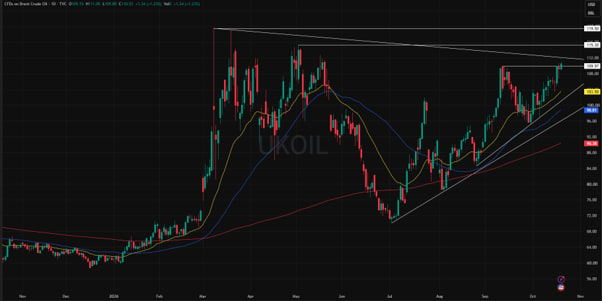
From a technical perspective, the $110 price range may emerge as both a technical and psychological resistance zone. The price oscillating right around this level suggests that the market appears to be consolidating at current levels, with buyers hesitant to push the price higher in the absence of new geopolitical catalysts.
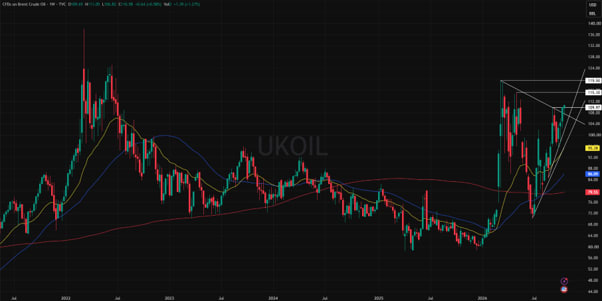
Fundamentals continue to support rising prices; however, following the sharp rally seen over the past few weeks, the possibility of a downward correction should not be overlooked. If the $110 level is broken more decisively to the upside, the next technical resistance may be found near the peaks from the spring of 2026. Should the price begin to decline, technical support could be found at levels such as the moving averages shown on the chart (e.g., EMA25, SMA50).
BRENT, 1 year chart
BRENT, 5 year chart
Summary
In the oil market, there is currently a tug-of-war between the heightened geopolitical tension in the Persian Gulf and the impact of high fuel prices on demand. Although supply remains tight due to disruptions in the Strait of Hormuz, the rally in Brent crude has encountered technical resistance at the $110 level. At the same time, exceptionally low global inventories may provide support for prices and could prevent a sharper downward slide.
Indicators shown on the charts:
- SMA200: 200-day moving average, red.
- SMA50: 50-day moving average, blue.
- EMA25: 25-day exponential moving average, yellow.
Risks
Credit risk of the issuer:
Investors in the products are exposed to the risk that the Issuer or the Guarantor may not be able to meet its obligations under the products. A total loss of the invested capital is possible. The products are not subject to any deposit protection.
Currency risk:
If the product currency differs from the currency of the underlying asset, the value of a product will also depend on the exchange rate between the respective currencies. As a result, the value of a product can fluctuate significantly.
Market risk:
The value of the products can fall significantly below the purchase price due to changes in market factors, especially if the value of the underlying asset falls. The products are not capital-protected
Product costs:
Product and possible financing costs reduce the value of the products.
Risk with leverage products:
Due to the leverage effect, there is an increased risk of loss (risk of total loss) with leverage products, e.g. Bull & Bear Certificates, Warrants and Mini Futures.
External author:
This information is in the sole responsibility of the guest author and does not necessarily represent the opinion of Bank Vontobel Europe AG or any other company of the Vontobel Group. This information is sponsored by Bank Vontobel Europe AG, which may be a counterparty to transactions involving the financial instruments discussed in this information. The further development of the index or a company as well as its share price depends on a large number of company-, group- and sector-specific as well as economic factors. When forming his investment decision, each investor must take into account the risk of price losses. Please note that investing in these products will not generate ongoing income.
The products are not capital protected, in the worst case a total loss of the invested capital is possible. In the event of insolvency of the issuer and the guarantor, the investor bears the risk of a total loss of his investment. In any case, investors should note that past performance and / or analysts' opinions are no adequate indicator of future performance. The performance of the underlyings depends on a variety of economic, entrepreneurial and political factors that should be taken into account in the formation of a market expectation.
Disclaimer:
This information is neither an investment advice nor an investment or investment strategy recommendation, but advertisement. The complete information on the products (securities) mentioned herein, in particular the structure and risks associated with an investment, are described in the base prospectus, together with any supplements, as well as the final terms relating to the securities. The base prospectus and final terms constitute the solely binding sales documents for the products mentioned herein. It is recommended that potential investors read these documents before making any investment decision. The documents and the key information document are published on the website of the issuer, Vontobel Financial Products GmbH, Bockenheimer Landstrasse 24, 60323 Frankfurt am Main, Germany, on https://prospectus.vontobel.com and are available from the issuer free of charge. The approval of the prospectus should not be understood as an endorsement of the securities. The securities are products that are not simple and may be difficult to understand. This information includes or relates to figures of past performance. Past performance is not a reliable indicator of future performance. This information may only be distributed or published in countries where such distribution or publication is permitted by applicable law. As stated in the relevant base prospectus, the distribution of the securities mentioned in this information is subject to restrictions in certain jurisdictions. This advertisement may not be reproduced or redistributed without prior permission by Vontobel.
© Bank Vontobel Europe AG and / or affiliated companies. All rights reserved.