Q2 earnings season kicks off in the eye of the storm

The second-quarter (Q2) earnings season is in full swing this week, with major US banks such as JPMorgan Chase, Bank of America, Citigroup, Wells Fargo, and Goldman Sachs releasing their results. As the earnings season begins, uncertainty is mounting in the Middle East and the Strait of Hormuz, while macroeconomic data is also being released on both sides of the Atlantic.
Bank earnings: A health check on the real economy and the consumer
Because banks are sensitive to the economic cycle, their earnings and commentary directy reflect the current state of the US economy and the US consumer. Investors are seeking answers to two questions in particular:
● Sustainability of net interest income: Interest rates remaining "higher for longer" have supported bank earnings, but is this already starting to weigh too heavily on loan demand?
● Credit loss provisions: Are there signs of increasing payment difficulties with American consumers' credit card debt or mortgages?
The sector rotation of recent weeks – with capital flowing from AI and technology stocks into more defensive assets and value stocks – has boosted the banking sector and lifted share prices ahead of the earnings season. Now, however, banks must live up to these heightened expectations.
US inflation
Alongside the earnings season, a major macroeconomic trigger for the markets this week is the release of the latest US Consumer Price Index (CPI) for June, set for release on Tuesday, July 14. The CPI directly impacts the debate surrounding the Federal Reserve’s interest rate decisions for the remainder of the year. If inflation proves stickier than expected, it could force the Fed to maintain a tough stance. This, in turn, would slow economic growth and put pressure on the stock market.
In addition to consumer prices, investors are closely monitoring the US Producer Price Index (PPI), set to be released shortly thereafter on Wednesday, July 15. If producer prices rise faster than expected, it signals future inflationary pressure for consumers and indicates that corporate earnings prospects will face challenges later in the year due to shrinking margins.
Related Products
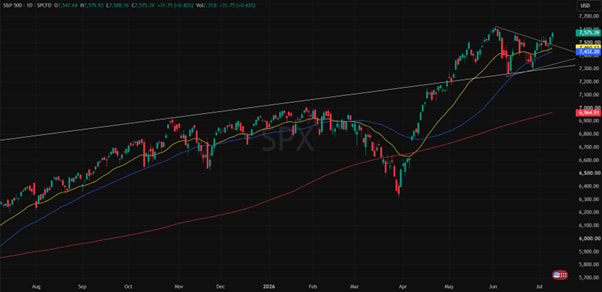
S&P 500, 1-year chart
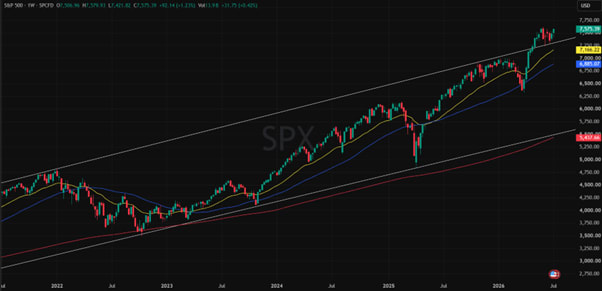
S&P 500, 5 year chart
Eurozone inflation: ECB’s course of action under scrutiny
The week’s most important macro indicator for European equities arrives on Friday, July 17, with the release of the final Eurozone inflation numbers for June. Preliminary (flash) data suggested that inflation had slowed to 2.8%, but the final numbers and specifically the composition of core inflation will reveal the true picture.
If inflation in Europe proves more persistent than expected, it would put pressure on the European Central Bank (ECB), to keep interest rates high for an extended period. This would create tension within the European banking sector. Like their US counterparts, European banks have benefited from high net interest margins but they would suffer from slowing economic growth and a freezing credit market if interest rates remained high for too long.
Related Products
DAX, 1 year chart

DAX, 5 year chart

Escalation in the Middle East brings the war premium back to oil
The preliminary agreement reached in June provided temporary relief to the market, the situation in the Middle East has once again escalated. Recent strikes between the United States and Iran have dashed hopes for a ceasefire, and threats to close the Strait of Hormuz had an immediate impact on energy markets.
Brent crude prices have risen close to the $80 mark – an increase of nearly $10 in a week from the $70 level. The important 200-day simple moving average (SMA200) is also at this level. Surpassing it would signal a bullish sentiment for oil. Furthermore, since much of the world's oil passes through the Strait of Hormuz, a prolonged disruption threatens to trigger a new inflation shock. This would directly impact global inflation and future central bank decisions regarding interest rates.
During the upcoming earnings season, investors can also expect company management to provide information on how the renewed rise in energy costs and longer shipping routes will affect margins and earnings guidance for the remainder of the year.
Related Products
Brent, 1 year chart

Brent, 5 year chart

Summary
The recent shift in investor focus from technology stocks to other sectors has positioned banks for success, but they must now deliver strong financial results to meet these heightened expectations must be met with strong numbers. Investors should be prepared for high volatility. If bank earnings released this week are disappointing, if inflation figures (CPI, PPI, and Eurozone inflation) are higher than expected, and if the price of oil continues to rise, stock markets could face a sharp correction.
Indicators shown on the graphs:
● SMA200: 200-day moving average, red.
● SMA50: 50-day moving average, blue.
● EMA25: 25-day exponential moving average, yellow.
Risks
Credit risk of the issuer:
Investors in the products are exposed to the risk that the Issuer or the Guarantor may not be able to meet its obligations under the products. A total loss of the invested capital is possible. The products are not subject to any deposit protection.
Currency risk:
If the product currency differs from the currency of the underlying asset, the value of a product will also depend on the exchange rate between the respective currencies. As a result, the value of a product can fluctuate significantly.
Disclaimer:
This information is neither an investment advice nor an investment or investment strategy recommendation, but advertisement. The complete information on the products (securities) mentioned herein, in particular the structure and risks associated with an investment, are described in the base prospectus, together with any supplements, as well as the final terms relating to the securities. The base prospectus and final terms constitute the solely binding sales documents for the products mentioned herein. It is recommended that potential investors read these documents before making any investment decision. The documents and the key information document are published on the website of the issuer, Vontobel Financial Products GmbH, Bockenheimer Landstrasse 24, 60323 Frankfurt am Main, Germany, on https://prospectus.vontobel.com and are available from the issuer free of charge. The approval of the prospectus should not be understood as an endorsement of the securities. The securities are products that are not simple and may be difficult to understand. This information includes or relates to figures of past performance. Past performance is not a reliable indicator of future performance. This information may only be distributed or published in countries where such distribution or publication is permitted by applicable law. As stated in the relevant base prospectus, the distribution of the securities mentioned in this information is subject to restrictions in certain jurisdictions. This advertisement may not be reproduced or redistributed without prior permission by Vontobel.
© Bank Vontobel Europe AG and / or affiliated companies. All rights reserved.
External author:
This information is in the sole responsibility of the guest author and does not necessarily represent the opinion of Bank Vontobel Europe AG or any other company of the Vontobel Group. This information is sponsored by Bank Vontobel Europe AG, which may be a counterparty to transactions involving the financial instruments discussed in this information. The further development of the index or a company as well as its share price depends on a large number of company-, group- and sector-specific as well as economic factors. When forming his investment decision, each investor must take into account the risk of price losses. Please note that investing in these products will not generate ongoing income.
The products are not capital protected, in the worst case a total loss of the invested capital is possible. In the event of insolvency of the issuer and the guarantor, the investor bears the risk of a total loss of his investment. In any case, investors should note that past performance and / or analysts' opinions are no adequate indicator of future performance. The performance of the underlyings depends on a variety of economic, entrepreneurial and political factors that should be taken into account in the formation of a market expectation.
Market risk:
The value of the products can fall significantly below the purchase price due to changes in market factors, especially if the value of the underlying asset falls. The products are not capital-protected
Product costs:
Product and possible financing costs reduce the value of the products.
Risk with leverage products:
Due to the leverage effect, there is an increased risk of loss (risk of total loss) with leverage products, e.g. Bull & Bear Certificates, Warrants and Mini Futures.