Arabica Coffee: Weather, Earthquake and Politics Behind a Volatile Rally


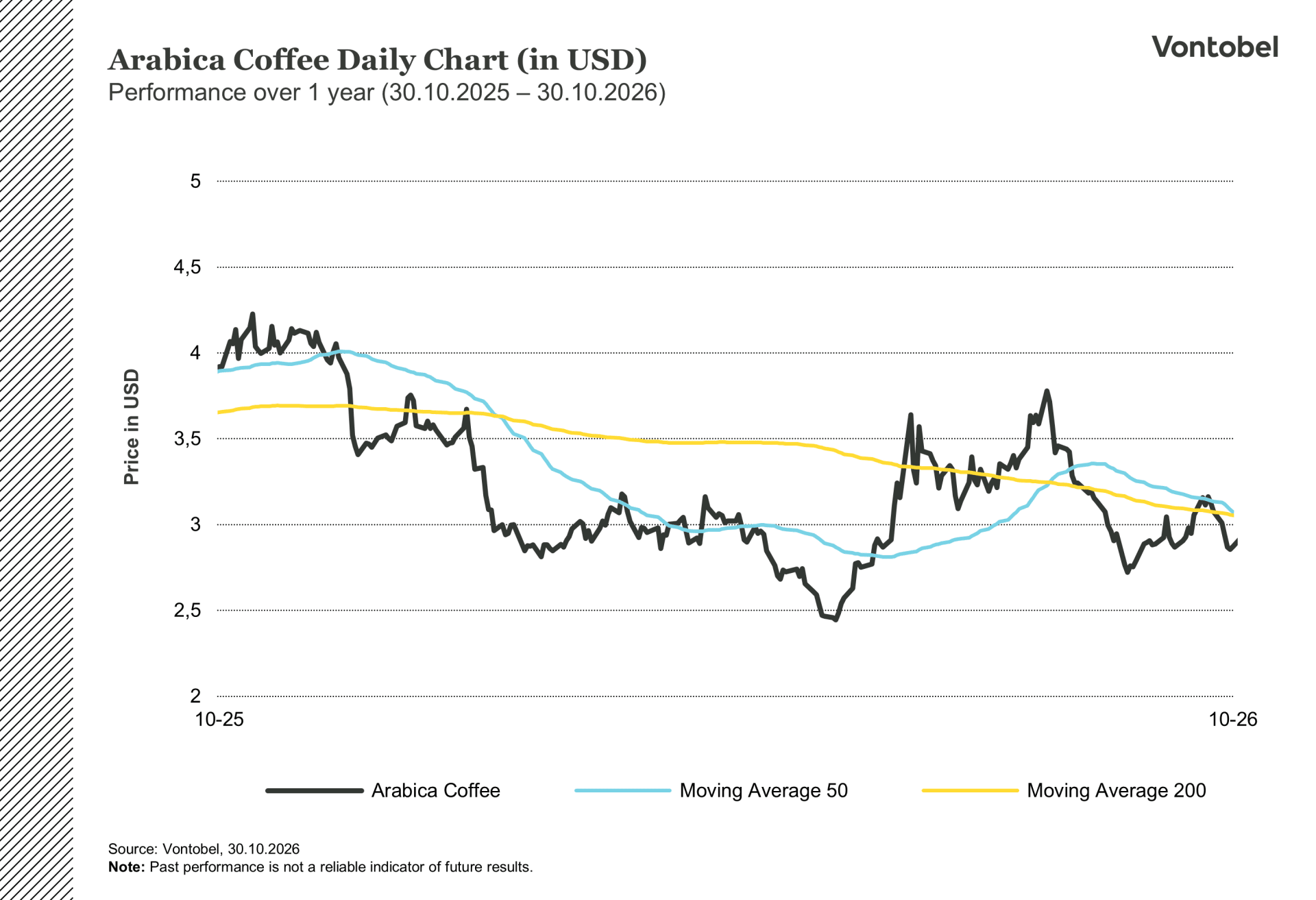
The coffee market has experienced a period of heightened volatility and increased activity in recent months. According to the Financial Times arabica coffee futures have risen significantly since early June 2026, reaching highs of 3.7 USD a pound after the Colombian earthquake in August. A rally including one of arabica’s largest single-day gains in 47 years. A move of this size is rarely explained by a single event. In this case, three factors have coincided: this year’s El Niño, a natural disaster in a key growing country, and political uncertainty in the world’s largest producer. Each can influence prices on its own, and together they have contributed to a notably volatile year for arabica.
El Niño and coffee market dynamics
Of these factors, weather has been an important factor influencing coffee prices this year. More broadly, Natural disasters and extreme weather are affecting commodities worldwide. The Financial Times reports that El-Niño related weather conditions have been widely cited as a key contributor to recent movements in arabica coffee futures. The impact is not limited to coffee. According to the European Central Bank, strong El Niño events typically raise global food commodity prices by around 9%. Economists at Jefferies have warned that the impact could be larger this time, given several ongoing conflicts around the world (Financial Times).
For coffee in particular, the concern may extend beyond a single season. El Niño is described as the biggest threat to overall coffee supply (Financial Times). As extreme weather becomes more intense and destructive, it may affect both arabica and robusta futures more than in the past (Financial Times). This is relevant because the two varieties can, to some extent, serve as partial substitutes in certain applications, disruptions affecting both markets simultaneously could reduce available alternatives for buyers and contribute to broader price volatility.
Related Products
Colombia’s earthquake and an already tight supply situation
While El Niño shaped the broader trend, the earthquake in Colombia caused a sudden disruption. In August, a magnitude 7.4 earthquake damaged the road connecting Colombia’s coffee-producing regions to the Pacific port of Buenaventura (Financial Times). For a crop that relies on transportation from farm to port, such disruption can have a significant impact on the amount of coffee that reaches the market, even if the coffee beans themselves are not lost.
The timing exacerbated the situation, as the shock hit a market with little capacity to absorb it. Colombia provides about a fifth of US coffee imports, and arabica stocks held in international exchange warehouses were described as low (Financial Times). With limited stored supply to draw on, interruptions to fresh supply can feed through to futures prices more quickly. On top of this, Colombia was already anticipating a smaller harvest this year, with a forecast decline of about 13% (Financial Times). Together, a smaller expected crop, disrupted transport links and low warehouse stocks together provide a possible explanation for why prices reached their highs in the weeks following the earthquake.

What the arabica–robusta spread indicates
The price of arabica can also be put into perspective by comparing it with robusta. According to Bloomberg, arabica is generally associated with a milder and more aromatic flavor profile, while robusta typically characterised by higher caffeine content. The difference between the two prices, known as the arabica–robusta spread, reflects the premium of arabica over robusta. It also indicates how much arabica goes into coffee blends: the higher the premium, the more valuable arabica is at that moment (Bloomberg). A wide spread can therefore point to strong relative demand for arabica, whereas a narrowing spread suggests that this premium is declining.
At present, the spread stands at around 145 cents, having declined by around 9% during this week (Bloomberg). Arabica still carries a substantial premium, but the recent decline suggests that part of its relative value has eased. High price levels and a narrowing premium can, therefore, occur at the same time, and the headline price alone does not show how arabica is valued relative to robusta.
Brazil’s election and currency developments
Beyond weather and supply considerations, politics has added another layer of uncertainty. As the largest producer of coffee, Brazil is particularly relevant for prices, and its recent election has created considerable uncertainty and turbulence in equity markets (Financial Times). President Luiz won re-election, and the result caused significant reactions in financial markets (Financial Times). The Brazilian real fell 8%, while the Bovespa equity index fell almost 14%, as reported by the Financial Times. Currency developments, together with changes in supply, may lead to further price changes in the coming months (Bloomberg). The market environment therefore combines weather, supply and political factors, which can make price developments harder to assess.
Outlook: harvest season and market developments
The harvest season is beginning in Colombia and other coffee-producing regions in Latin America, which may bring more product onto the market (Bloomberg). Together with currency movements, these supply developments could lead to further price changes. Whether additional supply will affect the price trend, however, remains uncertain. On the one hand, new harvest volumes could ease the tight supply situation. At the same time, weather conditions remain an area of focus. According to the Financial Times, El Niño continues to be viewed as a significant factor for coffee production. The Financial Times also reports that Colombia was already expecting a lower harvest this year, while transportation infrastructure has been affected by the recent earthquake.
Overall, the increase in arabica prices since June illustrates the sensitivity of coffee markets to developments relating to weather, supply conditions and broader economic factors. At the same time, the recent narrowing of the arabica-robusta spread may indicate changes in relative pricing dynamics between the two coffee varieties (Bloomberg). Taken together, these developments highlight the range of factors that market participants continue to monitor in the global coffee market.
Risks
Credit risk of the issuer:
Investors in the products are exposed to the risk that the Issuer or the Guarantor may not be able to meet its obligations under the products. A total loss of the invested capital is possible. The products are not subject to any deposit protection.
Currency risk:
If the product currency differs from the currency of the underlying asset, the value of a product will also depend on the exchange rate between the respective currencies. As a result, the value of a product can fluctuate significantly.
Market risk:
The value of the products can fall significantly below the purchase price due to changes in market factors, especially if the value of the underlying asset falls. The products are not capital-protected
Product costs:
Product and possible financing costs reduce the value of the products.
Risk with leverage products:
Due to the leverage effect, there is an increased risk of loss (risk of total loss) with leverage products, e.g. Bull & Bear Certificates, Warrants and Mini Futures.
Disclaimer:
This information is neither an investment advice nor an investment or investment strategy recommendation, but advertisement. The complete information on the products (securities) mentioned herein, in particular the structure and risks associated with an investment, are described in the base prospectus, together with any supplements, as well as the final terms relating to the securities. The base prospectus and final terms constitute the solely binding sales documents for the products mentioned herein. It is recommended that potential investors read these documents before making any investment decision. The documents and the key information document are published on the website of the issuer, Vontobel Financial Products GmbH, Bockenheimer Landstrasse 24, 60323 Frankfurt am Main, Germany, on https://prospectus.vontobel.com and are available from the issuer free of charge. The approval of the prospectus should not be understood as an endorsement of the securities. The securities are products that are not simple and may be difficult to understand. This information includes or relates to figures of past performance. Past performance is not a reliable indicator of future performance. This information may only be distributed or published in countries where such distribution or publication is permitted by applicable law. As stated in the relevant base prospectus, the distribution of the securities mentioned in this information is subject to restrictions in certain jurisdictions. This advertisement may not be reproduced or redistributed without prior permission by Vontobel.
© Bank Vontobel Europe AG and / or affiliated companies. All rights reserved.